


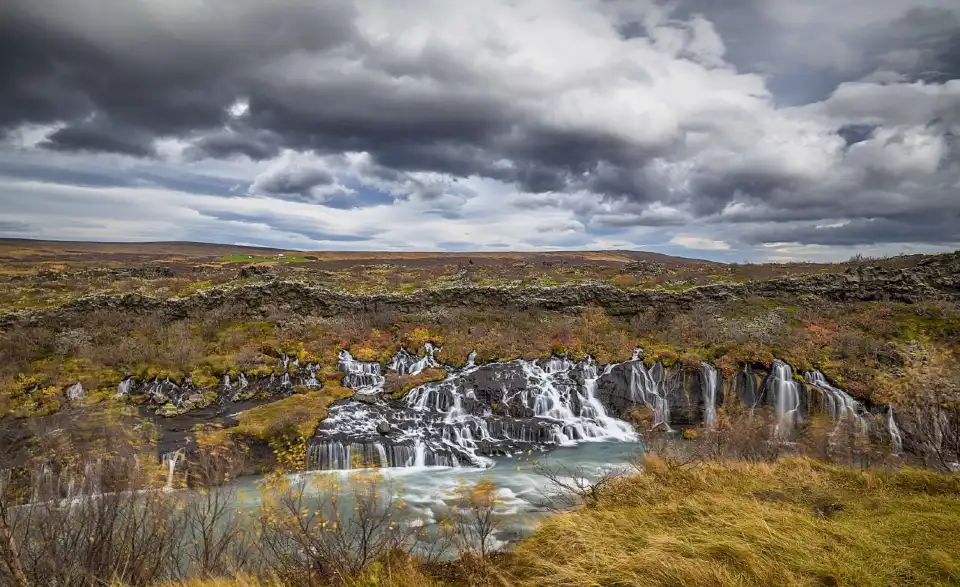
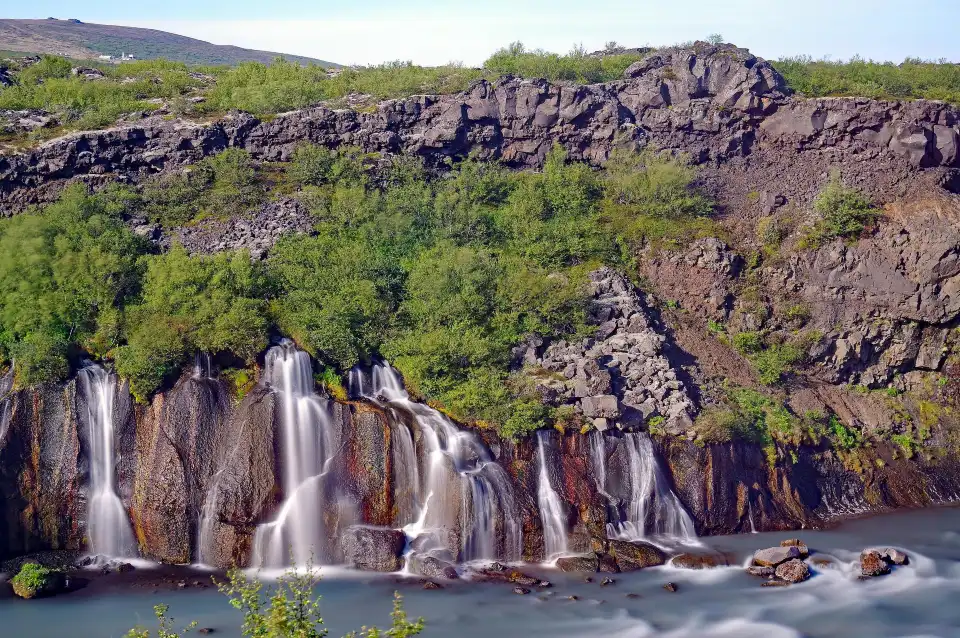
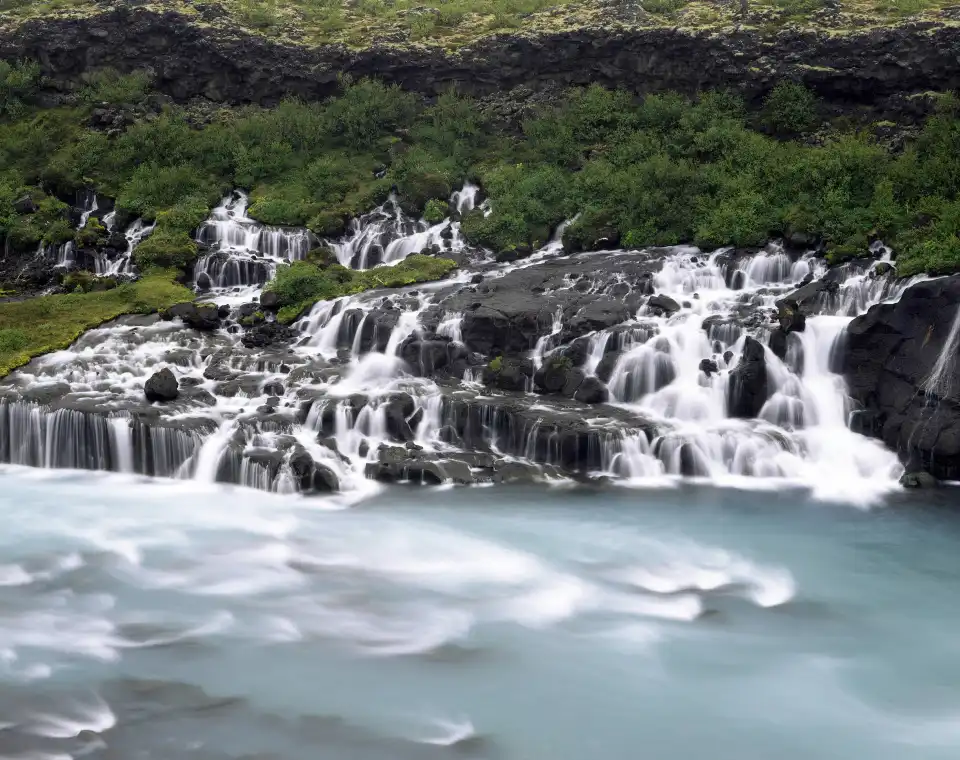
Hraunfossar does something no other Icelandic waterfall does: instead of one river falling, hundreds of springs seep directly out of the Hallmundarhraun lava field — a 900-metre line of white trickles and ribbons emerging from under the mossy lava, dropping into the glacial blue of the Hvítá river. The effect is unique: a waterfall with no single source, a lava field acting as the filter, and (in winter) the whole line iced into blue-white sculpture. Free, roadside, 90 minutes from the capital, with the Barnafoss rapids next door. Trip.Best ranks it #38 (4.3/5 from 3 verified reviews).
This is #38 of 39 in our Best Things to Do in Iceland guide. Below: the spring-line geology, the viewing banks and the paths, the Barnafoss pairing (the angry little brother 100 metres upstream), the winter-ice version, and the Borgarfjörður day that includes Langjökull (#31).
Temel çıkarımlar
- 900 metres of springs: water seeping straight out of the porous lava field along the river’s edge — a waterfall with no single river.
- The lava field is the filter: Hallmundarhraun’s lava filters snowmelt from Langjökull (#31)’s catchment for decades before it emerges — that is why the springs run even in drought.
- Barnafoss next door: the narrow rapids 100 metres upstream — the “children’s fall” with its own tragic folk story.
- Winter ice sculpture: the spring line freezes into blue-white cascades — the connoisseur version, plus aurora odds on clear nights.
- Free, roadside: open access with free parking and walking paths on both banks.
Hızlı cevap: Park at the main access (free), walk the path along the spring line to the viewing platforms (the wide view and the close-ups both work), continue upstream to Barnafoss for the rapids contrast, and in winter return for the iced line — 45–60 minutes covers both falls. Pair with Langjökull (#31) and Deildartunguhver for the Borgarfjörður day.
The spring-line geology
The mechanics are the wonder: the Hallmundarhraun lava field — erupted from a shield volcano line under Langjökull roughly 8,000–9,000 years ago — is porous enough to swallow whole rivers, and the snowmelt from the glacier’s catchment filters through the lava for decades before emerging at its edge. At Hraunfossar, that emergence happens along 900 metres of riverbank: hundreds of springs, from finger-wide trickles to metre-wide ribbons, dropping a few metres into the Hvítá’s glacial blue.
The result photographs like nowhere else: a waterfall without a waterfall’s shape — a lace curtain of water along a mossy lava wall. Summer is green-and-white; autumn adds the birch colour behind; winter freezes the trickles into blue-white ice sculptures with the river still running — the version locals consider the falls’ true beauty. The viewing paths run both banks; the main (east) side gives the platforms, the west side the paths along the springs.
Why the water is blue: the Hvítá below the springs carries glacial sediment (the grey-white “hvít” — white — of its name), while the spring water emerging from the lava runs clear blue — the two waters visibly mix along the falls’ line. The colour boundary in the river is the geology, visible.
Barnafoss: the angry little brother
One hundred metres upstream, the same river squeezes through a narrow rock channel as Barnafoss — the “children’s fall” — a violent, churning rapid rather than a curtain. The folk story gives the name its weight: two children from the nearby farm were left home, crossed the frozen natural stone-bridge over the falls against orders, one fell and the other leapt after — and their mother had the bridge demolished so no child would cross again. The falls’ roar carries the story for the locals.
The two falls make one stop: the path connects them, the contrast (lace curtain vs churning throat) is the lesson, and the combined visit runs 45–60 minutes. Signs at both tell the stories; the platforms frame the shots.
The Borgarfjörður day: Hraunfossar + Barnafoss morning, Deildartunguhver (Europe’s highest-flow hot spring) midday, Langjökull ice tunnel (#31) afternoon, Krauma soak to finish — the west-country day from Reykjavík that our itineraries post sequences in full.
Practical: access and the seasons
Access: the falls sit off Route 50/518 in Borgarfjörður, 90 minutes from Reykjavík, signed clearly — free parking, paths and platforms on both banks, toilets at the main lot in season. The visit: 45–60 minutes for both falls; photographers run longer in the right light (flat overcast for the spring-line texture; low sun for the river colour boundary).
Seasons: summer is the classic green version; autumn adds colour; winter is the connoisseur version — the iced spring line, the quiet, and the aurora odds (the site is dark-sky country). The paths ice in winter (studs as everywhere); the platforms stay open year-round. The site is stroller-friendly on the main path.
How it fits an Iceland route
Hraunfossar is the Borgarfjörður day’s anchor: Langjökull (#31), Deildartunguhver, Krauma, the Viking-era Reykholt (Snorri Sturluson’s home) all within 30 minutes. Ring Road travellers slot it into the western return leg (#19); capital-based visitors run it as the west day-trip. Our Golden Circle-adjacent west guide and the itineraries post carry the day plan.
Frequently asked questions
Why does Hraunfossar have no river?
The water emerges from underground: the porous Hallmundarhraun lava field swallows snowmelt from the Langjökull (#31) catchment, filters it for decades, and releases it as hundreds of springs along 900 metres of riverbank — a waterfall with no single source.
What is Barnafoss?
The narrow rapids 100 metres upstream — the same river squeezing through a rock channel. The name (“children’s fall”) carries the folk story of the two children and the demolished bridge; the signs tell it at the site.
Is Hraunfossar good in winter?
It is the connoisseur version — the spring line ices into blue-white sculpture with the river still running, the site empties, and the aurora odds work on clear nights. Studs for the iced paths.
What pairs with Hraunfossar in a day?
Barnafoss (next door), Deildartunguhver hot spring, the Langjökull ice tunnel (#31) and the Krauma soak — the Borgarfjörður day from Reykjavík, 90 minutes each way.
Where this ranks — and what is next
Hraunfossar is #38 of 39 in our Best Things to Do in Iceland guide — the full ranked list, built from Trip.Best traveler data, lives in one place.
Go deeper: Langjökull (#31) — the ice tunnel next door, Hot springs beyond the Blue Lagoon — the Borgarfjörður soaks.
Sources & official references
- Trip.com listing for Hraunfossar: 4.3/5 rating (checked November 2026).
- Trip.Best ranking data: #38 of 39 (November 2026).
- Site interpretive signage: Hallmundarhraun geology, the Barnafoss story (checked 2026).
- Editorial visits across seasons including the winter ice state, 2023–2026.
