




Snæfellsjökull is the mountain that carried Iceland into world literature: the 700,000-year-old stratovolcano with a glacier cap — 1,446 metres at the summit — that Jules Verne chose as the entrance to the centre of the Earth in 1864. It crowns the Snæfellsnes peninsula’s western end, visible from Reykjavík on clear days across the bay (a 100+ km sightline locals still point at), and anchors the peninsula loop that Icelanders call “Iceland in miniature” — black-pebble coves, lava cliffs, the fishing villages and the mountain itself. Trip.Best ranks it #37 (5.0/5 from 12 verified reviews).
This is #37 of 39 in our Best Things to Do in Iceland guide. Below: the volcano and the Verne connection, the viewing points (Saxhóll crater’s staircase is the best), the national park’s coast stops, the summit-option reality (guided winter/summer ascents), and the Snæfellsnes day that makes the mountain the loop’s anchor.
Temel çıkarımlar
- 1,446 m glacier volcano: a 700,000-year-old stratovolcano capped by the Snæfellsjökull ice cap — visible across the bay from Reykjavík on clear days.
- Jules Verne’s entrance: the 1864 novel sends its heroes into the Earth through this mountain — the international fame predates tourism by 150 years.
- Saxhóll crater staircase: the 500-step steel stair to the crater rim — the best viewpoint over the mountain and the coast, free.
- National park since 2001: Snæfellsjökull National Park wraps the mountain and its coast — the oldest of the national parks’ trio’s western member.
- The peninsula loop: Kirkjufell (#15) at the north, the mountain at the west — Snæfellsnes is the country’s best single-day drive.
Hızlı cevap: Drive the peninsula loop (2.5 hours from Reykjavík), climb the Saxhóll crater stairs for the mountain-over-coast panorama, stop at Djúpalónssandur’s black-pebble cove and Arnarstapi’s lava arches, and photograph the cone from the southern flats. Guided ascents run winter and summer for the summit-minded; most visitors take the loop and the views.
The volcano and the Verne connection
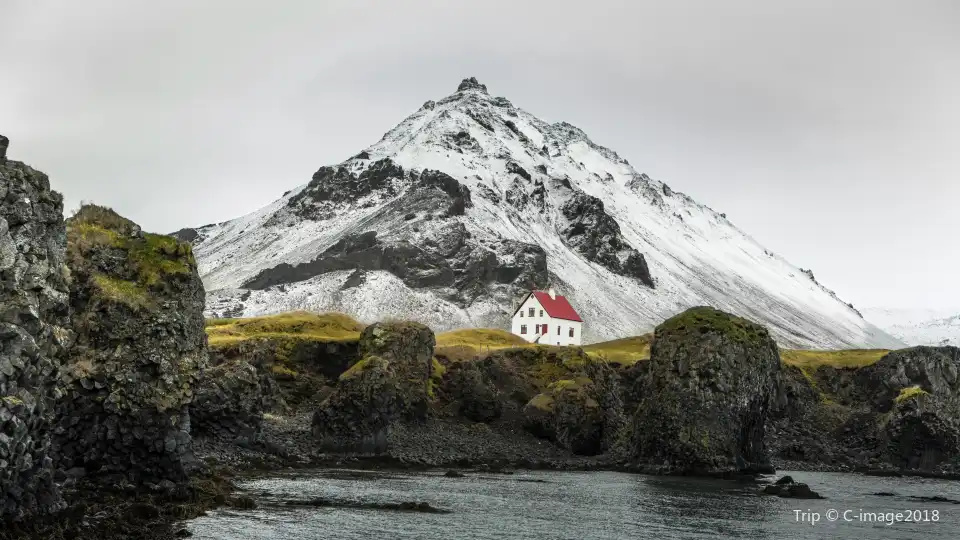
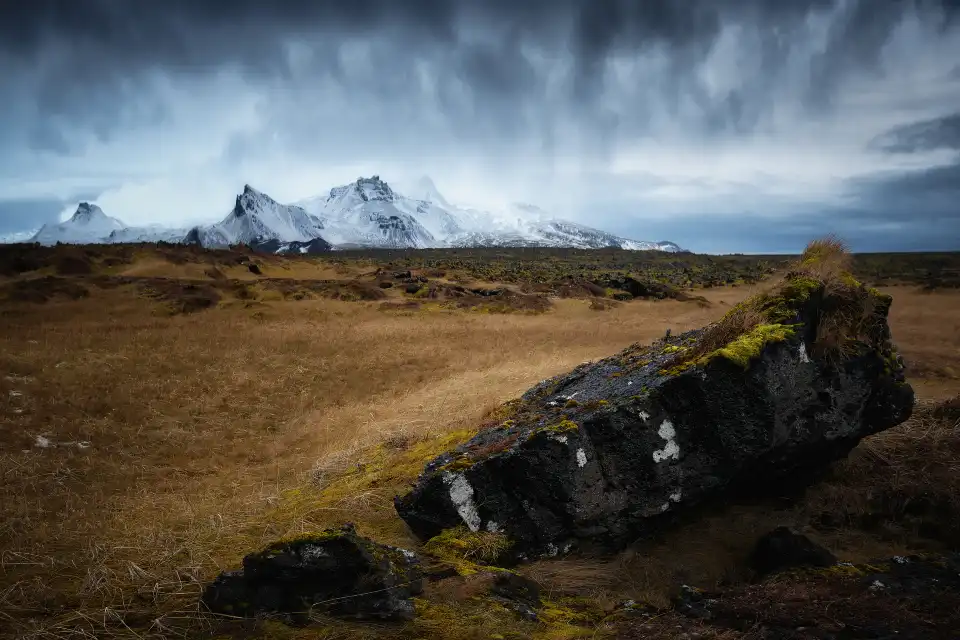
Snæfellsjökull is a classic cone: the stratovolcano rises 1,446 metres from the coast, its upper third wrapped in the glacier ice cap that gives it the -jökull suffix, its slopes falling through lava fields to black-pebble coast. The volcano last erupted around 200 AD (per tephra studies) — dormant, but the country counts it among the watch-list’s members, and the mysticism literature around it (the “energy field” lore, the songs, the Verne entrance) is part of the mountain’s cultural gravity.
The Verne connection is the fame: in Journey to the Centre of the Earth (1864), Professor Lidenbrock’s expedition enters the Earth through a crater on Snæfells (the Scartaris sun-marker, the down-the-volcano descent) — the novel made the mountain the world’s fictional doorway to the underworld, and the peninsula has leaned into it (the tourist literature, the cave tours, the town signage) ever since. It is Iceland’s most famous fictional address.
The mystic layer: beyond Verne, the mountain carries a serious esoteric reputation — poetry, “energy” claims and the 1993 crop-of-souls gathering that drew international mystics. The national park’s signage stays geological; the culture stays magical. Both are part of the visit.
The viewpoints: Saxhóll and the coast
Saxhóll crater: a small cinder cone on the northern road with a steel staircase (about 500 steps) to the rim — the peninsula’s best single viewpoint, free, where the whole west end lays out: the Snæfellsjökull cone behind, the coast’s lava cliffs and black coves below, the sea beyond. The stair (built 2019) is a design object in itself; the wind at the top is real.
The coast stops that frame the mountain: Djúpalónssandur (the black-pebble cove with the lifting-stones and the shipwreck iron), Arnarstapi–Hellnar (the lava-cliff coast with the Gatklettur arch and the bird cliffs), the southern flats (the cone-over-lava-field compositions), and the Rauðfeldsgjá gorge. The loop is a full day with six-to-eight stops; the mountain is visible from almost all of them — the loop’s organising presence.
The clear-day strategy: the mountain hides in cloud often (the coast’s weather wraps the cone). Check the webcams and the forecast; if the cone shows at breakfast, reverse the loop’s order and get the Saxhóll view while the window holds. Cloud gaps over Snæfellsnes can close within the hour.
Practical: the park, the drive and the summit option
The park: Snæfellsjökull National Park (2001) wraps the mountain and its coast — free entry, maintained paths, the Saxhóll stair, the cove and cliff walks. The drive: Route 54/574 circles the west end (2.5 hours from the capital; the full peninsula loop including Kirkjufell (#15) is a long day or a relaxed two-day trip with the Grundarfjörður overnight).
The summit: guided ascents run winter (ski-mountaineering format) and summer (hiking format) through licensed operators — a serious 6–8 hour day, not a walk-up. Most visitors take the viewpoints; the summit-minded book ahead. Winter: the peninsula’s roads hold well but wind closes sections; the coastal stops are the winter day’s anchors.
How it fits an Iceland route
Snæfellsjökull anchors the Snæfellsnes loop’s west end (#15’s Kirkjufell at the north, the coast between): the peninsula is the capital’s best 1–2 day trip and the Ring Road’s optional westward extension. Our Snæfellsnes guide maps the full loop, the Kirkjufell post (#15) covers the northern anchor, and the photography guide’s west chapter sequences the coast light.
Frequently asked questions
Why is Snæfellsjökull famous?
Jules Verne chose it as the entrance to the centre of the Earth in his 1864 novel — the world’s most famous fictional volcano address — and the mountain’s glacier-capped cone visible from Reykjavík carries the real-world fame. The esoteric literature adds its own layer.
Can you climb Snæfellsjökull?
With guides, yes — licensed operators run winter and summer ascents (6–8 hours, serious mountain conditions). The free alternative is the Saxhóll crater staircase and the coast viewpoints.
What is the best viewpoint for the mountain?
The Saxhóll crater rim (500-step stair, free) gives the mountain-over-coast panorama; the southern lava flats give the cone-over-field compositions; Djúpalónssandur and Arnarstapi frame it from the coast.
Is Snæfellsnes worth a full day?
Yes — the peninsula is “Iceland in miniature”: the mountain, Kirkjufell (#15), black coves, lava arches, bird cliffs and fishing villages in one 2.5-hour-from-capital loop. Two days with the Grundarfjörður overnight is the relaxed version.
Where this ranks — and what is next
Snaefellsjokull is #37 of 39 in our Best Things to Do in Iceland guide — the full ranked list, built from Trip.Best traveler data, lives in one place.
Go deeper: Snæfellsnes — Iceland in miniature (the full peninsula), Kirkjufell (#15) — the northern anchor.
Sources & official references
- Trip.com listing for Snaefellsjokull: 5.0/5 rating, 12 reviews (checked November 2026).
- Trip.Best ranking data: #37 of 39 (November 2026).
- Snæfellsjökull National Park information: paths, Saxhóll stair, coast stops (checked 2026).
- Jules Verne, Journey to the Centre of the Earth (1864) — the Snæfells entrance.
- Editorial peninsula loops across seasons, 2023–2026.
