







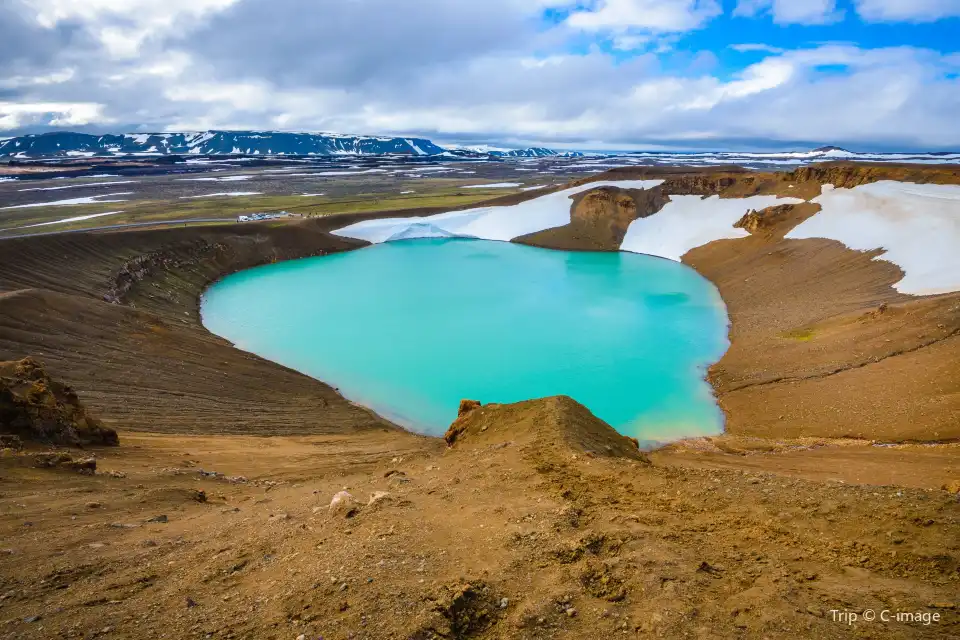
Krafla is the volcano system that keeps proving Iceland is alive: above lake Mývatn sits a caldera complex whose Víti explosion crater holds a milky turquoise lake (the “hell” name, the innocent colour), whose Leirhnjúkur lava fields cooled in living memory from the 1975–84 “Krafla fires”, and whose geothermal power station feeds the grid from the same heat. Free to visit, 15 minutes from the Mývatn cluster, walkable in an hour: the north’s rawest stop and the ranked list’s finale. Trip.Best ranks it #39 (5.0/5 from 13 verified reviews).
This is #39 of 39 in our Best Things to Do in Iceland guide. Below: the Víti crater and its colour, the Leirhnjúkur fields and the fires’ story, the power station context, the walking routes, and the Mývatn day that ends here.
Temel çıkarımlar
- The Víti crater: a 300-metre-wide explosion crater holding a milky turquoise lake — the name means “hell”; the colour is mineral chemistry.
- The Krafla fires, 1975–84: nine years of episodic eruptions and dike intrusions that remade the Leirhnjúkur fields — lava you can walk beside, cooled within living memory.
- Leirhnjúkur: the lava-field walk: steaming black basalt, orange-mineral vents, new land that is still cooling underfoot.
- Free, 24/7: open access with free parking; the Víti rim walk is 5–10 minutes, Leirhnjúkur 45–60.
- The power station context: the Krafla geothermal plant sits in the caldera — the same heat that makes the fields steams the baths at Mývatn (#35).
Hızlı cevap: Drive up from Route 1’s Mývatn stretch (the power-station road), walk the Víti crater rim (5–10 minutes, the turquoise payoff), then continue to Leirhnjúkur for the lava-field walk (45–60 minutes, steaming new land). Winter: the crater road plows but the fields are wind-real — check road.is. Pair with the Mývatn baths (#35) as the day’s hot finish.
The Víti crater and its colour
The Víti explosion crater formed in 1724 (the Mývatn fires’ opening act) when groundwater flashed to steam and blew the cone apart; the 300-metre bowl now holds a lake whose milky turquoise comes from dissolved minerals — sulphur-tinged, opaque, and photogenic against the red-and-grey crater walls. The rim path circles it in 5–10 minutes: the full bowl, the lake’s colour changing with cloud, the power station’s steam columns visible beyond (the modern neighbour of the 1724 violence).
The crater is the north’s most compact big-geology stop: parking at the rim road, no ticket, no queue, the payoff immediate. Winter keeps the road open most days (check road.is — the crater road plows with the region’s priority routes); the rim in ice wants studs, and the wind at the rim is the usual north-country discipline.
Two Vítis in Iceland: Krafla’s and Askja’s — both named “hell”, both holding milky lakes. Krafla’s is the accessible one (roadside); Askja’s sits deep in the Highlands behind F-road seasons. The name repeats because the formation does: explosion craters over geothermal systems.
Leirhnjúkur: walking the fires’ new land
The Leirhnjúkur lava fields are the deeper stop: the 1975–84 Krafla fires erupted episodically for nine years — dikes intruding, fissures opening, lava flows remaking the ground — and the fields they left are walkable today on marked paths: black basalt still steaming in places, orange and yellow mineral vents, cracks where the glow-era heat lingers, and the raw absence of soil on land younger than most visitors. The circuit runs 45–60 minutes over boardwalk and marked lava; the terrain is real (sturdy shoes, wind discipline) and the scale is humbling — a landscape born within living memory.
The fires’ story explains the field’s drama: the episodic pattern (quiet months, then sudden dike surges) kept the region on edge for nine years and gave volcanology the “Krafla fires” as a textbook case of rifting without a single big eruption. The paths, the steam, the fresh rock — it is the closest walkable equivalent to standing in a post-eruption report.
New-land rules: the paths exist because the ground does not — thin crust over warm rock, steam vents, and cracks with real depth. Stay on the marked route, keep children close, and never test the steaming ground. The boardwalk is the safety system.
Practical: access and the Mývatn day
Access: the Krafla road climbs from Route 1’s Mývatn stretch past the power station (the visitor viewpoint there explains the plant) to the Víti car park — 15 minutes from Reykjahlíð, free parking, no ticket. The visit: Víti rim (5–10 min) plus Leirhnjúkur (45–60 min) plus the power-station viewpoint; the whole stop runs 1–1.5 hours. Winter: the road plows most days (road.is check), the rim is studded-overshoe country, and the fields in snow-and-steam are a legitimate specialty.
The Mývatn day that works: Hverir’s steam fields (the free geothermal theatre at the road’s foot), Krafla’s Víti + Leirhnjúkur, Grjótagjá cave (the GoT lava cave, quick stop), the pseudo-craters at Skútustaðir, and the Mývatn Nature Baths (#35) to finish — the north’s densest geothermal day, all within 20 km.
How it fits an Iceland route
Krafla caps the northern ring day (#19): Goðafoss (#24) morning, the Mývatn cluster afternoon, the baths (#35) evening. It pairs thematically with the fire-and-ice system stops — Gunnuhver (#34) on Reykjanes, Hverir next door — the same geothermal grammar at every scale. Our Mývatn guide covers the cluster in full, and the Ring Road guide sequences the north.
Frequently asked questions
Why is the Víti crater’s lake turquoise?
Dissolved minerals — sulphur compounds and silica in the geothermal water — give the lake its milky turquoise. The name Víti means “hell” (the 1724 explosion earned it); the colour is chemistry, not temperature.
Can you walk on the Krafla lava fields?
On the marked paths, yes — the Leirhnjúkur circuit (45–60 minutes) crosses the 1975–84 lava fields on boardwalk and marked route. Off-path ground is thin crust over warm rock; stay on the route.
What were the Krafla fires?
The 1975–84 episode of episodic eruptions and dike intrusions at the Krafla system — nine years of ground opening, lava flowing and fissure events that remade the Leirhnjúkur fields and became a volcanology textbook case.
Is Krafla free to visit?
Yes — free access and free parking at both the Víti rim and the Leirhnjúkur fields. The power station viewpoint is the bonus; the Mývatn baths (#35) nearby are the paid soak.
Where this ranks — and what is next
Krafla is #39 of 39 in our Best Things to Do in Iceland guide — the full ranked list, built from Trip.Best traveler data, lives in one place.
Go deeper: Mývatn — the north’s geothermal guide (the cluster), Mývatn Nature Baths (#35) — the day’s hot finish.
Sources & official references
- Trip.com listing for Krafla: 5.0/5 rating, 13 reviews (checked November 2026).
- Trip.Best ranking data: #39 of 39 (November 2026).
- Site interpretive signage: Víti 1724, the Krafla fires 1975–84 (checked 2026).
- Krafla power station visitor information (Landsvirkjun).
- Editorial north visits across seasons including winter steam conditions, 2023–2026.
