








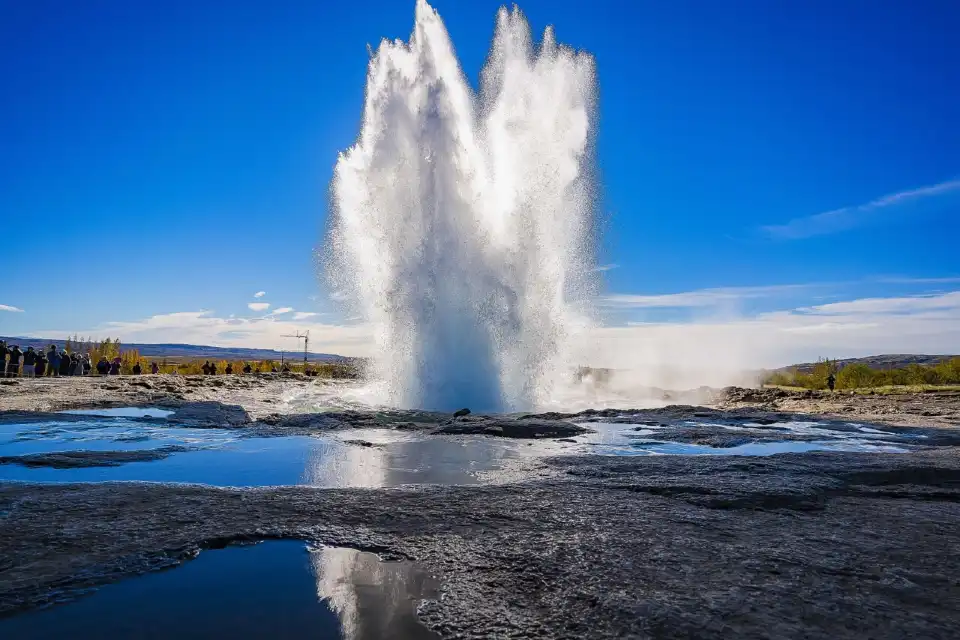
Geysir is the hot-spring field that named the phenomenon: the Great Geysir gave English the word “geyser”, and while the great one mostly sleeps, its neighbour Strokkur erupts every five to ten minutes, 15–20 metres into the sky, free, on schedule, forever. It is the most reliable natural spectacle in Iceland — no timing skill required, no ticket, no trail — and the geothermal field around it (steaming vents, boiling mud, the blue pools Blesi and Fata) is the country’s textbook geology display.
This is #14 of 39 in our Best Things to Do in Iceland guide (4.7/5 from 156 verified reviews). Below: how Strokkur’s cycle works and the eruption-watching technique that gets the shot, the field’s quieter pools worth the walk, the winter version, and the Golden Circle context that makes this the easiest ranked stop on the list.
Punti chiave
- Strokkur erupts every 5–10 min: to 15–20 m typically, sometimes 30 — the country’s most reliable natural show.
- The Great Geysir is mostly dormant: it gave the world the word; eruptions are now rare events (post-earthquake reactivations have happened).
- The field is the textbook: fumaroles, mud pots, the twin blue pools Blesi and Fata — walk beyond Strokkur and the field opens up.
- Free, 24/7: paid parking; the visitor centre hotel and café handle facilities.
- Anticipation photography: the dome pulses before the eruption — read the pulse, pre-frame, fire on the launch.
Risposta rapida: Park, walk 5 minutes to Strokkur, watch one full cycle (you will see the dome pulse and understand the rhythm), then position upwind of the prevailing spray with the sun behind you and shoot the launch at 1/1000 s. Walk the field’s upper loop (Blesi, Fata, the vents) while waiting between eruptions. Ten minutes to Gullfoss (#13) after.
The eruption, decoded
Strokkur’s cycle is readable: water in the vent surges and the dome above it pulses, swells, and collapses twice or three times before the real launch — a boil-up that flashes to steam and throws the column 15–20 metres (30+ on the strong ones) in a second and a half, then falls back as a rain of hot water that the crowd treats as a shower. The whole eruption is over in seconds; the show is the anticipation. First-timers consistently mis-time the small eruptions and miss the big one — watch two full cycles before committing to a position.
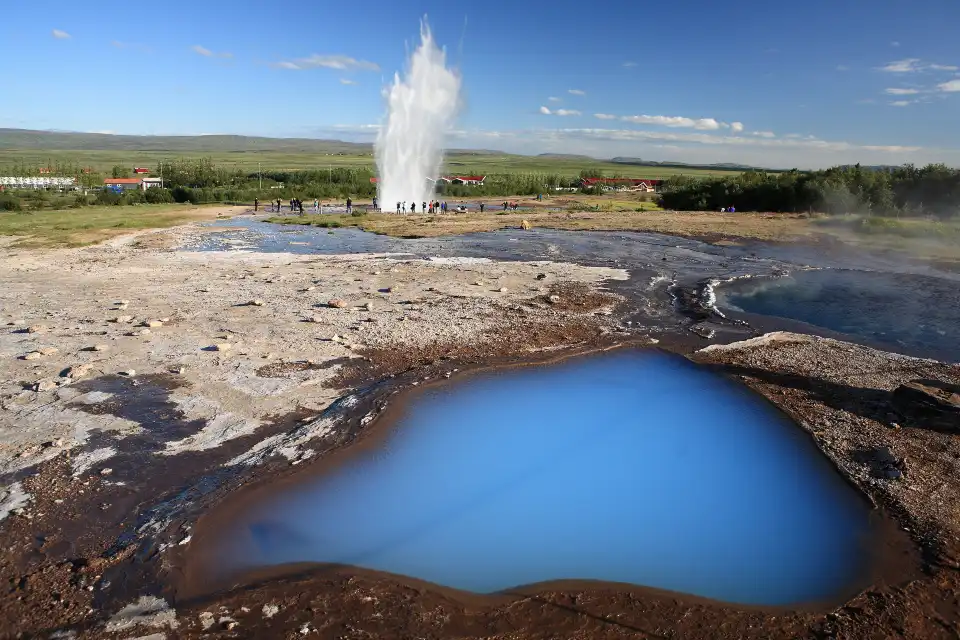
The field around it is half the visit: fumarole vents hissing steam ribbons, bubbling mud pots, and the colour-coded pools — Blesi and Fata, the two blue basins whose colour comes from dissolved silica, are the photographer’s quiet favourites a few minutes up the boardwalk. The Great Geysir itself sits calm in its basin; its stone-throwing history (Icelanders once triggered it with soap, now banned) is told on the signs. The upper field loop takes 20–30 minutes and thins the crowd fast.
Stay on the paths: geothermal ground is thinner than it looks — boiling water moves under seemingly solid crust, and the field’s fencing is not decoration. Every year someone tests it; the burns are serious. Paths, boardwalks, marked viewpoints: that is the whole rule set.
Shooting the eruption
The technique is anticipation photography: pre-frame after a couple of cycles (wide lens, the launch point dead centre, sun behind you so the column is lit), set 1/1000 s to freeze the column or 1/250 for motion feel, ISO to match, and fire on the dome’s final pulse. Wind decides your position — stand upwind of the prevailing spray or the “rain” ends your session early. The steam column against a blue sky is the classic; overcast days photograph the white column against dark basalt surprisingly well.
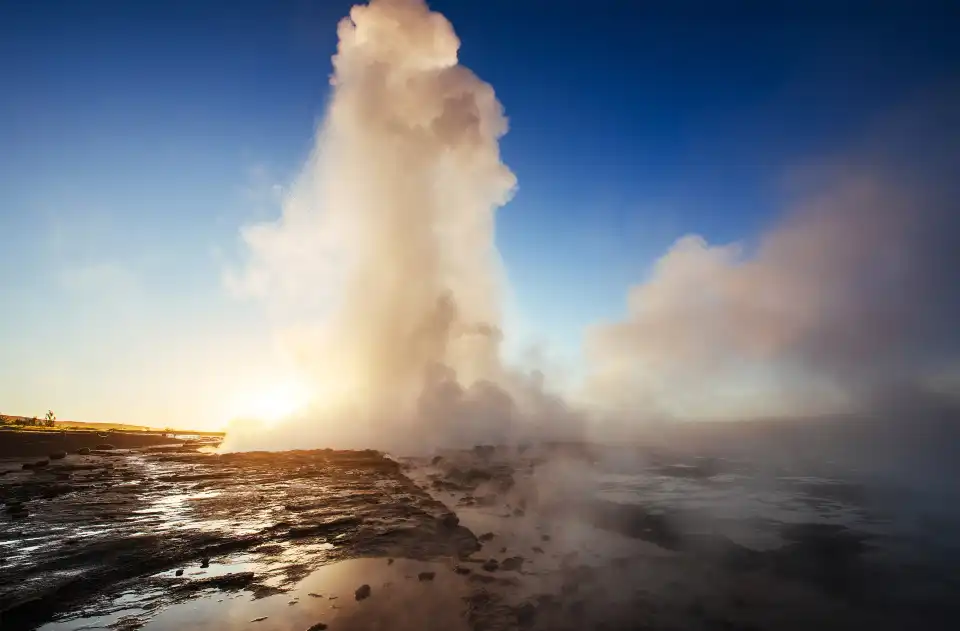
Winter transforms the shot: −10°C air turns every eruption into a steam bomb that hangs in the freezing air, and ice sculptures build around the vents. The aurora bonus exists on clear nights (the field is a dark site 90 minutes from the capital), though the eruption column under aurora is a rare double — chase it as a bonus, not a plan. Drone use: national rules plus site crowd density; usually not worth it here.
The big-eruption tell: watch the dome’s collapse pattern — two quick pulses then a long, still boil usually means the launch is coming. Regulars read it at 80% accuracy; the technique is two cycles of attention, nothing more.
Practical: access, facilities and timing
The field sits directly on the Golden Circle road (Route 37) with a paid car park, the visitor centre (hotel, café, geothermal-bread demonstrations at the bakery — worth the stop) and a 5-minute path to Strokkur. Total stop time: 30–60 minutes; with the upper field loop and a café break, an hour and a half. It pairs mechanically with Gullfoss (#13): the two stops are ten minutes apart and make the Circle’s western half a single block.
Year-round operation: the field does not close for weather (the eruption does not care), winter paths are maintained, and the studded-overshoe rule applies as everywhere. Crowds follow the tour buses — 10:00–15:00 — but the eruption’s frequency makes queues irrelevant here: everyone sees multiple launches regardless of crowd size.
How it fits an Iceland route
Geysir is the Golden Circle’s centre stop (#11): Gullfoss (#13) ten minutes west, Þingvellir (#18) 50 minutes north. The geothermal grammar it teaches repeats across the country — Hverir’s steam fields in the north, Gunnuhver’s mud pools on Reykjanes (#34), Krafla’s Víti (#39). Our Golden Circle guide sequences the full loop, and the photography guide’s Strokkur chapter carries the eruption workflow.
Frequently asked questions
Does the Great Geysir still erupt?
Rarely — the Great Geysir is mostly dormant, erupting only after significant seismic reactivation. Strokkur, 100 metres away, erupts every 5–10 minutes and is the field’s working star.
How high does Strokkur erupt?
Typically 15–20 metres, with stronger eruptions reaching 30 metres. Height varies with the field’s internal pressure — no two days are identical.
Is the geothermal area safe for children?
Yes, on the paths: boardwalks and marked routes keep everyone off the thin crust. Hold small children’s hands near the vents, and treat the fencing as absolute — the water under the ground is genuinely boiling.
Can you bathe at Geysir?
No — the field is a geology site, not a spa. The nearest soak is the Secret Lagoon (#32) at Flúðir, 25 minutes south on the Circle’s return leg.
Where this ranks — and what is next
Geysir is #14 of 39 in our Best Things to Do in Iceland guide — the full ranked list, built from Trip.Best traveler data, lives in one place.
Go deeper: The Golden Circle route logic (#11), Gullfoss (#13) — ten minutes away.
Sources & official references
- Trip.com listing for Geysir: 4.7/5 rating, 156 reviews (checked November 2026).
- Trip.Best ranking data: #14 of 39 (November 2026).
- Site operator information: parking, paths, facilities (checked 2026).
- Eruption behaviour per field monitoring and operator briefings.
- Editorial visits across seasons including winter steam conditions, 2023–2026.
