









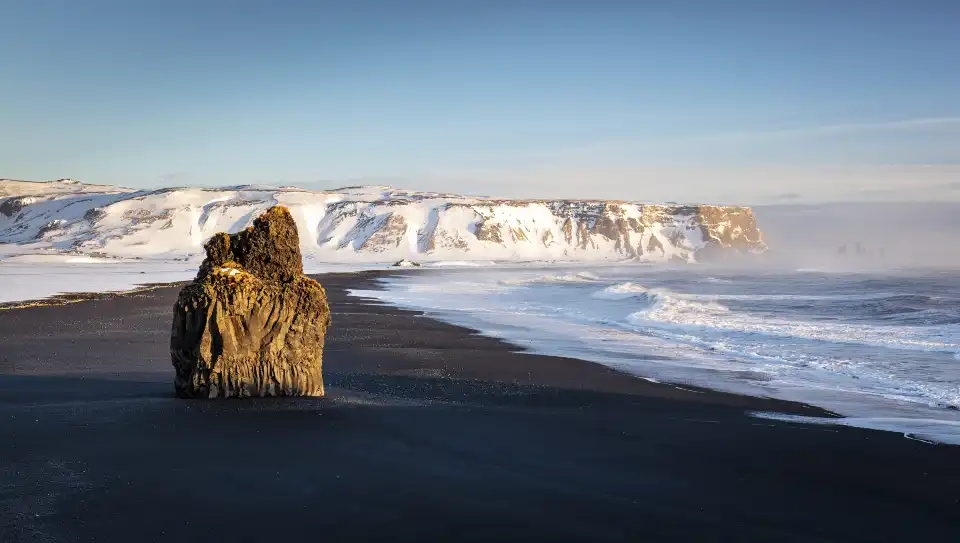
Reynisfjara is the black-sand beach every Iceland itinerary gets measured against: a full kilometre of jet-black volcanic sand, the hexagonal basalt columns of Reynisfjall, the Hálsanefshellbar cave, and the Reynisdrangar sea stacks rising from the surf like ship masts. It is also the beach with the strictest safety rules in the country — the sneaker waves here have killed visitors — and the tension between beauty and danger is exactly why it lives in memory. Trip.Best ranks it #17 with 4.5/5 from 95 verified reviews.
This is #17 of 39 in our Best Things to Do in Iceland guide. Below: the geology that built the columns, the troll legend behind the stacks, the safety rules as absolute law, the dusk light that makes the beach legendary, and the Dyrhólaey (#25) pairing that completes the Vík afternoon.
Punti chiave
- Basalt column geometry: the Reynisfjall cliffs expose hexagonal columns — the same cooling-lava physics as Svartifoss and Hallgrímskirkja’s facade.
- The sneaker waves are lethal: standing ocean warnings, multiple fatalities: never turn your back on the sea, stay behind the berm, read the swell sets.
- Reynisdrangar: the troll stacks: three sea stacks offshore — the trolls who dragged a three-masted ship ashore and met the sunrise.
- Dusk is the ranked light: the Trip.Best field wisdom: the beach photographs best at dusk, which is also when the hazard peaks — manage both.
- Free, 24/7: paid parking; no gate, no season, no light after dark except the aurora’s.
Risposta rapida: Park, read the beach condition board at the entrance, and walk the berm line only: the columns and cave on your right, the stacks framed left through the spray. Never pose at the waterline, never stack rocks inside the wet zone, and leave when the sets grow. Dusk visit if you can manage it — and keep the ocean in your eyes the whole session.
The columns, the cave and the stacks
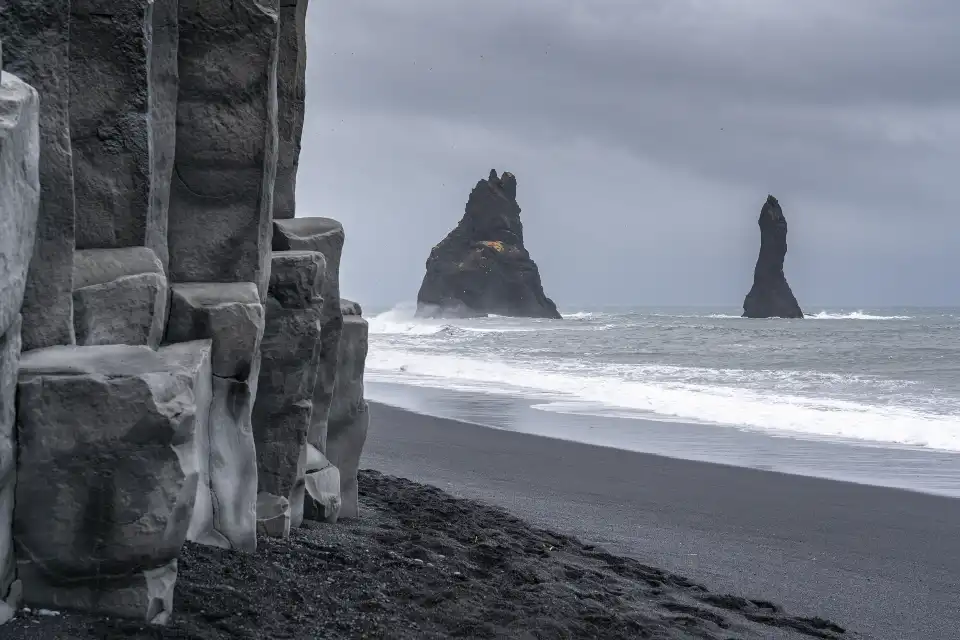
The beach’s architecture comes from Reynisfjall, the 340-metre hyaloclastite mountain that ends in a cliff of columnar basalt — lava cooled slowly into hexagonal pillars, the same formation logic as Svartifoss’s hanging curtain and the capital’s church facade. At the cliff’s base sits Hálsanefshellbar, a cave framed by columns that hums with the surf; you can walk in (mind the birds in nesting season — parts close). The sand itself is black volcanic grain, dense enough that footprints hold like drawings.
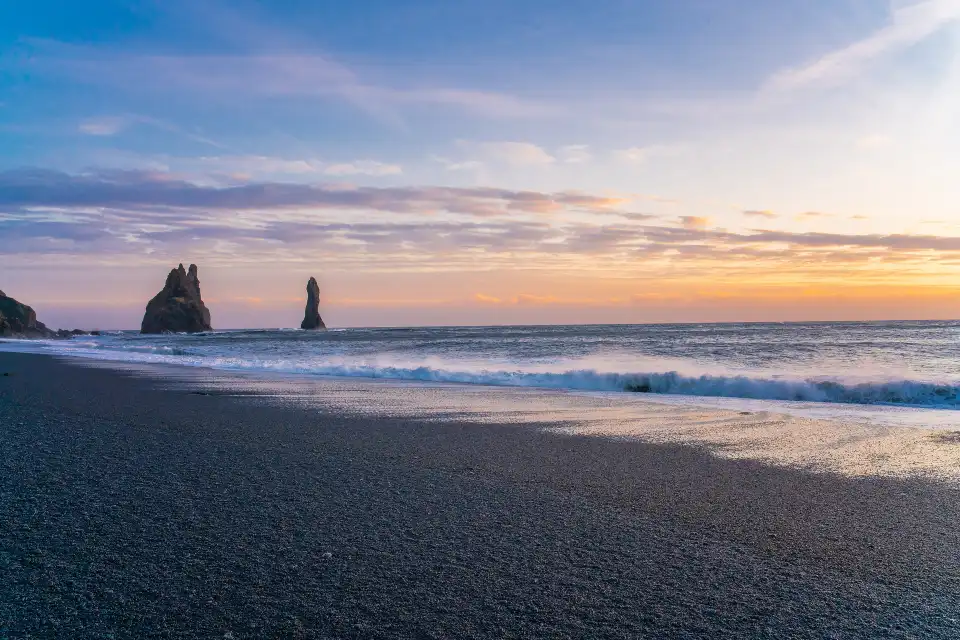
Offshore, the Reynisdrangar stacks — 60+ metres of basalt rising from the Atlantic — give the beach its legend: trolls dragging a three-masted ship to shore, caught by sunrise and turned to stone. The stacks move position with every angle you shoot from (an optical fact the photos exploit); on storm days they disappear into spray and reappear like shipwreck ghosts. The village of Vík sits 5 minutes east — the church on the hill is the emergency-upland marker locals know.
The safety law — read it twice: sneaker waves run far up this beach without warning after long calm sets; people have been swept to their deaths here and at Diamond Beach. The rules: never turn your back on the ocean, stay behind the berm, keep children in hand, never stand on wet rock inside the surf zone, and treat every “calm minute” as borrowed. safetravel.is maintains a standing warning for this exact beach.
The dusk light and the frames
Reynisfjara’s ranked light is dusk: the west-facing beach catches the last light sideways across the columns, the stacks silhouette against the sunset arc, and the spray catches what is left of the gold. Storm days photograph dramatically (the stacks in spray, the foam lines) — from a distance, behind the berm. Overcast flat light flattens the black sand into gray; the column texture and the stack compositions still work.
The frames: the columns’ geometry close-up (the hexagons as texture), the cave interior looking out (tripod, long exposure), the classic stack-plus-curve composition down the beach, and the mountain-plus-beach aerial-style from Dyrhólaey (#25) — which is the better “whole beach” vantage and the reason the two stops pair. Drone use: national rules apply; the beach’s wind is often beyond small-drone limits anyway.
The Dyrhólaey vantage: for the whole-beach composition — stacks, curve, Vík church — shoot from the Dyrhólaey headland 15 minutes west (#25). The beach’s best aerial-style frame is not from the beach itself.
Practical: access, kit and the Vík base
Access: signed off the Ring Road 5 km west of Vík, paid parking, toilets and the (seasonal) café. The visit: 45–90 minutes; the beach walk to the cave and back is the standard loop. Kit: waterproof windproof layers (the beach is exposed in all weather), studded overshoes in winter (the basalt ices), and nothing you cannot run in — the honest safety gear is attention.
The Vík base makes the afternoon: Reynisfjara, Dyrhólaey (#25), the Lava Show (#30) and Skógafoss (#8) chain into one South Coast day from Vík’s hotels and guesthouses. Winter visits: daylight windows are short, the beach wind is brutal some days, and the aurora over black sand is a legitimate reward on clear nights — from far behind the berm.
How it fits an Iceland route
Reynisfjara is the South Coast’s midpoint spectacle: Skógafoss (#8) 40 minutes west, Dyrhólaey (#25) 15 minutes west, Vík and the Lava Show (#30) 5 minutes east. Ring Road routes overnight in Vík after this stop. Our Reynisfjara deep-dive carries the geology and history in full, the photography guide’s South Coast chapter sequences the dusk workflow, and the safety guide (112, safetravel) is the reading that matters most here.
Frequently asked questions
Why is Reynisfjara dangerous?
Sneaker waves: large waves arrive without warning after long calm sets, run far up the beach, and have swept visitors to their deaths. The ocean here does not negotiate — the berm-line and eyes-on-the-sea rules are the whole defense.
What are the Reynisdrangar stacks?
Three basalt sea stacks offshore — in legend, trolls hauling a ship ashore who were caught by sunrise and turned to stone; in geology, remnants of the eroding headland. They photograph from every angle along the beach.
Can you enter the basalt cave?
Yes — Hálsanefshellbar is walk-in at the cliff base (mind the surf line and the nesting-bird closures in summer). It is a few minutes from the main access; the columns around it are the texture subject.
Is Reynisfjara or Diamond Beach better?
Different offers: Reynisfjara has the columns, cave, stacks and village infrastructure; Diamond Beach (#3) has the grounded ice. Photographers do both in one South Coast run — dusk at Reynisfjara, sunrise at Diamond Beach.
Where this ranks — and what is next
Reynisfjara Beach is #17 of 39 in our Best Things to Do in Iceland guide — the full ranked list, built from Trip.Best traveler data, lives in one place.
Go deeper: Reynisfjara — the most dramatic coastline (full guide), How to photograph Reynisfjara (dusk workflow).
Sources & official references
- Trip.com listing for Reynisfjara Beach: 4.5/5 rating, 95 reviews (checked November 2026).
- Trip.Best ranking data: #17 of 39 (November 2026).
- safetravel.is sneaker-wave warnings and beach incident record.
- Site operator information: parking, seasonal café, nesting closures (checked 2026).
- Editorial visits across seasons with dusk-safety protocols, 2023–2026.
