





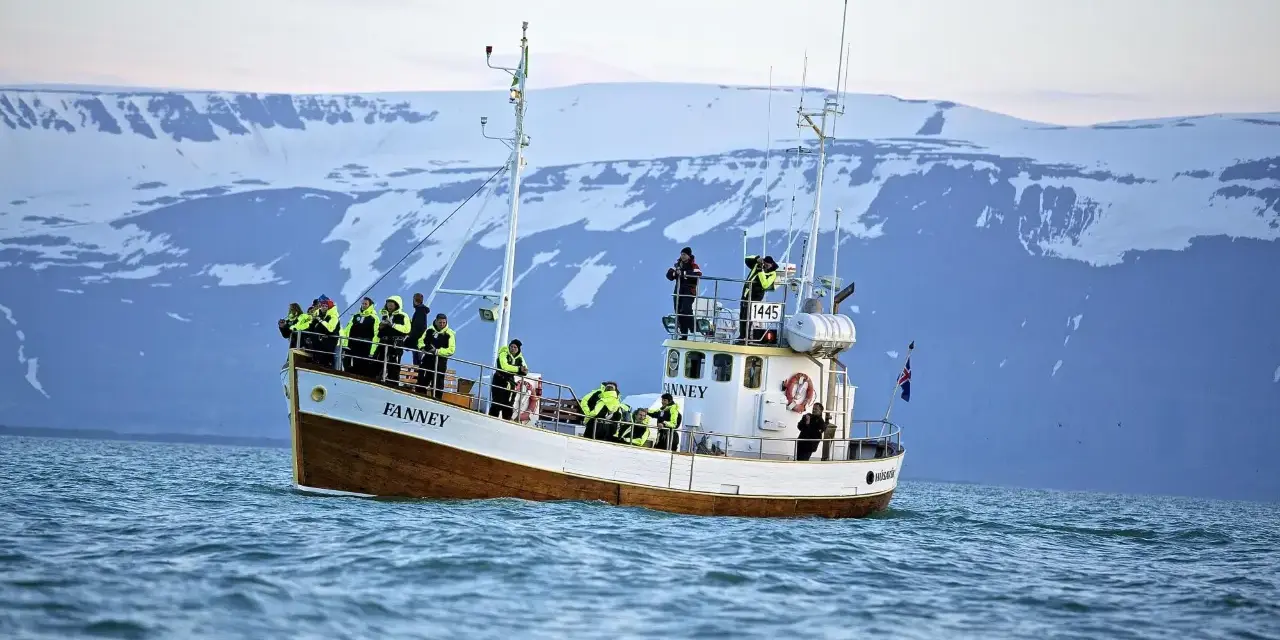
Húsavík does one thing better than almost anywhere on earth, and the town knows it. From the harbour of this tidy wooden town of about 2,200 residents — on the calm, food-rich waters of Skjálfandi Bay — boats have been going out to whales since the 19th century, first hunting them, now showing them off. Today the bay is one of Europe’s most reliable whale-watching arenas: humpbacks lunge-feeding a few hundred metres from the pier, minke whales surfacing off the bows, white-beaked dolphins riding the wake, and — on lucky June-to-August days — the blue whale, the largest animal that has ever lived, passing through its feeding grounds. Our team has sailed here in flat calm and in fog that turned the bay into a sound stage; this guide covers the whales, the boats, the museum, the sea-baths and the pop-culture moment that put the town on the map.
The honest pitch: Húsavík is worth its own stop, not just a detour. Between sails you have a genuinely good whale museum on the main street, geothermal sea-baths overlooking the bay, and a north loop of Dettifoss, Ásbyrgi and Mývatn all within an hour. Few towns this small punch this hard.
Temel çıkarımlar
- Skjálfandi Bay is the reason: shallow, sheltered and plankton-rich, it draws humpbacks (the most common sighting), minke whales, white-beaked dolphins and occasional blue whales in June–August.
- The oak boats are the signature: restored wooden fishing vessels in the 19th-century tradition, plus modern electric-hybrid boats — sailing with engines near-silent is a different whale experience.
- The Whale Museum anchors the visit: on the main street, it turns every sighting into biology you actually understand.
- GeoSea gives the bookend: geothermal sea baths above the harbour, open year-round — soak with the bay and the boats in view.
- Timing is simple: the whale season runs roughly May–September with the best odds June–August; the town sits 45 minutes from Mývatn and about 1.25 hours from Akureyri.
Hızlı cevap: sail once in the morning (calmest seas, best light) and again in the evening if the first trip whetted you — operators run varied schedules across the season, and the midnight-sun sails of midsummer are the region’s signature. Pair the day with Dettifoss or Ásbyrgi, book the museum and GeoSea around the sail times, and treat the weather forecast, not the whale forecast, as the thing to check.
Why Húsavík became the whale capital
Skjálfandi Bay is a whale trap in the friendliest possible sense. The bay is shallow, sheltered and fed by currents that concentrate plankton and the fish that graze it — a feeding station in a country of currents. Whales do what whales do when food piles up: they come, they stay, and they feed where the boats can reach them within minutes of leaving the pier. Add a deep maritime tradition — this was one of Iceland’s earliest whaling harbours in the modern era, and its wooden boatbuilding heritage still defines the harbour — and the transition from whaling town to whale-watching capital reads as history completing a circle.
The town itself makes the claim easy to embrace. Húsavík’s harbour sits at the foot of the main street, so the whole place works around the sail: coffee before, the museum between, the baths after. It is compact, walkable, honest about its purpose and unpretentious about its fame. The population of roughly 2,200 supports restaurants, guesthouses and a cultural scene that trades far above its size in summer — and empties into cosy local scale when the season closes.
The whales of Skjálfandi Bay
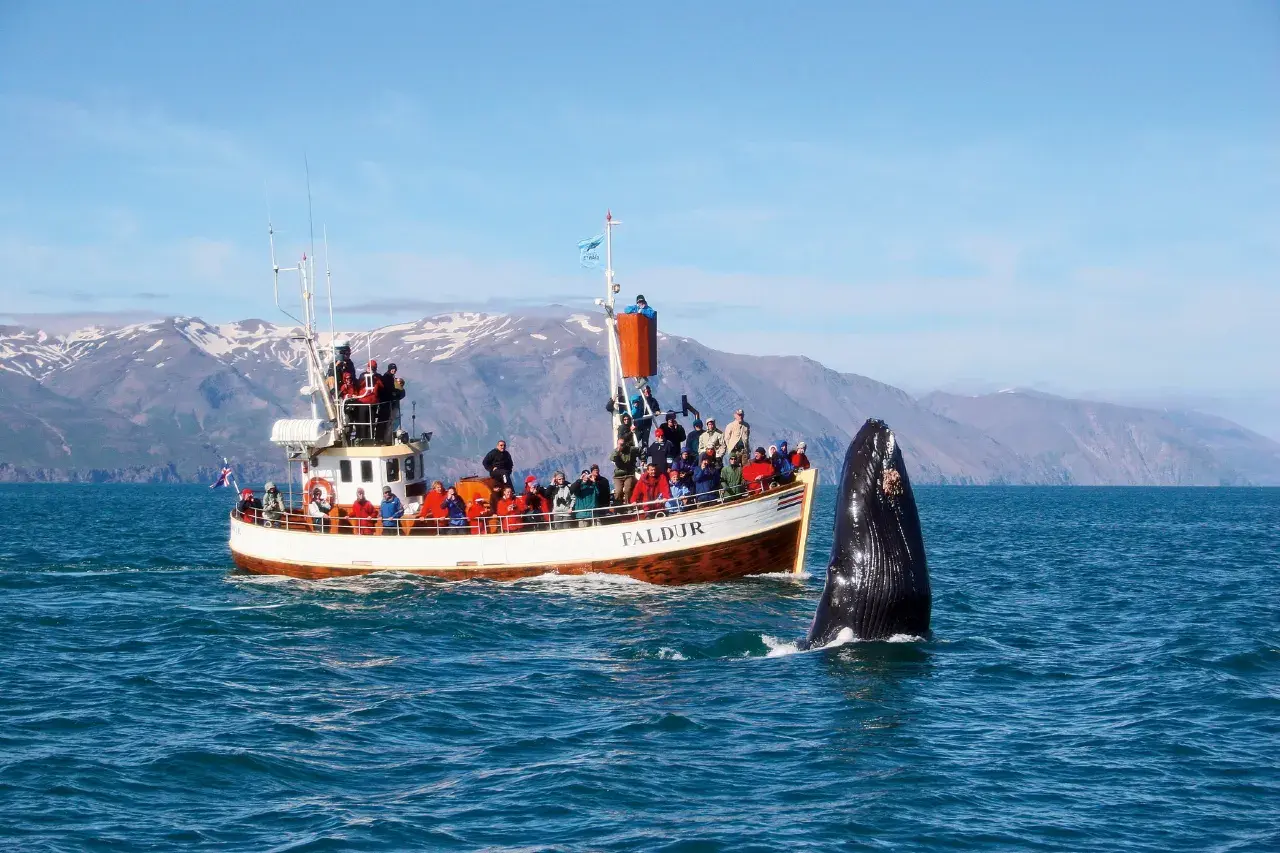
Humpbacks are the reliable stars. They feed in the bay through the summer, often close to shore, and their behaviour is tailor-made for watching: fluke-up dives, surface lunge feeds, and the pectoral fin slaps that reward every phone raised in the boat. Minke whales appear regularly, faster and shyer, surfacing in quick arcs that keep spotters honest. White-beaked dolphins ride the bows and play the wake, usually in small pods. And in June through August, the bay’s rarest headline: blue whales pass through their feeding grounds — sightings are occasional rather than promised, which is exactly why the ones that happen get remembered for decades.
Seasonality shapes the odds. The core season runs roughly May to September, with June–August the sweet spot when feeding is busiest and the midnight light stretches sail times into the golden hours. Calm weather matters more than any date: whales surface everywhere but are vastly easier to spot in settled seas, so a flexible plan beats a fixed one. And keep expectations honest — wildlife never performs on schedule, and any operator worth booking will tell you the same. The ocean does the scheduling; the boats just ask politely.
Oak boats, RIBs and electric-hybrids
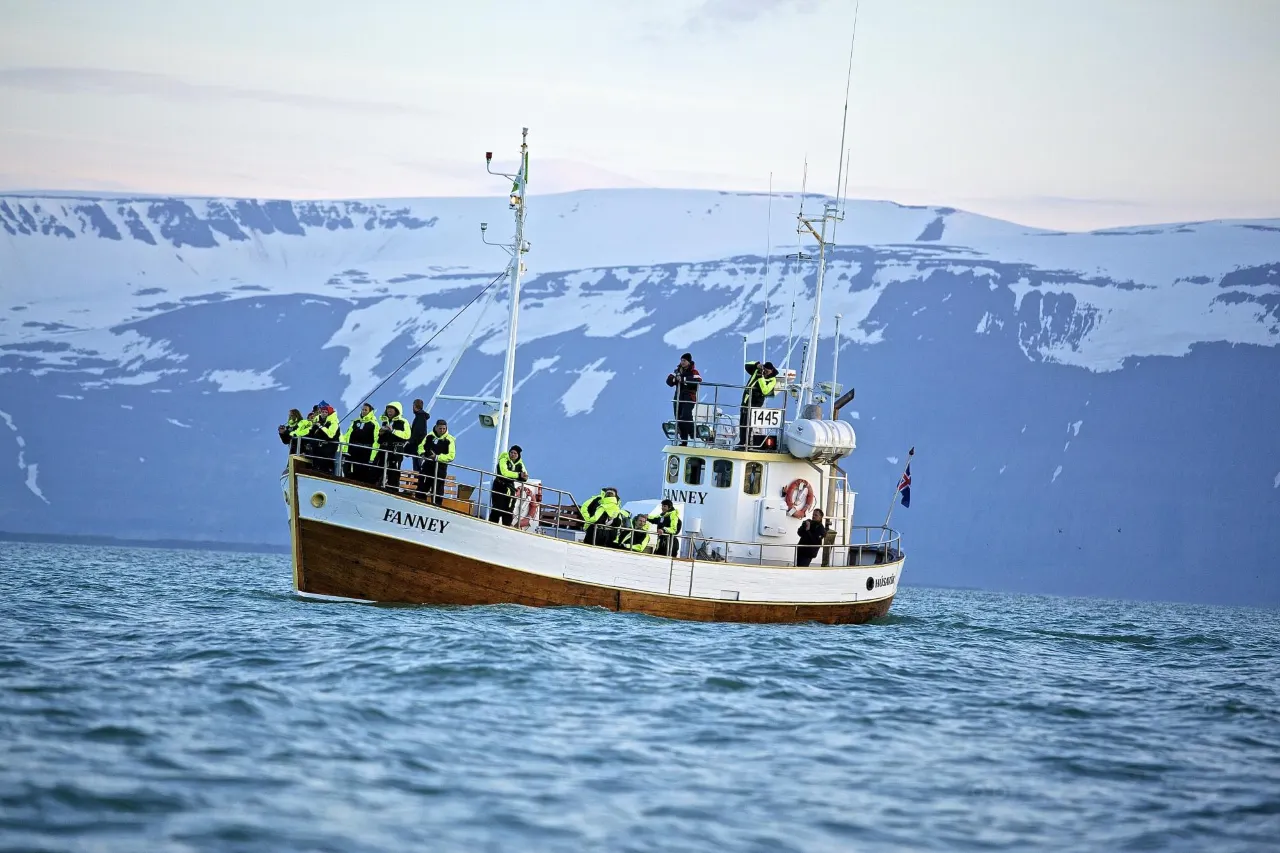
Húsavík’s fleet is its personality. The classic choice is the restored oak fishing boat — wooden vessels built or rebuilt in the 19th-century tradition, slow, stable and atmospheric, with the sound of the sea instead of the sound of engines for much of the sail. Operators like North Sailing have added electric-hybrid boats that cruise quietly on battery power near the whales, cutting noise and emissions while making the close approaches feel almost meditative. For travelers who want speed and intimacy, RIB (rigid inflatable) tours run smaller groups faster, closer to the action and with a thicker suit required.
How to choose? The oak and hybrid boats suit families, photographers and anyone for whom the boat is half the experience; RIBs suit the restless and the cold-tolerant. Durations and inclusions vary by operator and season — check current schedules and dress for sea wind regardless of choice. What every option shares is the departure: a working harbour, a short briefing, and within minutes the first blows in the bay. Our team’s bias is the hybrid sail for a first visit and the RIB for a second — the bay rewards both approaches, and the whale etiquette is identical: let the animals set the distance.
Worth knowing: book ahead in July–August when the day’s sails fill with summer traffic, and keep a weather margin — tours pause for wind and fog, and operators reschedule rather than force it. The morning sail is usually the calmest; the midnight-sun sails of midsummer are the ones you will still be talking about in winter.
The Húsavík Whale Museum
On the main street, a few steps from the harbour, the Húsavík Whale Museum is the best half-hour-to-hour you can spend between sails. The exhibitions walk from whale biology and evolution through the town’s whaling history to modern research, with skeletons — including a full-size giant — that recalibrate your sense of scale before you get back on the water. Everything you meet on the sail makes more sense afterward: the feeding lunge, the fluke patterns researchers use to identify individuals, the reason a blue whale’s blow looks like a forest chimney.
The museum’s role in town goes beyond exhibits; it is the institution that trained a generation of local guides, and its pairing with the sails is the template for responsible wildlife tourism — see it, then understand it. Families rate it highly; children handle the skeletons better than the biology lectures, and the town’s modest-scale museums keep visits human-sized. Combine it with the harbour walk and you have covered Húsavík’s indoor culture before lunch.
GeoSea and the town itself
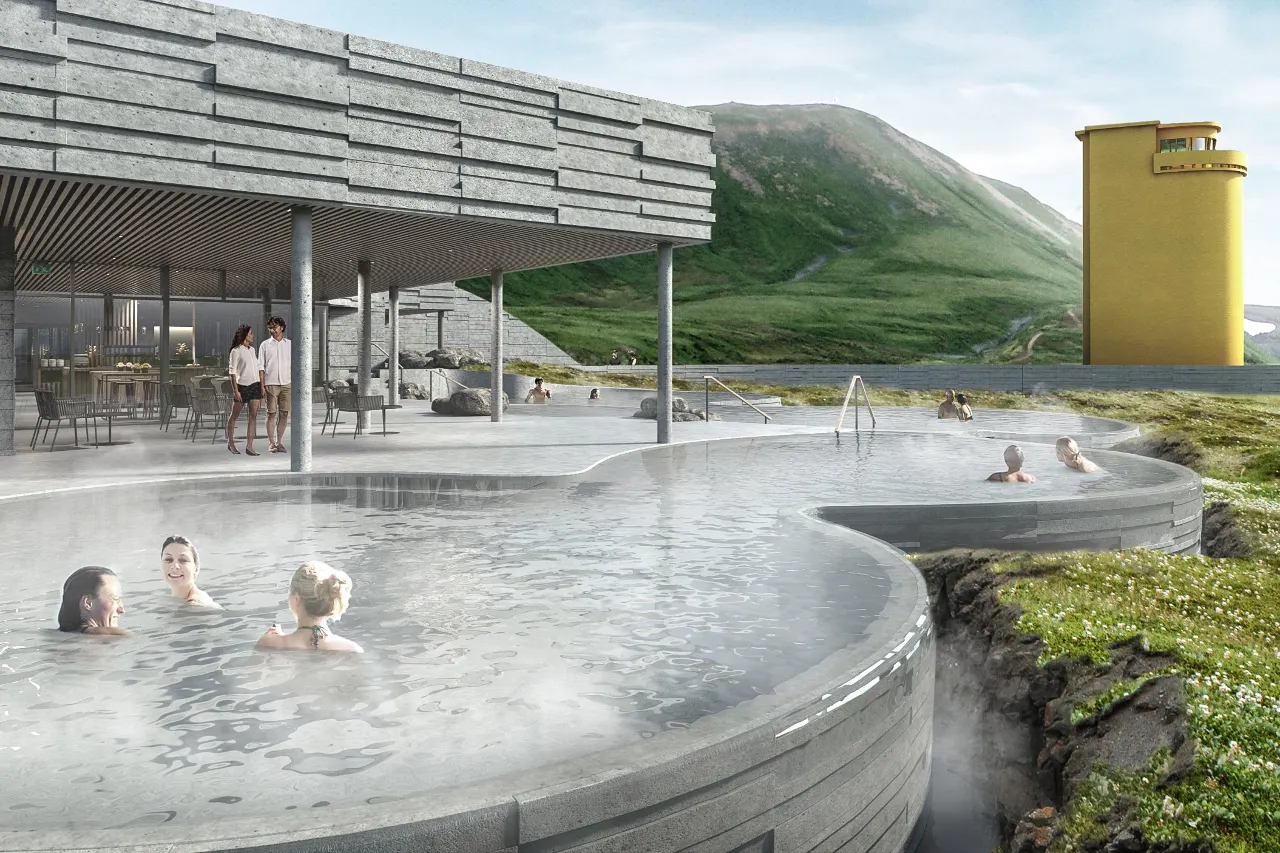
GeoSea, the geothermal sea baths perched above the harbour, turned Húsavík’s evening into an institution: mineral-rich warm water in infinity-style pools facing the bay, with the wooden town below and the whales — on a good day — spouting in view. It runs year-round, which makes it the perfect post-sail thaw and a genuine winter attraction when the aurora works the sky over open water. The entry is paid at the national lagoon standard; the wash-before-you-enter rules are the law of the land, and the sea air does the rest.
The rest of the town rewards the slower traveler. The harbour walk takes in the traditional timber houses; the church on the hill — one of Iceland’s distinctive wooden churches — frames the bay in photos; and the town’s cafés and fish restaurants run the summer gamut from quick harbour food to proper dinners. Húsavík is small enough to absorb in an afternoon and good enough to justify a night: guesthouses fill with whale-worn travelers who came for one sail and stayed for the evening light on the bay.
The Eurovision effect
In 2020, the Netflix film “Húsavík” — the Eurovision Song Contest story with Will Ferrell and Rachel McAdams — adopted the town as the emotional homecoming of its plot, filmed locally and crowned with an Oscar-nominated original song named for the place. The effect on tourism was immediate and a little surreal: travelers arrive humming the ballad, the town plays along with the good grace of somewhere finally recognized, and the song has become an unofficial second anthem. It is, in our experience, the only Eurovision entry that has measurably influenced flight bookings to a fishing town of 2,200.
The film’s portrayal is accurate in the way that matters: Húsavík’s appeal is the combination of modesty and spectacle — a working town at the edge of a bay full of giants. The pop-culture moment passes; the whales and the oak boats remain. Visit now, in the season’s long light, and you understand why the story chose this harbour to come home to.
Planning the north loop
Húsavík’s geography is its cheat code: the town sits 45 minutes from the Mývatn district and roughly 1.25 hours from Akureyri, with Dettifoss and Ásbyrgi canyon on the eastern leg of the circuit. The classic northeast day: morning sail from Húsavík, drive south for the geothermal wonders of Mývatn (Hverir, Krafla, the Nature Baths), or east for Dettifoss and the horseshoe of Selfoss. The full loop — Akureyri, Goðafoss, Mývatn, Dettifoss, Ásbyrgi, Húsavík — fills two to three days and covers the best of the north without repetition.
Two planning notes earn their ink. First, the sail and the drive rarely share weather windows: the bay calms in high pressure while mountain roads stay tricky in wind, so check road.is and the en.vedur.is forecast each morning and let the conditions sequence your day — whales in calm, canyon in dry. Second, season matters twice here: whale odds peak June–August, while the aurora works September onward; mid-September splits the difference with thinner crowds and the year’s first dark skies over the bay. Our Mývatn guide Ve Dettifoss guide complete the circuit’s other halves.
Frequently asked questions
When is whale watching best in Húsavík?
The season runs roughly May–September, with June–August the strongest window for humpbacks, minkes and dolphins — and the best (though never guaranteed) blue-whale odds. Calm seas improve sightings more than any calendar date, so keep plans flexible and let the forecast choose between the morning and evening sail.
Are whales guaranteed on a tour?
No responsible operator guarantees wildlife. Skjálfandi’s hit rates are among the best in Europe, but the honest contract is: a beautiful bay, a knowledgeable crew and a very good chance. Many operators offer a return sail if a trip draws a blank — ask when booking rather than assuming.
Which boat should I choose — oak, RIB or electric-hybrid?
Oak and electric-hybrid boats for stability, silence and the full harbour-to-bay experience; RIBs for speed, closeness and small groups. Families and photographers usually prefer the wooden and hybrid sails; thrill-seekers take the RIB. Durations vary by operator — check current schedules and dress for sea wind in every case.
Can I see whales from shore in Húsavík?
Sometimes — the bay’s shallows bring humpbacks within view of the harbour and the GeoSea terraces on feeding days, and the town’s whale-related street art keeps expectations cheerful. But shore sightings are luck, not planning. The boats exist because the bay rewards proximity, and the sail is the experience you came for.
How do I fit Húsavík into a north Iceland trip?
Slot it into the northeast loop: Mývatn district is 45 minutes south, Dettifoss and Ásbyrgi an hour east, Akureyri about 1.25 hours west. A sail in the morning plus a geothermal afternoon is a full day; the two-to-three-day north loop covers the whole region. Our Mývatn and Dettifoss guides map the connecting legs.
Finish the north loop
The bay is one third of the northeast’s charm — Mývatn’s lagoons and Dettifoss’s power complete it.
For the southern equivalent, read the Reykjavik whale-watching guide; for the soak before or after the sail, see the best hot springs beyond the Blue Lagoon; and our Akureyri guide covers the base city that ties the north together. Season logic lives in the weather & wind guide.
Sources & official references
- Official Icelandic services: en.vedur.is (bay weather and aurora forecasts), road.is (northeast roads), safetravel.is (marine and coastal safety) — checked 2026.
- Trip.com Iceland destination guide (checked 2026): Húsavík profile, whale-watching season framing (May–September), GeoSea listing and species notes.
- Húsavík Whale Museum exhibition information and local maritime heritage sources (oak boat tradition, whaling-era history).
- Tour operator published seasonal schedules including North Sailing’s electric-hybrid fleet; verify live availability when booking.
- Editorial visits across seasons 2024–2026 by the Iceland Travel Guides team.
