









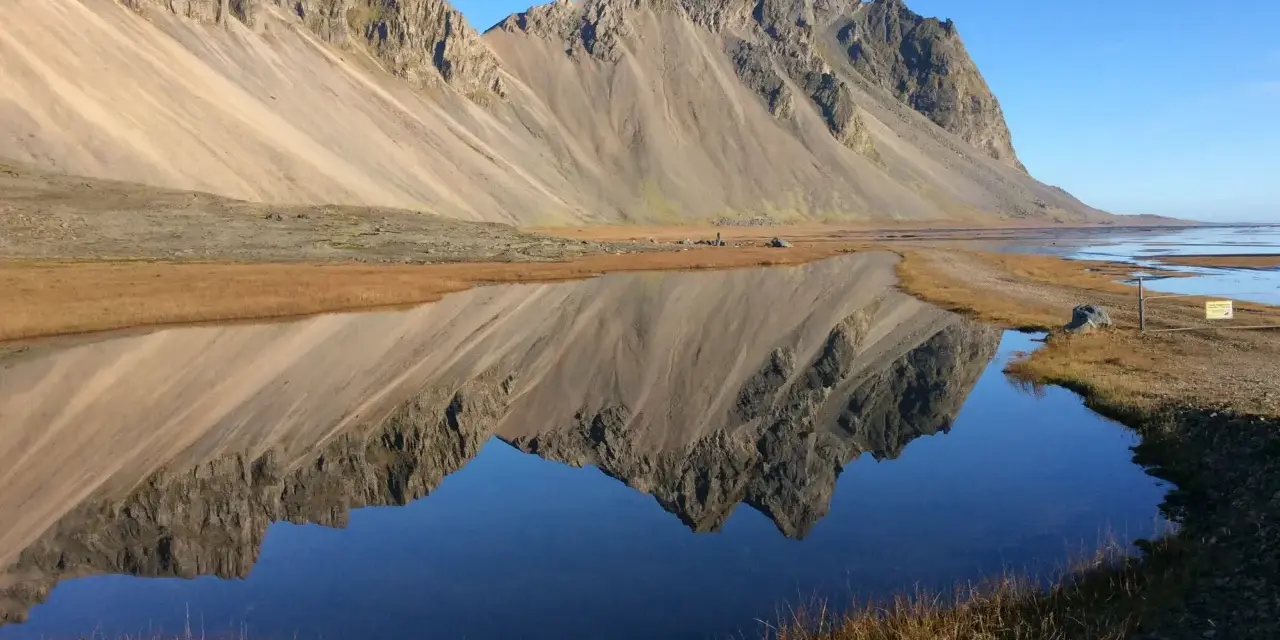
This is spot 2 of 20 in our Iceland Photography Guide, and it is our team’s vote for the single best photo location in the country. Vestrahorn — the 454-metre horned massif that drops into the sea at Stokksnes on the southeast coast — gives a photographer more usable compositions per hour than anywhere else in Iceland: a mirror-flat tidal lagoon, rolling black dunes, a black beach with the Atlantic on your right, and a second horn (Eystrahorn) standing guard down the shore. We have shot Stokksnes in gray-day flatness, in storm spray, under a full aurora and in three centimetres of still water at 05:00, and the mountain has never once sent us home empty.
Unlike almost every other stop on this list, Vestrahorn is private land with a paid entrance and a fixed set of access rules — which is exactly why it stays this good. This guide covers the café parking system, the tide logic that decides whether you get the mirror, the dune-and-beach compositions, the wind discipline, and how to pair it with the Jökulsárlón triangle that dominates this stretch of the Ring Road.
Key takeaways
- Pay at the café: Stokksnes is private land — parking is paid via the on-site café by the Viking-village film set, and the receipt covers the dunes, the beach and the lagoon.
- The mirror is a tide story: still water pooling on the flats after high tide gives the reflection; a falling tide drains it. Time the visit from the tables, not the clock.
- Three scenes, one gate: the lagoon mirror, the black dunes and the beach all sit within 1.5 km — shoot the mirror at calm, the dunes when wind ripples them, the beach when waves build.
- Gray is fine here: unlike most reflection spots, Vestrahorn works in overcast — the horn’s graphic ridgelines carry a flat sky better than almost any mountain in Iceland.
- Night is the upgrade: clear dark nights put the aurora directly behind the horn; the café allows overnight parking for guests.
Quick answer: pay the modest entrance at the Viking Café, then choose your scene by the tide and the wind. Glass on the flats — go to the lagoon side and shoot low with a polarizer off. Ripples moving on the flats — climb the dunes for the layered black-sand ridgelines with Eystrahorn behind. Waves on the beach — work the waterline with a long lens. Stay until blue hour: this is the rare big-name spot that is actually better after sunset than before it.
Access, parking and the film set
Turn off the Ring Road onto Route 99 toward Höfn’s airport side and the road dead-ends at the Viking Café, the gatehouse for the whole Stokksnes headland. Entry is paid at the café (the master list flags it: “parking is paid via the on-site café by the Viking-village film set”) — you pay per person, keep the receipt, and follow the signed tracks out to the three shooting zones. The fee is small by Icelandic standards and buys you something rare: kept paths, no fencing sprawl, and landowners who genuinely allow night shooting.
Three practical notes from our trips. First, the café building doubles as your weather shelter — between the wind and the rain, Stokksnes sessions are always intermittent, and a coffee half-way through is part of the workflow, not a luxury. Second, the reconstructed Viking-village film set near the gate is a legitimate foreground for wide frames, especially in mist — photograph it from the path edges, not inside the structures. Third, the gravel spur is short but washboarded; anything low-slung should roll it slowly.
Winter access is the same system with shorter café hours, so buy the ticket before dusk if you plan to stay for aurora — the gate barrier and the honour-box system handle the late exits, but your receipt is what makes that legal.
The light and tide window
The master list gives Stokksnes “mirror-flat mornings and evenings”, and both halves matter. Vestrahorn faces west-southwest across the flats: low sun from the southwest lights the horn’s front face directly at sunset, while sunrise brings the softer, cooler side-light that reveals the mountain’s convoluted eastern ridges. Between the two, blue hour is the showpiece — the horn silhouettes into pastel sky and the remaining pools on the flats pick up the entire gradient. We have repeatedly shot sunrise, left, and regretted it by 21:00.
Tide decides the mirror. On a receding tide the flats drain and dry; the classic still-water reflection appears when water is left pooled and motionless on the flat — most reliably in the hours around and just after high tide in calm weather. Tide tables for Höfn are the tool; wind over 6–7 m/s stirs even shallow pools, so cross-reference the hourly wind on en.vedur.is. If the mirror is off the menu, the dunes and beach take over — that is the advantage of a one-gate, three-scene location.
Gray weather is not a downgrade here the way it is at Kirkjufell: the horn’s dark, serrated profile against an even sky is one of Iceland’s most graphic silhouettes, and flat light is what makes the black-sand ripples read as texture rather than contrast chaos.
Compositions that work
Stokksnes rewards scene-hopping more than any other stop on the list. Three setups cover ninety percent of the portfolio:
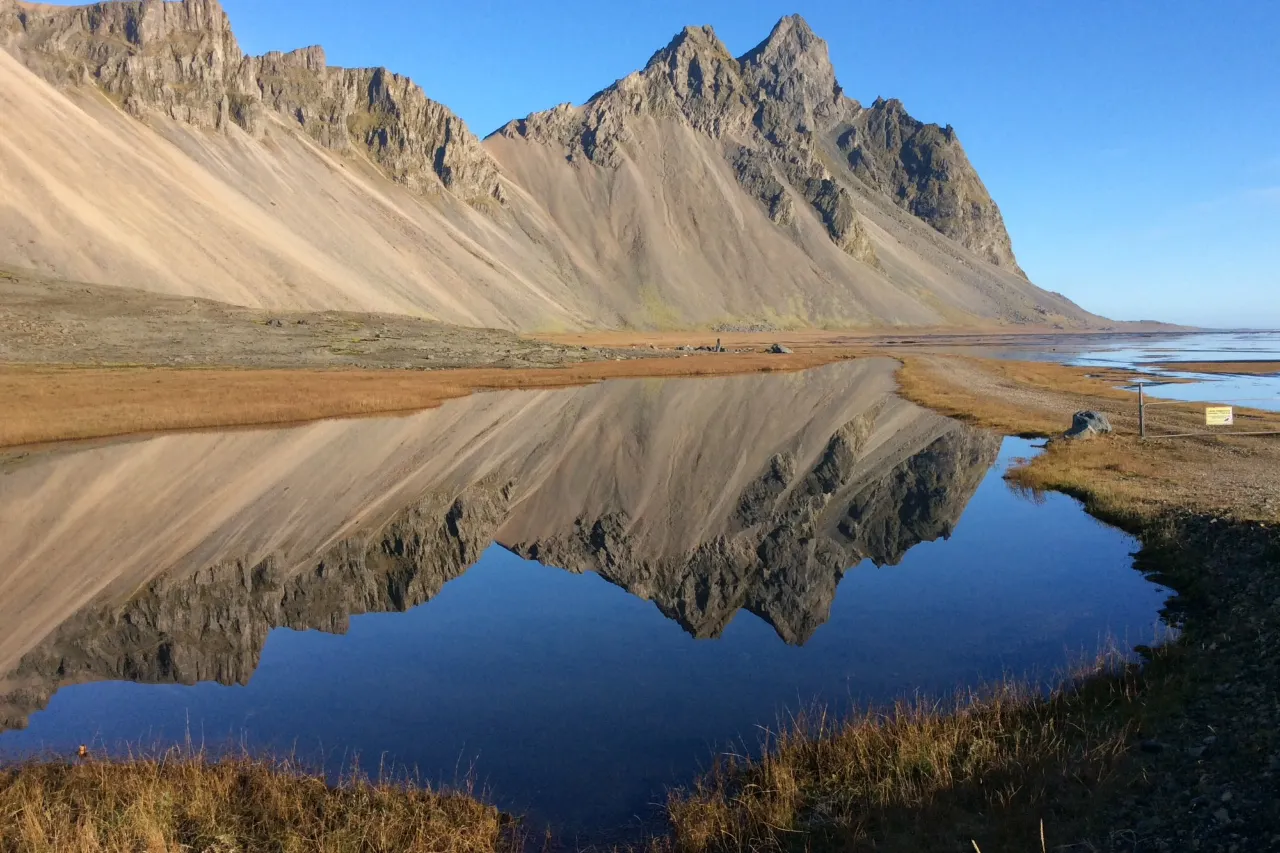
- The mirror: from the lagoon side, find a shallow pool roughly the width of your frame, drop to ankle height, and put the horn’s reflection dead centre. Polarizer off (it kills the reflection), CPL on only for the dune scenes. Vertical frames double the mountain; horizontals double the sky.
- The dunes: follow the boardwalk past the film set to the black dune field, and walk until the ridge lines stack — Vestrahorn behind, Eystrahorn far left across the bay, one dune crest as the leading line. Side-wind days ripple the sand; that moving sand against the dark mass is the shot most people miss.
- The beach waterline: where the dunes end, the Atlantic works the black sand. Long lens, 1/4–1 second on the swash, waves feathering around the horn. Sneaker-wave rules apply here in full — compose from above the Berm line, never from the wet sand.
Include humans sparingly: a single figure on a dune crest or at the lagoon edge gives the horn its scale and has saved more than one of our flat-sky frames. The film-set turf roofs work as foreground in mist — keep them small, keep them to the path side.
Settings and technique
The mirror shot is a polarizer-off, tripod-low, f/8–f/11 exercise: expose for the mountain, bracket or use RAW to hold the sky, and let the reflection carry itself. Water shallow enough to see the sand through still reads as a mirror if you shoot within a few degrees of the water plane — get low or get nothing. On ripple days, a 6-stop ND and 4–10 seconds smooths the pools into a soft mirror illusion; that is the fallback when true glass never arrives.
The dunes want texture discipline: side light or nothing, f/8, shutter fast enough that rippling sand stays crisp (1/125 s+), and a lens cloth on standby — wind-driven sand is an open-lens hazard. The beach frames run long-lens (100–200 mm), shutter-drag (1/4–1 s, ND as needed) on the swash zone. Focus the horn, not the wave; the wave is motion, the horn is the subject.
Aurora nights run the master-list recipe — tripod, manual focus to the horn edge, ISO 1600–3200, 8–15 seconds — with one Stokksnes-specific note: the aurora sits behind the horn to the north, so compose the horn off-centre left or right and let the lights fill the other side. The café permits overnight stays; check the aurora and cloud forecast on en.vedur.is before committing the evening.
Seasons and pairing the day
Stokksnes has no dead season. Summer trades the aurora for midnight-sun side-light that lasts until 01:00 and the greenest dune grasses; autumn brings equinox storms whose clearing skies make the best mirror mornings of the year; winter is the full package — snow-dusted horn, long blue hours, aurora behind the summit; spring is the windiest window but also the emptiest roads. The one constant is the wind: Stokksnes sits in a fetch that funnels southeast gales straight down the flats.
Geographically the stop belongs to the southeast triangle that our master guide calls the highest-yield photography stretch in the country: Vestrahorn, Jökulsárlón Ve Diamond Beach string along one 45-minute section of Ring Road, and Höfn — the lobster town — sits ten minutes east for meals and fuel.Shoot all three in one weather window rather than treating them as separate days; the southeast rarely gives you two good windows in a row.
Safety notes
Stokksnes is gentler than the south-coast beaches but not risk-free: the beach section takes the same Atlantic swells that make Reynisfjara lethal, so treat the waterline with the same discipline — stay above the berm, never turn your back on the sea, and abandon the frame when sets grow. The dune paths are soft and wind-exposed; in gusts over 15 m/s walking the exposed crests is genuinely hard work. The flats themselves are firm, but the lagoon edge softens near the outflow — the same wet-sand logic as any tidal flat, applied without drama.
Frequently asked questions
How much does Stokksnes cost, and is it worth it?
Entry is a small per-person fee paid at the Viking Café (check current pricing at the gate — it changes; our last visits matched the café’s posted rate). For the three shooting scenes, kept paths, night-photography permission and a warm shelter, it is one of the best-value tickets in Iceland. The master guide keeps it at spot 2 for a reason.
Which is better, Vestrahorn or Eystrahorn?
Vestrahorn for the mirror and the dunes — it is the accessible one. Eystrahorn, across the lagoon toward the east, has no café, no paths and a signed private road, but it appears in the background of every good Stokksnes dune frame; photograph it from the Vestrahorn side rather than trying to reach it.
When does the mirror actually work?
Calm wind (under ~6 m/s) plus water left pooled on the flats — most reliably around high tide and just after, which shifts daily. Cross-check the Höfn tide table with the en.vedur.is hourly wind. If both fail, shoot the dunes: same gate, different masterpiece.
Can I stay overnight for the aurora?
Yes — the café allows paid guests to remain after dark, and the aurora sits directly behind Vestrahorn on clear nights (September–March). Run the standard recipe from the master guide: ISO 1600–3200 to start, 8–15 seconds, manual focus, tripod anchored against the same wind you shot the dunes in.
The full field list lives in one place
Spot 2 of 20 — the master guide ranks all twenty locations by region, best light and a field tip for each.
Go deeper: the Jökulsárlón complete guide covers the lagoon’s boats and ice logistics, the wind planning guide explains the forecast habits this coast demands, and the Ring Road guide sequences the southeast triangle into one workable day.
Sources & official references
- Access and paid entry via the on-site café (Viking Café, Stokksnes) — confirmed on editorial trips 2022–2026; verify current hours and pricing on site.
- Tides and weather: Icelandic Meteorological Office forecasts (en.vedur.is) and coastal tide tables for Höfn.
- Sneaker-wave guidance per safetravel.is and site signage on the beach section.
- Master list context: Iceland Photography Guide — 20 Best Photo Spots (this site).
