








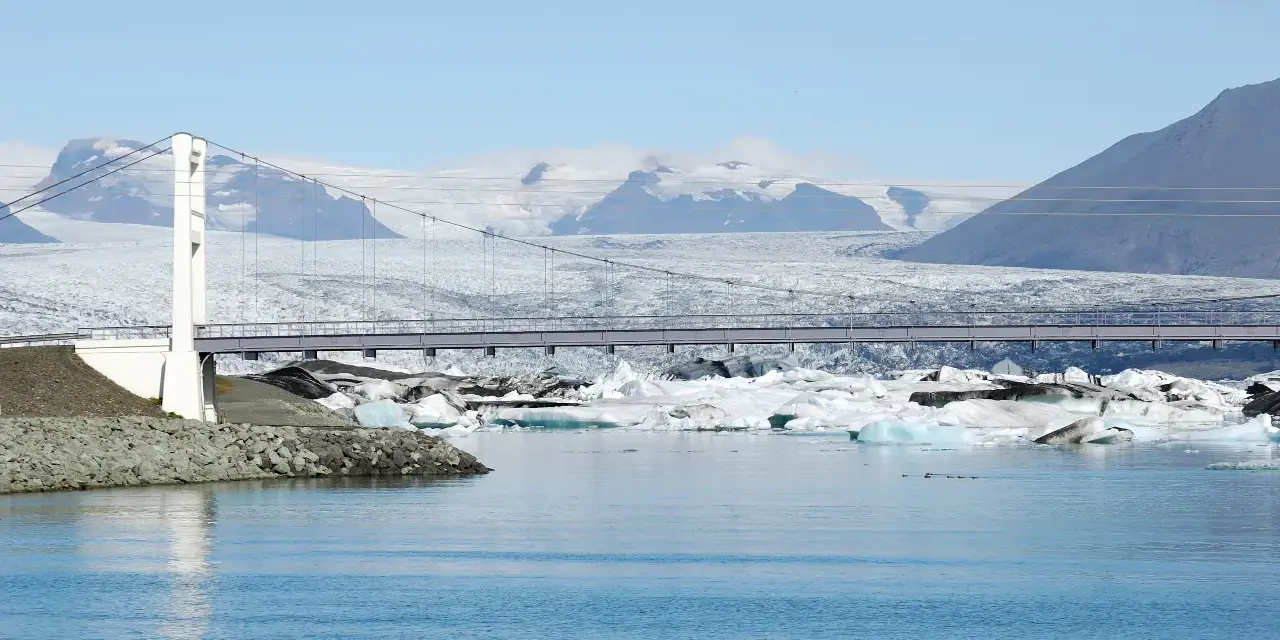
This is spot 3 of 20 in our Iceland Photography Guide — the iceberg factory. Jökulsárlón, where Breiðamerkurjökull calves blue bergs into a tidal lagoon that drifts them out to sea, is the most versatile location on our list: it photographs at any hour (the master guide’s own field tip), in any weather, from four or five distinct vantage points within ten minutes of the same car park. Seals surf the ice, the glacier fills the background, the Ring Road bridge gives the widest frame, and the whole scene reorganises itself every single hour as the bergs drift. Our team rates it the location we never tire of — twenty trips in, we still shoot it for an hour every time we pass.
The lagoon rewards walkers: both shores tell a different story, and the crowd thins the moment you leave the bridge. This guide covers the vantage points and their light, the boat-tour question, the settings that separate a snapshot from a portfolio frame, and how Jökulsárlón chains with Diamond Beach — its output door, twenty minutes of the same tide.
Principais conclusões
- Walk both shores: the bridge gives the widest frame; the east shore puts the glacier directly behind the bergs; the west shore gets the golden-hour side-light.
- Any hour works: drifting ice reorganises the frame continuously — this is the one big-name spot where midday is not a disadvantage.
- The bergs are the subjects, the glacier is the backdrop: shoot individual icebergs with compression (100–200 mm) rather than only wide postcards.
- Boats change the angle: amphibian and zodiac tours (seasonal) put you at berg level — the only way to photograph the ice up close.
- Pairs with Diamond Beach: the same bergs exit to the sea 300 metres away — plan the tide to shoot both in one visit.
Resposta rápida: park at the main Jökulsárlón lot, cross to the bridge for the wide classic first, then walk the east shore toward the glacier for the ice-wall frames, finishing on the west shore if the sun is dropping. Give the lagoon ninety minutes, then carry the same ticket of time across the road to Diamond Beach when the tide is low enough to strand ice on the sand.
Getting there and the vantage points
Jökulsárlón sits directly on the Ring Road, 380 kilometres east of Reykjavík — the drive eats a full morning, which is why the master guide recommends anchoring a night in Höfn or Kirkjubæjarklaustur around it. The main car park (café, toilets, boat operators) serves everything; from there the shooting is divided into four vantage points, and the master guide’s tip names the first: walk both shores; the bridge gives the widest frame.
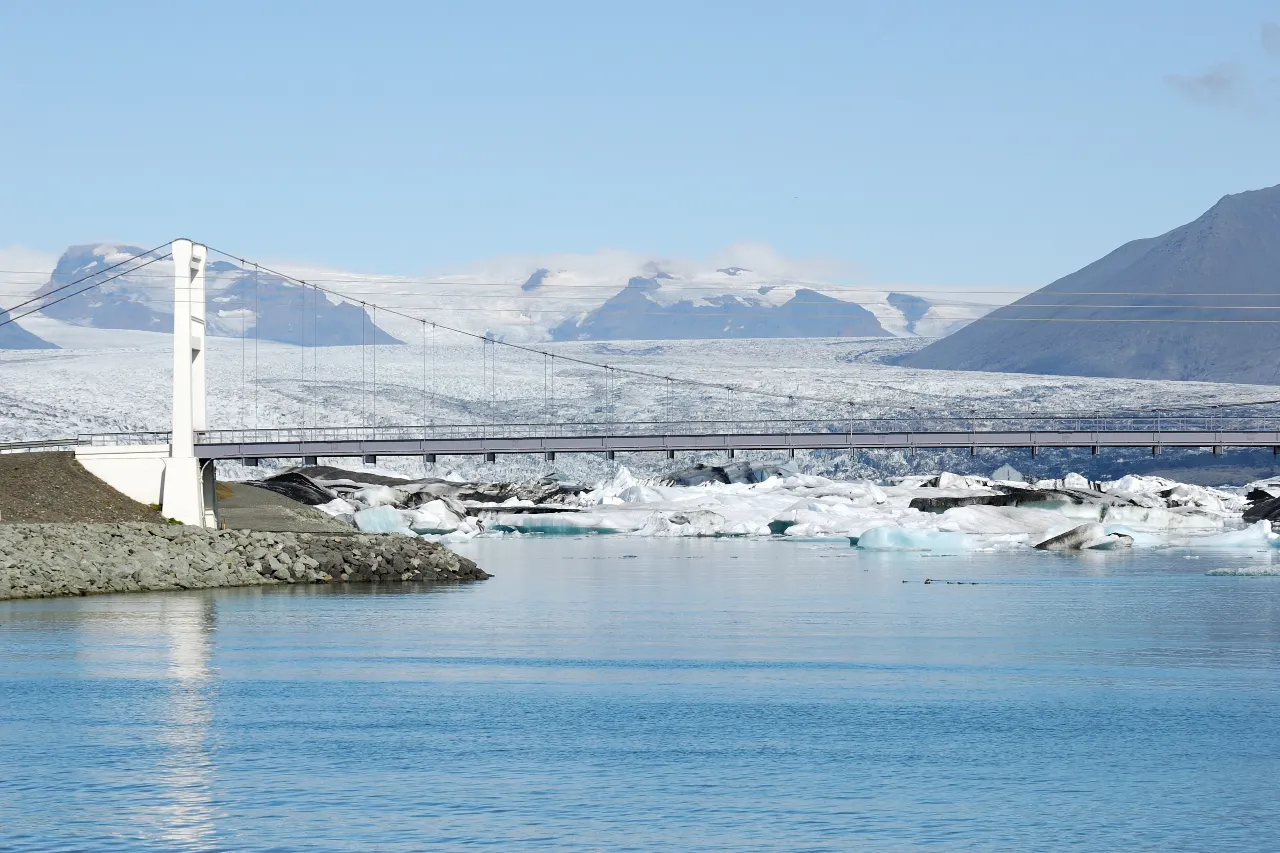
The bridge itself photographs the whole lagoon floor: ice fields in the foreground, the glacier wall kilometres back, the river mouth threading the bergs seaward. Tripods stack up here at sunset — arrive early or shoot it at dawn. The east shore track (five minutes from the lot) brings the bergs against the glacier’s calving front, the most three-dimensional angle. The west shore is the quieter bank: lower, grassier, with the lagoon’s shallows full of grounded bergs that photograph beautifully at golden hour with warm side-light. And the beach/river mouth at the seaward end is technically Diamond Beach territory — but the two are one continuous subject at the same tide.
Paths are informal and can be muddy after rain; waterproof boots are part of the kit here, not an option. Drone flying follows the national rules summarised in the master guide — and note that the lagoon sits inside Vatnajökull National Park, where permissions are stricter than the baseline.
Light and the “any hour” rule
The master list gives Jökulsárlón “any hour — the ice never stops drifting”, and that is the operational truth of the place. Bergs calve, ground, flip and drift out with the tide continuously, so the composition you liked at 09:00 is gone by 11:00 — and something better has arrived. The lagoon faces roughly south; the sun sweeps behind the glacier wall at midday, side-lights the ice all afternoon and sets behind the west bank. Golden hour turns grounded bergs into warm sculptural objects; blue hour and night open the long-exposure-and-stars game.
Weather beats clock, but gray has a specific gift here: overcast makes the deep-blue subsurface of the ice glow saturated, while harsh sun flattens exactly that colour. The best single session we have had at Jökulsárlón was a featureless white afternoon. Storm light is the other prize — clearing bands of sun across the glacier wall with icebergs dark in front. Watch the hourly window on en.vedur.is and be willing to wait in the café; the lagoon pays patience back more reliably than any other stop on the list.
Compositions that work
The lagoon is one of the few Icelandic locations where long-lens work beats wide-angle half the time. The frames that consistently earn their keep:
- The bridge wide: 16–35 mm from the bridge or its footings, ice foreground to glacier background, the river channel as the leading line. Vertical stacks help when the sky is dramatic.
- The compression portrait: 100–200 mm on a single grounded berg against the glacier wall — layers of ice at different distances compress into a single blue palette. This is the shot that separates lagoon photographers from lagoon tourists.
- The mirror fragments: in calm minutes, sheltered coves on both shores mirror their bergs; polarizer off, get low, work fast — the window is minutes, not hours.
- The wildlife bonus: seals haul out on the ice and swim the channels; a 200 mm lens with patience turns the landscape stop into a wildlife session. Give them distance and never bait or call.
- The dark-and-stars frame: on clear winter nights, bergs silhouette under the Milky Way or aurora — long exposures from the shore tracks, headlamp on red mode.
Scale is the perennial failure mode: lone tourists include no human reference and the bergs read as pebbles. Either include a real person on the shore track (with consent) or compose so the glacier wall dominates the background — scale by context, not by novelty.
Settings and technique
Exposure for ice is an exposure-for-white problem: bergs are brighter than the meter thinks, so dial +0.7 to +1.3 EV compensation in daylight and check the histogram — blown berg tops are unrecoverable. In flat gray light, meter clean and let the blue glow carry the frame. f/8–f/11 holds depth from foreground ice to glacier; focus roughly a third into the frame or focus-stack the wide shots.
The water is nearly always moving, and that is a choice point: 1/30–1/125 s keeps berg reflections painterly-blurred; 10–30 seconds with a 6-stop ND flattens the lagoon into fog-glass and isolates the ice as fixed objects. Both are legitimate — pick per frame. Long lens compression (135–200 mm) wants faster shutter discipline (1/500 s+) unless the tripod is anchored; the shoreline wind at Jökulsárlón is constant enough to wreck handheld long shots.
Winter nights run the aurora recipe from the master guide (ISO 1600–3200, 8–15 s, manual focus) with one lagoon-specific addition: bergs drift, so a 15-second exposure smears their reflections — drop shutter or embrace it deliberately. Cold drains batteries twice as fast over open water; rotate spares through an inside pocket.
The boat-tour question
Two operators run seasonal boat trips on the lagoon — amphibian vehicles on a fixed circuit and fast zodiacs that reach the calving front. For photographers the zodiac is the real tool: you photograph from the ice’s level, bergs tower around the boat, and seals surface at arm’s length. Trips run in the main season (roughly May–October; check operators directly) and the zodiac requires the provided flotation suit — dress thin layers under it, gloves with grip for the camera.
Honest advice: the boat is worth it once, not every visit. The shore frames remain the most repeatable, and the tour angle is weather-dependent (wind cancellations are routine). If your itinerary allows one tour across the whole southeast, our team would spend it here rather than on the glacier hikes — the berg-level perspective cannot be bought any other way.
Seasons and pairing the day
Every season photographs here, which is rare. Summer brings the boats, the seals, the midnight-sun soft light — and the crowds; dawn and late evening own the lagoon. Autumn layers the first storms and clear aurora nights over empty shores. Winter freezes the edges, silences the tours, and adds ice caves and blue-hour pastels within an hour’s drive. Spring is the shortest window and the muddiest, but the berg density stays high all year.
Pair the lagoon with its own outflow: Diamond Beach is the same ice, delivered to the surf 300 metres south — our standard plan is lagoon first (any light), beach second at low tide. The complete Jökulsárlón guide covers the tours, the café and the seasonal detail in depth, and the Ring Road guide shows how the whole southeast triangle fits one or two working days.
Frequently asked questions
Do I need a drone for the lagoon?
No — the bridge, shores and long-lens compression cover every essential frame. If you fly, the national baseline applies (120 m altitude, line of sight) and the lagoon sits inside Vatnajökull National Park, where permits and local restrictions come first. The master guide’s gear section covers the rules; assume no-fly until you have checked signage.
Are the boat tours worth the cost?
Once, yes — the zodiac’s berg-level perspective is the only way to photograph the ice up close, and the flotation suits make it comfortable in any weather. Book early in the day (wind cancels afternoon trips more often), and treat it as a bonus session on top of the shore work, not a replacement for it.
Can you walk right up to the icebergs?
On the shore tracks, yes, to grounded bergs on the banks — but never climb them: bergs roll without warning and the water is lethal within minutes. The safe distance rule from the master guide applies everywhere on this coast: the camera is never worth the waterline.
How much time should I budget?
Ninety minutes on the lagoon plus forty-five on the beach is our standard stop. If the weather is turning dramatic, double it — the lagoon is the single most weather-responsive location on the master list, and the photographers who leave early are the ones whose galleries fill up at the café’s postcard rack instead.
The full field list lives in one place
Spot 3 of 20 — the master guide ranks all twenty locations by region, best light and a field tip for each.
Go deeper: the Jökulsárlón complete guide, the ice-and-glacier context in Glaciers and Ice Caves, and the south-coast sequencing in the Ring Road guide.
Sources & official references
- Lagoon depth and formation history: published surveys of Breiðamerkursandur and Vatnajökull National Park materials (checked 2026).
- Boat tours and seasonal schedules: on-site operators at Jökulsárlón; verify directly per visit.
- National-park and drone rules: Vatnajökull National Park regulations and the national aviation baseline summarised in the master guide.
- Weather windows: en.vedur.is hourly forecasts for the southeast.
- Editorial photography trips across seasons 2022–2026 by the Iceland Travel Guides team.
