









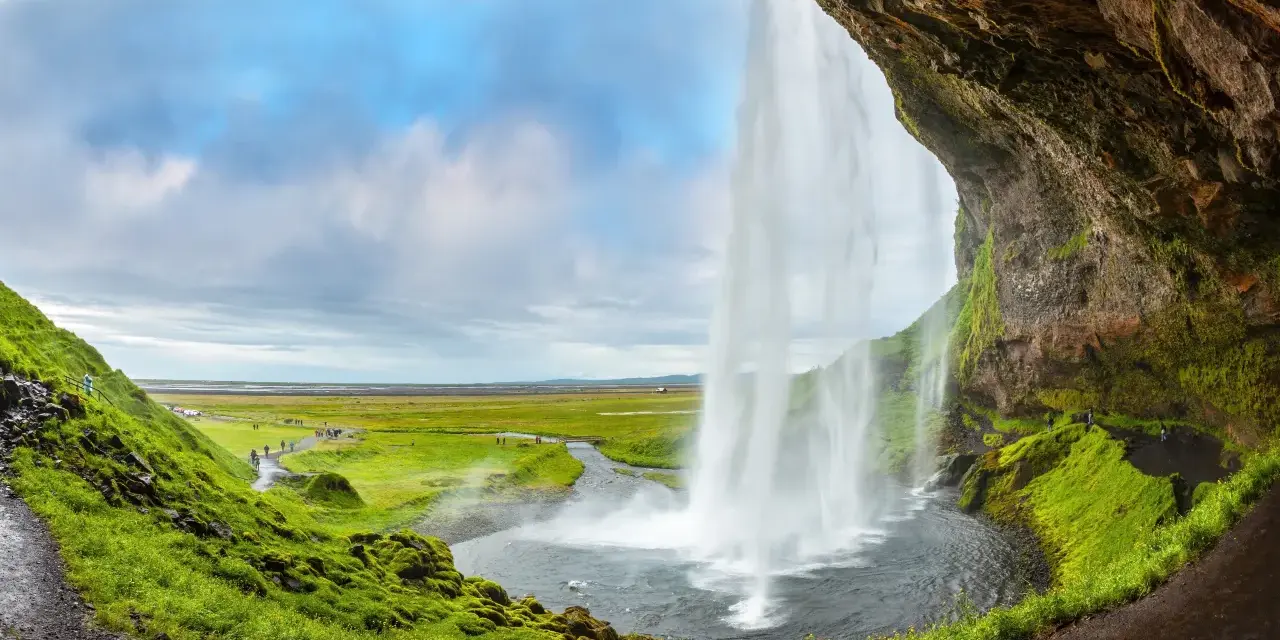
This is spot 6 of 20 in our Iceland Photography Guide — the waterfall you can stand behind. Seljalandsfoss drops a 60-metre ribbon off the old sea cliffs of the south coast, and its walk-behind trail is the single most famous camera position in Iceland: waterfall in front, curtain of falling water around you, light coming through the opening. The master guide’s field tip sets the tone — “waterproof jacket and lens cloth are mandatory, not optional” — because the position that makes the shot also soaks everything you own. Our team has shot the walk-behind in golden hour, in storm wind and at 03:00 in summer light, and the frame never stops being worth the spray.
Seljalandsfoss is also the gateway stop of the south coast: 120 kilometres from Reykjavík, on the Ring Road, with a second waterfall (Gljúfrabúi) hiding in a slot canyon 550 metres north that most visitors miss entirely. This guide covers the access and fee reality, the golden-hour geometry, the walk-behind technique that keeps gear alive, the Gljúfrabúi bonus, and how the stop chains with Skógafoss twenty minutes east.
Key takeaways
- Golden hour is the window: low light through the fall’s opening is what the walk-behind frame is for; midday gives white chaos and rainbows at best.
- Waterproof everything: jacket, trousers, lens cloth in a chest pocket, camera rain cover — the master guide’s “mandatory, not optional” is literal.
- The paid lot is shared: Seljalandsfoss and Gljúfrabúi share one car park and one small fee — plan a two-waterfall session on one ticket.
- Gljúfrabúi is the deeper shot: the hidden fall inside the slot canyon needs wading and nerve — and rewards with the most unique waterfall frame on the south coast.
- Shoot it both ways: front frames from the meadow (long exposure, spray-lit) and the behind-position (fast shutter, light through the curtain) are two different genres — bring lenses for both.
Quick answer: pay the small parking fee, shoot the front meadow first (long exposure, tripod, polarizer), then wait for low sun and do the walk-behind at 1/60–1/250 s, f/4–f/5.6, jacket on, cloth ready. Finish at Gljúfrabúi — rubber boots or barefoot-wet-shoes, phone torch for the canyon, and the widest lens you carry. Total session: ninety minutes, two waterfalls, one dry bag.
Access, fees and the shared lot
Seljalandsfoss sits right off the Ring Road, about two hours east of Reykjavík — the kind of stop that works on day one of any itinerary. The private lot charges a modest fee (pay by card at the barrier), shared with Gljúfrabúi to the north; the café and toilets operate seasonally. Paths are flat gravel: the front meadow is step-free, and the walk-behind trail is a narrow, wet, uneven ledge that closes when ice builds — check the site status in winter before promising anyone the behind shot.
The lot empties with the coaches mid-afternoon and refills at sunset in summer. Dawn sessions are quiet and give you both falls with nobody in frame; the walk-behind at 05:00 with nobody else on the ledge is one of the south coast’s genuine privileges. Winter turns the ledge into an ice rink periodically — the closure is enforced for good reason, so treat any open-with-ice day as a front-side-only day.
One gear-flow note: leave the tripod in the car for the behind-position, take it for the meadow. The ledge is too narrow for three legs and a photographer facing the wrong way when a gust pushes the curtain out.
The golden-hour geometry
The master list gives Seljalandsfoss golden hour, and the reason is physical: the fall drops off a south-facing cliff in an open concave cove, so low western sun enters the cove, backlights the curtain and throws rainbows through the mist — from behind the fall, you shoot into that lit water and the whole frame glows. In summer the low light lingers for hours either side of “night”; in winter the sun’s arc stays so low that midday itself becomes the golden hour, and the behind-position closes if ice forms.
Front-side light is the opposite story: the meadow faces the fall’s north flank, so morning side-light and evening backlight both work, but the strongest front frames come at gray light — the 60-metre ribbon over dark moss reads cleanest with even sky. Rainbows form on bright afternoons in the cove mist; they are the midday compensation prize.
Wind is the variable that changes the plan: gusts push the curtain outward, closing the ledge and drenching the meadow. The hourly forecast on en.vedur.is settles whether tonight is a walk-behind night or a polarizer-and-retreat night.
Compositions that work
Seljalandsfoss supports three distinct frames, and the best sessions shoot all three:
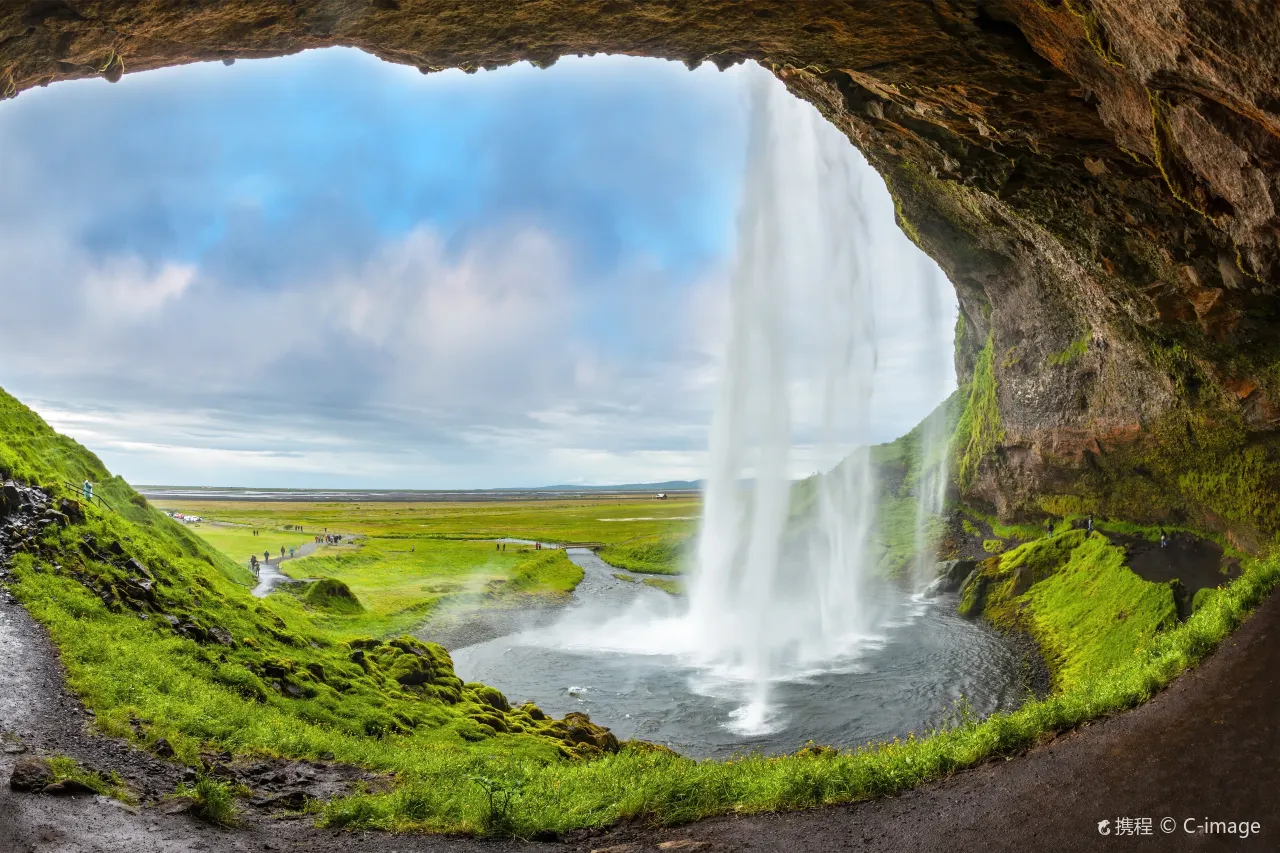
- The walk-behind curtain: from the ledge, 16–35 mm, the fall’s opening as the frame — water arc left and right, cove and valley beyond, backlight through the curtain at golden hour. Fast shutter (1/60–1/250 s) keeps the arc crisp; this is the shot, and the only one of its kind on the master list.
- The meadow classic: from the front gravel bank, 24–70 mm at 0.5–2 seconds — the full ribbon over moss, spray drifting, autumn grass or summer lupines as foreground. The polarizer greens the moss and cuts wet-rock glare.
- The rainbow slot: bright afternoons put a rainbow in the cove mist; 70–200 mm isolates the band behind the curtain’s base. Fast shutter, spot-meter on the fall.
People management is part of composition here: the ledge is single-file, and a red-jacketed tourist mid-frame is either a disaster or a scale gift depending on timing. Patience windows of ten minutes usually clear any frame; the behind-position at off-hours is effectively private.
Settings and the walk-behind technique
Behind the fall, the technique is anti-long-exposure: 1/60–1/250 s, f/4–f/5.6, auto-ISO capped at 1600, hand-held (or braced against the rock) because the ledge is narrow and the light is dim. Focus manually before entering — set to the far bank through the opening, tape or note the ring. Shoot bursts; the curtain flickers and one frame in five is clean. Keep the lens hood on and the cloth at chest level; wipe vertically before every burst, not after the shot looks soft.
The meadow session runs classic waterfall discipline: tripod, 0.5–2 seconds, f/8–f/11, polarizer rotated to taste, ISO 64–100. Spray is constant — rain cover between frames, microfiber over the front element between bursts. Exposure metering on the water with +0.3 to +0.7 EV keeps the ribbon white without clipping the moss.
Winter adds the frozen variant: ice stalactites fringing the fall, lower flow, quieter lot. The behind-position may close — front frames with the ice fringe are the seasonal prize, shot at gray light for the blue-white palette.
Gljúfrabúi — the hidden bonus
Five hundred and fifty metres north of the main lot, Gljúfrabúi pours out of a vertical slot canyon, hidden behind a rock nose — you enter the slot through a knee-deep stream wade between boulders, and the fall opens up filling the entire frame of rock above you. It is the most dramatic single frame on the south coast and the one most visitors skip because of the wade. Waterproof boots make it trivial in summer; in winter the canyon is icy and the entry can be closed.
Shoot it at 16–24 mm from inside the slot: the fall as a vertical column between canyon walls, sky reduced to a slit, the stream in the foreground. Long exposure (2–8 seconds) silks the fall; the light inside is dim — tripod and ISO discipline required. The return wade soaks you again, which is why the guide’s packing rule exists: everything here is “mandatory, not optional.”
Seasons and pairing the day
Summer gives the walk-behind at its easiest (no ice, warm wading), lupine foregrounds and the midnight-sun golden hours that never end; winter gives the ice-fringe palette and the shortest ledges; autumn gives the strongest flow after rains and the emptiest lot; spring gives the maximum-water ribbon and the muddiest meadow. The fall flows year-round — there is no dead season, only different gear.
The chain is the point: Skógafoss sits twenty minutes east and pairs perfectly in one afternoon; Reykjadalur’s hot river is a short detour north for a soak session after; and Sólheimasandur’s plane wreck splits the two falls for the photographers who want the full south-coast portfolio day. The complete Seljalandsfoss guide covers the falls’ own history and logistics in depth.
Frequently asked questions
Can you really walk behind Seljalandsfoss?
Yes — a narrow ledge loops behind the 60-metre curtain when it is open (it closes when ice makes the ledge dangerous). You will be soaked to some degree every time; the master guide’s packing rule is the whole answer: waterproofs on, cloth ready, spare battery warm.
What settings survive the spray?
Fast shutter behind the fall (1/60–1/250 s, manual focus pre-set), long exposure in the meadow (0.5–2 s on the tripod). Rain cover between frames, hood on, cloth vertical wipes before bursts. The gear that dies here dies from repeated wet-dry cycles, not from one soaking — keep it wet or keep it covered, never half-way.
Is Gljúfrabúi included in the parking fee?
Yes — one lot, one fee, both falls. The slot entry needs the stream wade; waterproof footwear is the difference between a fun ten minutes and a cold hour. Bring a headlamp in shoulder season; the slot is dark even at noon.
Seljalandsfoss or Skógafoss for a one-hour stop?
Seljalandsfoss for the unique position (nothing else in Iceland has the walk-behind), Skógafoss for the force and the staircase game. They are twenty minutes apart — the correct answer for most photographers is both, meadow-to-meadow, in one afternoon.
The full field list lives in one place
Spot 6 of 20 — the master guide ranks all twenty locations by region, best light and a field tip for each.
Go deeper: the complete Seljalandsfoss guide, the top-10 waterfalls roundup that ranks the south coast’s falls, and the safety guide for the ledge-and-ice rules in winter.
Sources & official references
- Access, parking fee and winter ledge closures: Seljalandsfoss visitor area signage and site status (checked 2026).
- Weather and wind windows: en.vedur.is hourly forecasts for the south coast.
- Waterfall dimensions per published survey figures (60 m drop, Gljúfrabúi slot access).
- Field technique: editorial photography trips across seasons 2022–2026 by the Iceland Travel Guides team.
- Master list context: Iceland Photography Guide — 20 Best Photo Spots (this site).
