Nobody lands in Keflavík needing Icelandic. English is spoken fluently by nearly everyone you will meet — airport desks, petrol stations, hiking guides, hotel receptions, the farmer mending a fence who waves as you pass — and you could cross the entire country on English alone. But something shifts when you open with a word or two of the local language. Our team has watched café counter conversations warm instantly after a slightly mangled takk fyrir, and we have seen rural guesthouse hosts extend a ten-minute chat into an hour because a visitor tried góðan daginn first. The effort costs you nothing; the goodwill it buys is real.
It helps that Icelandic is a genuinely fascinating language to touch, even at tourist depth. It is a North Germanic tongue that has changed remarkably little in roughly 1,000 years — trained readers can still work through the medieval sagas in the original — and it is spoken today by approximately 380,000 people, nearly all of them on one small island in the North Atlantic. That isolation plus pride produced a language where the past and present sit side by side in every sentence.
This guide is the practical version of that story: the handful of phrases that actually earn smiles, the pronunciation rules that decode almost every sign you will pass, the menu and road-trip vocabulary that makes daily logistics smoother, and the meanings hidden inside place names — because once you know that Vík simply means “bay”, the map stops being a wall of consonants.
Key takeaways
- You do not need Icelandic: English fluency is nearly universal, and every official service — road notices, safety briefings, museum signage — is available in English.
- But attempts are disproportionately rewarded: locals love the effort; a já, nei or takk fyrir opens conversations that English alone does not.
- Two letters do most of the heavy lifting: þ (a hard “th” as in “thorn”) and ð (a soft “th” as in “this”) appear everywhere; master both sounds and half the map becomes readable.
- Place names are mini-lessons: Reykjavik is “Smoky Bay”, Húsavík is “house bay”, Jökulsárlón is “glacier river lagoon” — geography written in plain words.
- Menu literacy pays daily: knowing kjötsúpa, pylsa, skyr and brauð makes every roadside stop faster, cheaper and more fun.
Quick answer: learn five words — góðan daginn (hello), takk fyrir (thanks), já (yes), nei (no) and bless (hi and bye) — and add ég skil ekki (I don’t understand) as your escape hatch. That starter kit covers every interaction a visitor realistically has. Everything else in this guide is garnish, useful and enjoyable but strictly optional; nobody expects fluency from a tourist, and nobody will judge you for the pronunciation.
Why learn any Icelandic at all
The honest answer is: convenience says don’t bother, connection says do. On pure logistics, English carries you everywhere — Icelanders consistently rank among the most fluent non-native English speakers in the world, and the tourism sector runs on it. But language here is tied up with identity in a way visitors quickly sense. This is a nation that kept a medieval literary tradition alive on isolated farms through centuries of hardship, and the language is the container for that tradition. Icelandic is not a relic; it is spoken in classrooms, boardrooms and petrol stations every day.
That is why attempts land so well. A visitor who opens with góðan daginn is signaling something the locals rarely hear: that the language itself is seen. The typical response is warm — often delight, almost always a smooth switch to flawless English the moment your five-word stock runs out. Icelanders switch to English quickly, and it is not rudeness; it is efficiency, the same instinct that makes them give you exact driving times rather than vague directions.
The practical payoff is smaller but real: reading road signs and menus gets faster, announcements become half-decipherable, and you stop mispronouncing the places you are staying in — which matters more than you would think when asking for directions in small towns.
From real trips: the biggest return we have seen comes from the smallest effort — saying bless when leaving a guesthouse instead of nothing at all. It is the word that most often turns a transactional goodbye into a conversation about the weather, the road ahead and where the puffins actually are.
The phrases that open doors
These nine cover virtually every social situation a traveler meets. Do not worry about grammar — Icelanders forgive everything and appreciate the attempt.
| Phrase | It means | Use it when |
|---|---|---|
| Já | Yes | Any confirmation — tours, tables, extra bread |
| Nei | No | Polite declines; pairs with a smile |
| Takk fyrir | Thank you | The end of every interaction — checkouts, directions, doors held |
| Góðan daginn | Good day / hello | Entering shops, cafés and guesthouses |
| Bless | Hi and bye | The casual all-purpose greeting — it works in both directions |
| Glaður að hitta þig | Nice to meet you | Introductions, especially in smaller towns and family businesses |
| Ég skil ekki | I don’t understand | When conversation outruns your vocabulary — always answered in English |
| Getur þú hjálpað mér? | Can you help me? | Flat tires, confusing parking meters, tour bookings, lost hikers |
| Varlega | Careful | What you will hear from guides and locals on icy steps and slippery trails |
Two usage notes from experience. First, bless genuinely does double duty as both hello and goodbye — you will hear it exchanged rapidly and warmly at the end of phone calls, and there is no trap in using it for either. Second, varlega is worth knowing by ear, not just by mouth: guides, bus drivers and locals use it constantly on ice, gravel and clifftop paths, and recognizing it as “careful” rather than an instruction to leave is useful.
For bookings and logistics, the question getur þú hjálpað mér? is the workhorse. Follow it with plain English (“…with booking the whale-watching tour tomorrow?”) and you have a polite, human opening to any request. The person will switch to English mid-sentence and help with more effort than a cold English opener usually gets.
Pronunciation: þ, ð and one famous glacier
Icelandic orthography looks hostile but follows a handful of consistent rules. The letter þ (thorn) is a hard “th”, the first sound in “thorn” — so Þingvellir is “THING-vet-lir”. The letter ð (eth) is the soft “th” of “this”, a breathy middle-of-word sound in names like Reykjavik (roughly “RAY-kya-vik”). Neither letter has any secret complexity: they are simply the two “th” sounds English never gave separate letters.
Three more rules decode most of the map. The double ll collapses into a single breathy “tl” sound, so fjall (mountain) ends like the “tl” in “little” said sharply. The combination jó sounds like “yo”, which is why Jökulsárlón begins with a “y” feel and why jól (Christmas) sounds like “yohl”. And stress almost always falls on the first syllable, which lets you chunk any long word into a rhythm instead of a stutter.
Then there is the boss level: Eyjafjallajökull, the volcano whose 2010 ash cloud grounded European aviation and taught the world one Icelandic word. A playful approximation is “AY-ya-fyat-la-yer-kutl”. Break it into Eyja-fjalla-jökull — “islands-mountain-glacier” — and say it with confidence rather than precision. Locals will correct you smilingly, and the correction is part of the fun. The same decomposing trick works everywhere: long Icelandic names are just short meaningful pieces stuck together, and once you hear the pieces, the language stops sounding like a dare.
Worth knowing: nobody expects a visitor to nail pronunciation, and the attempt itself is the social point. Aim for rhythm and the two “th” sounds; accuracy of vowels is a bonus. The one thing to avoid is skipping the attempt entirely and anglicizing place names loudly — “Vik” as in “Vik-ings” lands very differently from Vík.
Reading the menu: food words
Icelandic menus usually list dish names in Icelandic with English descriptions underneath, so nothing is ever actually hidden from you. But knowing four everyday words changes the experience from reading to recognizing. Kjötsúpa is lamb soup — the national comfort bowl, hearty with root vegetables. Pylsa is the hot dog, and its plural pylsur is behind the country’s most famous cheap meal. Skyr is the thick cultured dairy that predates modern yogurt fashion by a millennium — it is the breakfast of locals and the cheapest protein on the island. Brauð is bread, most memorably the dark, dense, faintly sweet rye bread that often arrives warm with butter.
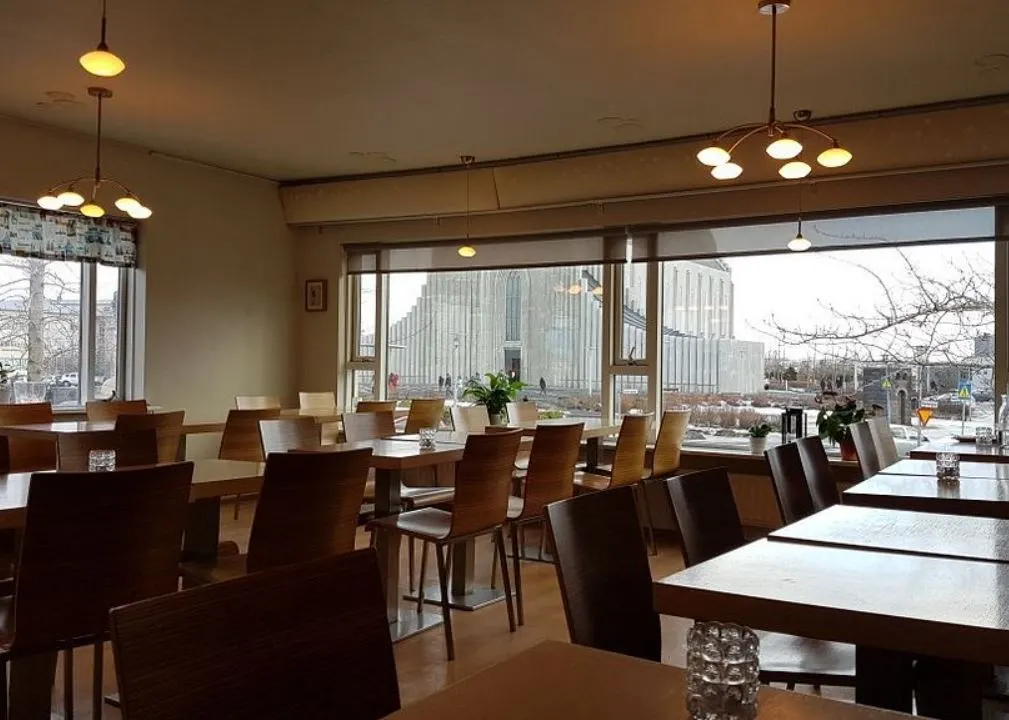
With those four words you can walk into nearly any roadside café and order confidently. When you want to go deeper — fermented shark, smoked lamb, langoustine — our Icelandic food & drink guide covers the full menu, dish by dish, with the honest verdict on which specialties are worth your krónas.
Road-trip words
A scatter of vocabulary makes road days smoother. Vegur means road, and it is the final element of almost every named street and highway in the country — once you spot the pattern, every sign becomes two chunks: a descriptive first word plus -vegur. Opin means open and lokað means closed; you will find them on road-status boards, car-park signs and trail notices, and during winter storms they are the two words that matter most in the country.
That last point deserves emphasis in any language: Icelandic road conditions change fast, and the words on a sign can lag the actual conditions. The authoritative sources are the official services — check road.is for road status and en.vedur.is for weather before and during every driving day. Both are in English, and both are the difference between a detour and a stranded afternoon. Our Ring Road driving guide covers the routines we use on every winter drive.
What the place names mean
Icelandic place names are descriptions, not labels, and the translations are often charmingly literal. Reykjavik means “Smoky Bay” — the steam rising from geothermal springs that struck the first settlers. Húsavík means “house bay”, a reminder that one good farm building once anchored an entire region. Vík is simply “bay”, the smallest possible name for the southern town beneath the cliffs. And Jökulsárlón is “glacier river lagoon” — jökull the glacier, sá/á the river, lón the lagoon — which is exactly what the place looks like. You can read the full picture in our Jökulsárlón guide.
Learn four or five of these root words — vík (bay), fjall (mountain), jökull (glacier), á (river), dalur (valley) — and the map turns from noise into narrative. A drive through fjalls and dalurs to a vík reads like a sentence, which is precisely what it is: the landscape named by the people who first had to navigate it, in words that have held their meaning for a thousand years.
Numbers and the politeness of trying
You will almost never need to count in Icelandic — card terminals, English menus and English staff handle the arithmetic — but the first five are satisfyingly learnable: einn, tveir, þrír, fjórir, fimm (one, two, three, four, five). They cover the small counter moments — how many of something, which campsite number, how many tickets — and they make phone numbers and parking spots feel less foreign.
Beyond vocabulary, the real lesson is one of proportion. Icelandic is spoken daily by roughly 380,000 people, which means every new word you learn represents a meaningful share of its living speakers. That rarity is exactly why the effort registers. Staff will switch to English instantly, prices will stay the same, and nothing practical will change — but the interaction will. A takk fyrir at the end of a purchase is a tiny thing that consistently produces a longer answer, a better tip about the road ahead, or simply a warmer goodbye.
Frequently asked questions
Do I really not need to speak Icelandic to travel in Iceland?
Correct — English fluency is nearly universal, and tourism runs on it. Every official resource you need (road status, weather, safety guidance) is published in English. Icelandic is for connection, not necessity; even a five-word effort changes the texture of interactions in a way travelers consistently report back to us.
How do you pronounce Eyjafjallajökull?
Approximately “AY-ya-fyat-la-yer-kutl”. Break it into Eyja-fjalla-jökull — islands-mountain-glacier — stress the first syllable of each piece, and say it boldly. The approximation is the point; locals enjoy the attempt and will happily model the real thing.
What is the single most useful word to learn?
Takk fyrir — thank you. It fits every interaction, costs nothing and is the phrase travelers tell us earns the most visible warmth. Góðan daginn is the close second for opening exchanges in shops and guesthouses.
Why does Icelandic look so old-fashioned compared to other Scandinavian languages?
Because it genuinely changed less. Isolation, a strong literary tradition and deliberate resistance to wholesale borrowing kept Icelandic close to the language of the medieval sagas — trained readers can still read them in the original. Where other Nordic languages streamlined, Icelandic preserved.
Will people switch to English mid-conversation when I try Icelandic?
Almost always, and quickly. It is efficiency, not impatience — the same instinct that makes locals give exact driving times. Treat the switch as part of the exchange: open in Icelandic, continue in English, close with takk fyrir, and everyone gets the good version of the interaction.
Put the phrases to work
The Golden Circle and the capital are where most first conversations happen — tour briefings, farm stops, café counters. Start there.
Where to practice first: the classic Golden Circle route packs farm visits, café stops and geothermal sites into a single conversational day, and our food & drink guide gives your menu vocabulary a full workout. For the wider frame, the travel guide and the trip planner assemble everything into a working itinerary, and the blog
Sources & official references
- Icelandic language background: North Germanic classification, approximately 380,000 speakers and saga-era continuity, as summarized in mainstream linguistic references and the manuscript collections held in Reykjavik.
- Pronunciation values for þ, ð, double-l and jó follow standard modern Icelandic pronunciation guidance; the Eyjafjallajökull rendering is a playful approximation, not a phonetic transcription.
- Phrase set limited to standard, verified everyday Icelandic; no invented or nonstandard forms are used in this guide.
- Trip.com Iceland destination guide (checked 2026): practical language tips for visitors and cultural context.
- Editorial visits across regions 2024–2026 by the Iceland Travel Guides team.
