





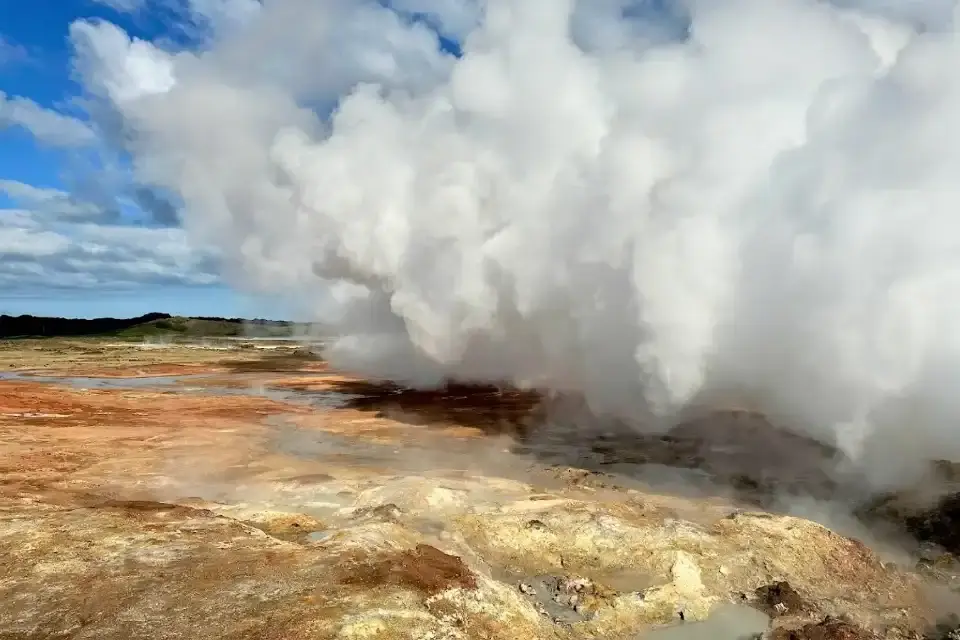
Gunnuhver is the Reykjanes peninsula’s raw geothermal heart: mud pools and steam vents clustered around Iceland’s single largest hot spring, named for Gunna — a ghost who, the legend says, was trapped in the spring by a priest’s Bible after haunting the local farm. The ground steams, boils and bubbles behind wooden boardwalks; the smell is honest sulfur; the access is free. It is the wildest of the easily-reachable geothermal fields — closer to the raw version of Geysir (#14) than to any spa — and the anchor of the Reykjanes day from the capital or the airport.
This is #34 of 39 in our Best Things to Do in Iceland guide (5.0/5 from 3 verified reviews — tiny sample, giant steam plumes). Below: the field and its biggest spring, the Gunna story, the Reykjanes eruption context (this is active volcanic country now), the boardwalk rules, and the peninsula itinerary that pairs it with the Bridge Between Continents and the cliff coast.
Key takeaways
- Iceland’s largest hot spring: the main spring spans ~20 metres — the country’s biggest, boiling at 100°C+ with steam columns visible from kilometres away.
- The Gunna legend: a 16th-century ghost trapped in the spring by a priest’s Bible — the name is the story; the signs tell it properly.
- Active volcanic country: Reykjanes erupted repeatedly 2021–2024 (Fagradalsfjall, Sundhnúkur) — check safetravel/vedur.is for closures before driving the peninsula.
- Boardwalks over boiling mud: the paths cross the field safely; off-path ground is genuinely dangerous (thin crust, boiling water beneath).
- Free, 24/7: open access; the Reykjanes day adds the Bridge Between Continents, the cliff coast and the lighthouse.
Quick answer: Check the peninsula’s eruption status first (vedur.is/safetravel.is — Reykjanes is active volcanic country), then drive the Reykjanes route: Gunnuhver boardwalks (30–45 minutes), the Bridge Between Continents, Valahnúkur cliffs and the lighthouse. Keep to the boards, breathe the honest sulfur, and read the Gunna sign aloud — the legend is half the visit.
The field, the spring and the steam
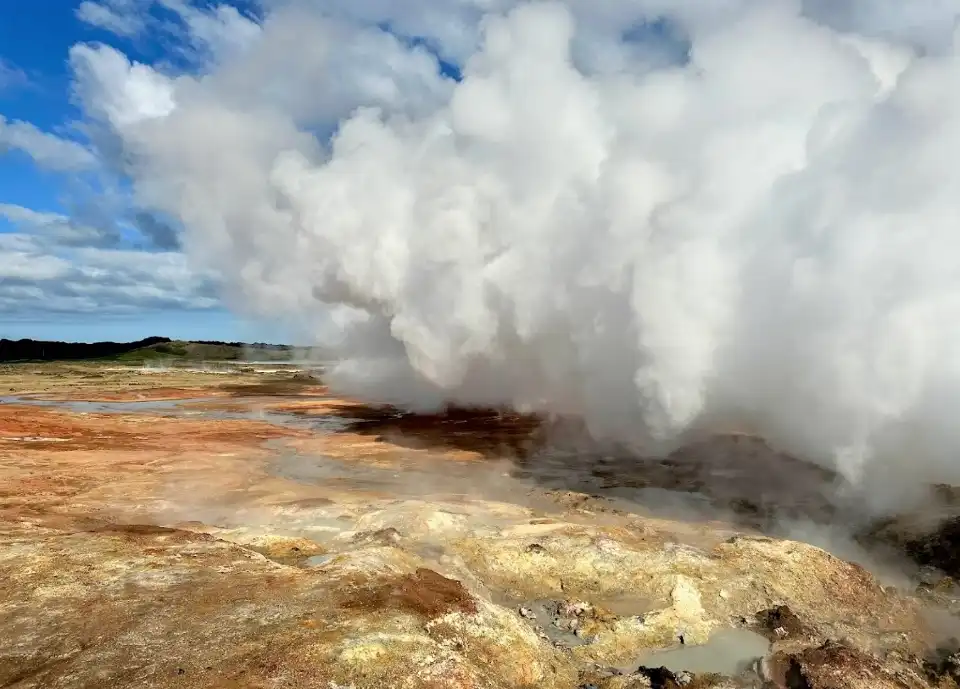
Gunnuhver is a high-temperature geothermal field — Reykjanes’ most powerful — where the ground itself is the exhibit: mud pools bubbling grey-and-orange, steam vents hissing from cracks, fumarole chimneys built of mineral deposits, and the main spring, Iceland’s largest, spanning roughly 20 metres of actively boiling water. The boardwalk loop (30–45 minutes) crosses the field at safe height with the steam columns close enough to fog your glasses and the sulfur aroma doing its honest work. On cold days the steam builds cloud-plumes visible across the peninsula; on calm days the mud pools perform for whoever stands still.
The setting is raw: no spa infrastructure, no visitor centre beyond the signs and the paths — the field is what the Blue Lagoon (#nearby) sits on top of, in its unbuilt form. Photographers get the steam-and-mineral textures, the boardwalk leading lines, and the rust-red ground chemistry; everyone else gets the planet working, audibly.
The crust rule: off-boardwalk ground is thin crust over boiling water — the field’s fencing and paths are survival equipment, not decoration. Stay on the boards, hold children’s hands, and never test the ground beyond the markers. Geothermal burns are catastrophic; the signs say so plainly.
Gunna: the ghost in the spring
The name carries the peninsula’s best ghost story: Gunna was a labourer’s wife at the local farm in the 1500s who died (the versions differ on how) and returned as a restless spirit — stealing, troubling, driving the household out. The Reverend Eiríkur of Staður was called to deal with her; the legend says he lured her to the spring and trapped her inside it with his Bible, where she remains — the steam, locals will say, is Gunna still boiling.
The story is told on the field’s interpretive signs and repeated in every Reykjanes retelling — it is the peninsula’s folk identity marker, and it explains why a boiling 20-metre spring carries a first name. Whether you read it as history, folklore or geothermal etymology, the sign-by-the-spring version is worth the stop.
The eruption context — read before you drive: Reykjanes entered a new volcanic era in 2021 (Fagradalsfjall, then the Sundhnúkur sequence 2023–2024); eruptions and ground deformation have closed roads and towns (Grindavík) periodically since. Gunnuhver itself stays open through most events, but the daily check — vedur.is, safetravel.is, road.is — is now a normal part of any Reykjanes drive.
Practical: access and the Reykjanes day
Access: the Reykjanes route from the capital or directly from Keflavík airport (the field is 20 minutes from arrivals — a legitimate first-stop or last-stop option with luggage-friendly logistics at the nearby services). Free parking at the field; the boardwalk loop runs 30–45 minutes; no facilities on site (the nearby towns carry them).
The Reykjanes day that works: Gunnuhver → Bridge Between Continents (the plate boundary walk) → Valahnúkur cliffs and Reykjanesviti lighthouse → the Bridge-and-cliff coast road → optionally the Blue Lagoon or the Sky Lagoon-equivalent soak to end. The peninsula is the airport-adjacent half-day — the ring road’s optional appendix that most visitors skip and locals rate.
How it fits an Iceland route
Gunnuhver anchors the Reykjanes appendix: arrival-day or departure-day geography, paired with the Bridge Between Continents and the cliff coast, optionally with a soak. It also pairs thematically with the geothermal grammar stops — Geysir (#14), Hverir (the north’s version), Krafla (#39). Our hot-springs guide and the safety guide carry the check-lists; the peninsula’s eruption status is the itinerary’s first line.
Frequently asked questions
Why is it called Gunnuhver?
For Gunna, the 16th-century ghost of local legend: the Reverend Eiríkur trapped her in the spring with his Bible, and the steam is Gunna boiling. The field’s signs tell the full story — the name is the peninsula’s best ghost tale.
Is Gunnuhver safe to visit?
On the boardwalks, yes — the paths cross the field at safe height. Off-path ground is thin crust over boiling water; stay on the boards, hold children, and respect every closure. The wider peninsula check (vedur.is/safetravel) covers the volcanic-era status.
How big is the main spring?
Roughly 20 metres across — the largest single hot spring in Iceland, actively boiling with steam columns that carry across the peninsula on cold days.
What pairs with Gunnuhver on a Reykjanes day?
The Bridge Between Continents, Valahnúkur cliffs and the Reykjanes lighthouse — the peninsula’s half-day loop from the airport or the capital, optionally ending with a soak.
Where this ranks — and what is next
Gunnuhver Hot Springs is #34 of 39 in our Best Things to Do in Iceland guide — the full ranked list, built from Trip.Best traveler data, lives in one place.
Go deeper: Hot springs beyond the Blue Lagoon — the soak guide, The safety and 112 guide (volcanic-era checklists).
Sources & official references
- Trip.com listing for Gunnuhver Hot Springs: 5.0/5 rating (checked November 2026).
- Trip.Best ranking data: #34 of 39 (November 2026).
- Site interpretive signage: the Gunna legend, field facts (checked 2026).
- vedur.is and safetravel.is Reykjanes volcanic-era guidance (2021–2026).
- Editorial peninsula visits across eruption-era conditions, 2023–2026.
