




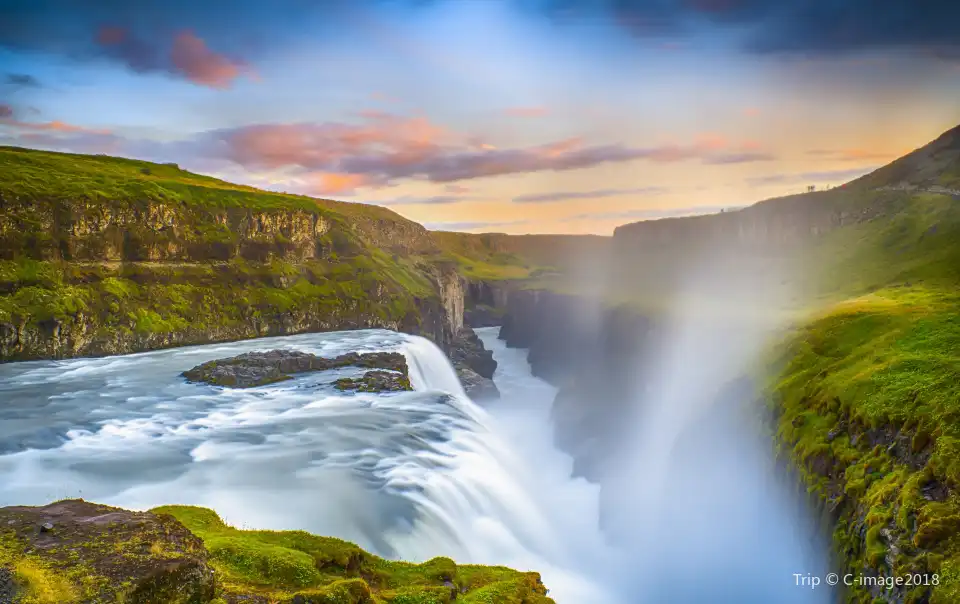
Gullfoss is the Golden Circle’s roar: 32 metres of the Hvítá river dropping in two tiers into a basalt canyon so narrow the water seems to vanish into the Earth. It is Iceland’s most famous waterfall for reasons beyond scale — the edge-of-the-canyon viewpoint (you stand metres from the first drop), the conservation story of Sigríður Tómasdóttir (the farmer’s daughter whose fight saved it from a dam), and the rainbows that name it “golden”. Free, enormous, and 4.8/5 from 249 verified reviews — the highest-review count in the top ten.
This is #13 of 39 in our Best Things to Do in Iceland guide. Below: the two paths and what each delivers, the canyon-edge experience and its rules, the winter ice version, and the timing (the fall is on every bus route — the windows that dodge the crowds are worth knowing).
Key takeaways
- 32 m in two tiers: into an 11-metre canyon crack — the water appears to swallow itself at the edge.
- Two paths: the upper path (edge-of-drop views, the classic frame) and the lower path (full curtain, closest and wettest — closes when icy).
- The conservation story is real: Sigríður Tómasdóttir’s early-1900s fight against the dam proposal is why Gullfoss still flows; her stone memorial stands above the fall.
- Free, 24/7: paid parking only; the café and visitor centre handle the rest.
- Winter is spectacular: the canyon ices into blue sculpture; the lower path closes but the upper edge stays.
Quick answer: Park once, walk the upper path first (the edge view is the signature), then the lower path if it is open (closest, soaked, spectacular — waterproofs). Clear midday light throws rainbows into the mist; winter visits stay on the upper edge with studs. Pair with Geysir (#14) ten minutes east and Þingvellir (#18) on the loop.
The canyon-edge experience
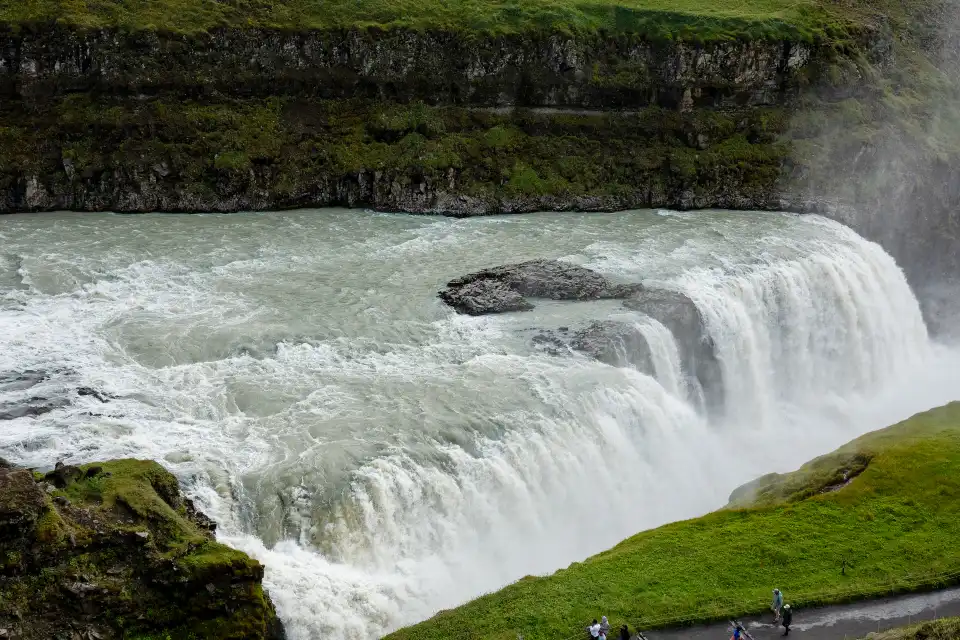
Gullfoss’s signature is the viewpoint geometry: the upper path runs along the canyon rim to a platform essentially at the lip of the first drop — the Hvítá river walks off the edge of the world three metres to your left. The perspective is disorienting in the best way: you watch the whole river bend, accelerate and vanish, and the mist column rises past you. The lower path (when open) descends into the canyon mouth for the full frontal curtain — louder, wetter, closer to the water than most big waterfalls allow.
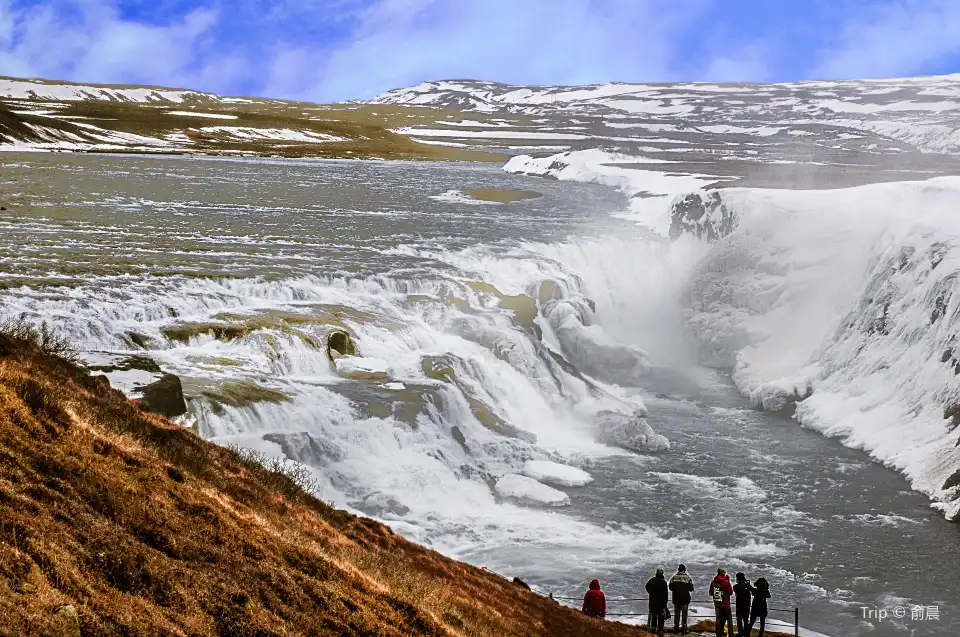
The fall’s flow varies with season and weather — glacier-fed and moody — which is part of the show: spring melt roars, autumn rain swells it, winter freezes the canyon walls into blue-and-white sculpture with the central channel still roaring black through the ice. Only severe conditions close the whole site; some version of the fall is viewable every day of the year.
Edge discipline: the upper path’s edge is real cliff with railings only in sections — hold children, respect the barriers, and never climb the closure fences for a photo. The canyon eats mistakes; the signs are not decorative.
Sigríður and the fall that almost died
In the early 1900s foreign investors leased Gullfoss to generate electricity; Sigríður Tómasdóttir, daughter of the farmer at Haukadalur, fought the dam plan — walking to Reykjavík, threatening to throw herself into the falls, and (through the lawyer who later became Iceland’s first president) forcing the contract’s collapse. Her campaign became a founding story of Icelandic nature protection, and her stone memorial above the fall is one of the country’s few monuments to a private citizen.
The story matters to the visit: Gullfoss is not just scenery, it is the proof-of-concept for the idea that Icelandic nature belongs to the public — the same principle that keeps every waterfall on this list free to walk to. The visitor centre tells it properly; the memorial tells it in stone.
Light, rainbows and the winter version
Rainbows are Gullfoss’s party trick: clear-sky midday sun into the mist column throws arcs that move with your position — the “golden” name is earned hourly in summer. Overcast days trade rainbows for moody grey-green drama (the canyon photographs best in flat light, like most of Iceland). The upper path gives the rim-and-drop composition; the lower path the frontal curtain; the drone question is answered by the crowd density and national rules — leave it packed on busy days.
Winter: the canyon ices over into blue-white sculpture while the central channel keeps flowing black through the middle — the most photogenic winter waterfall state in the country. Studded overshoes are essential; the lower path closes, the upper edge stays. On clear winter evenings, aurora occasionally sits above the canyon — the Circle’s night bonus.
Beat the buses: Gullfoss is the Golden Circle’s busiest stop 10:00–15:00. The 08:30–09:30 window and post-17:00 light are the quiet ones — and the morning window often has the canyon to the photographers who stayed in Reykjavík one coffee too long.
How it fits an Iceland route
Gullfoss is the Golden Circle’s anchor stop: Geysir (#14) ten minutes east, Þingvellir (#18) 50 minutes north, Kerið (#16) and the Secret Lagoon (#32) on the return leg. It chains naturally into a South Coast day (Skógafoss #8 is 90 minutes east on Route 1). Our Gullfoss deep-dive carries the full story and trail detail, the photography guide’s Golden Circle chapter sequences the light, and the Circle post (#11) runs the whole route logic.
Frequently asked questions
Is Gullfoss free to visit?
Yes — open access 24/7 with paid parking. The visitor centre café and shop sit at the car park; no gate, no ticket, no time limit.
Which path is better — upper or lower?
Do both when open: the upper path has the canyon-edge signature view; the lower path gets you closest to the full curtain. The lower path closes in winter and after ice — the upper edge remains.
Why is it called the Golden Falls?
Two answers, both true: the sediment-rich glacial water glints brown-gold in low sun, and the midday rainbows in the mist column. The name “Gullfoss” predates both explanations and has stuck through all of them.
Can you see the northern lights at Gullfoss?
On clear winter nights, occasionally — the canyon is a dark site 90 minutes from the capital. The fall itself is illuminated only by the sky; the aurora bonus is real but not guaranteed. The en.vedur.is forecast decides.
Where this ranks — and what is next
Gullfoss Falls is #13 of 39 in our Best Things to Do in Iceland guide — the full ranked list, built from Trip.Best traveler data, lives in one place.
Go deeper: The complete Gullfoss guide (history, paths, light), The Golden Circle route logic (#11).
Sources & official references
- Trip.com listing for Gullfoss Falls: 4.8/5 rating, 249 reviews (checked November 2026).
- Trip.Best ranking data: #13 of 39 (November 2026).
- Site operator information: parking, path status, winter closures (checked 2026).
- The Sigríður Tómasdóttir conservation record and memorial.
- Editorial visits across seasons including winter ice state, 2023–2026.
