




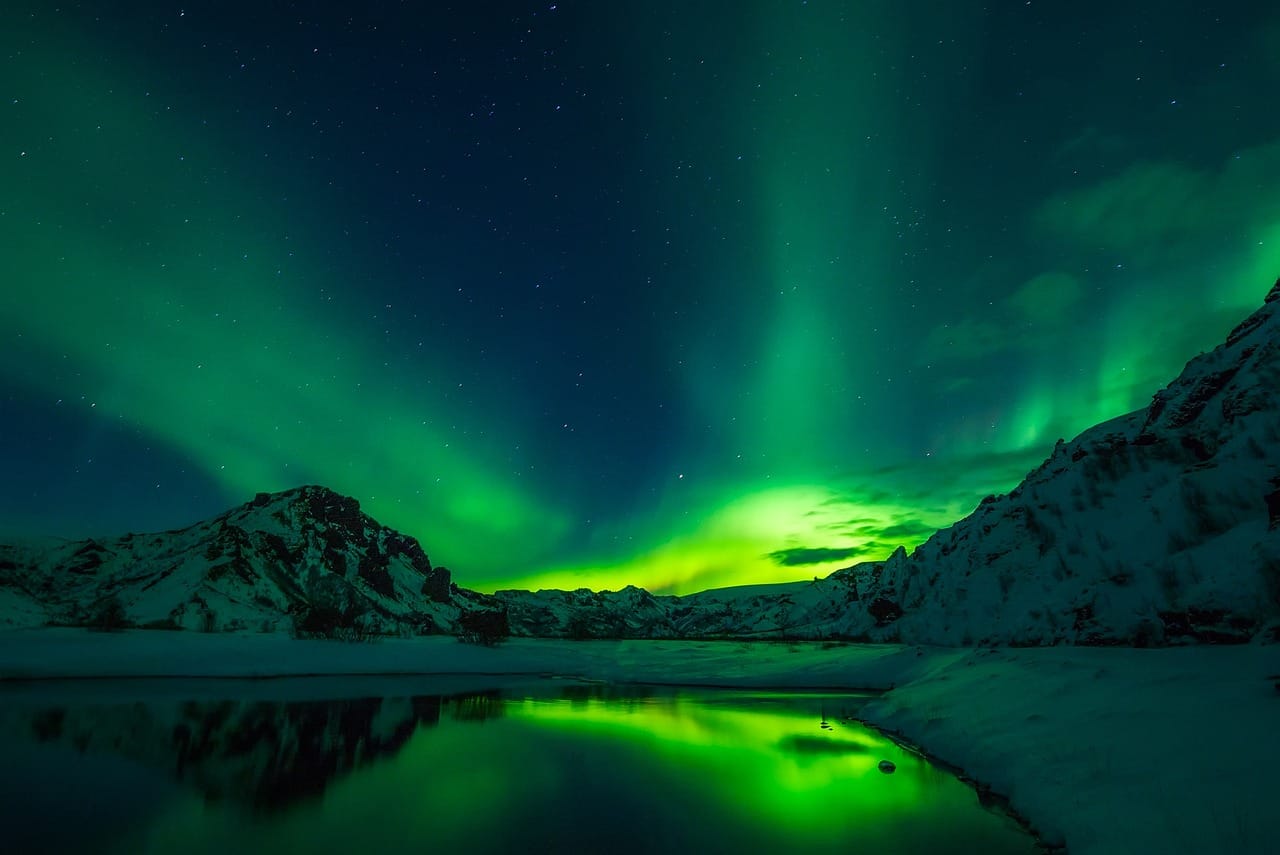
This is spot 20 of 20 in our Iceland Photography Guide — the wildcard that can happen anywhere. The aurora borealis earns its master-list place not as a location but as a system: “clear, dark nights — Sep–Mar peaks,” with the field tip giving the whole recipe in one line — “tripod, manual focus, ISO 1600–3200, 8–15 s; forecast on en.vedur.is.” Iceland sits under the auroral oval, which means the lights are overhead rather than horizon-distant — on any clear dark night between September and March, the green can appear over any master-list spot you are standing under, from Kirkjufell’s pond to Vestrahorn’s horn to Goðafoss’s horseshoe edge.
This closing guide turns that line into a complete field system: the forecast habit (cloud beats KP), the location logic (darkness over drama, foregrounds over emptiness), the full camera recipe from setup to edit, the night-safety rules, and the seasonal window that makes the equinox months the statistically smart bet.
Points clés à retenir
- Cloud beats KP: Iceland sits under the auroral oval — the limiting factor is cloud cover, not geomagnetic activity. The en.vedur.is cloud map is the real forecast; check it every evening from September to March.
- The recipe is fixed: tripod, manual focus set before dark, ISO 1600–3200 to start, 8–15 s, f/2.8, RAW — then tune to the display’s speed.
- Foregrounds decide the shot: the lights are the sky’s half; the master list’s nineteen locations are the other half — pick a spot with a silhouette worth lighting.
- Equinox months win: September–October and February–March combine the statistical activity peak with manageable nights and (in September) still-usable evening temperatures.
- Night safety is location safety: the same rules as daylight (berms, paths, canyon edges) plus headlamps, company and the car-as-base discipline.
Réponse rapide : every evening from September to March, check en.vedur.is (cloud cover over your region + aurora activity); if the sky is clear and dark, drive to a scouted foreground (Kirkjufell, Goðafoss, Þingvellir, Grótta — any master-list silhouette), set up before dark: tripod, manual focus on the foreground’s edge, f/2.8, ISO 1600–3200, 8–15 s. Shoot RAW, bracket your first minutes, and tune shutter to the lights’ speed. Warm layers, headlamp on red, spare batteries inside your jacket, and never chase lights down a beach or a rim at night.
The forecast habit: cloud beats KP
The single most important aurora habit in Iceland is reading en.vedur.is correctly: the Icelandic Meteorological Office publishes both a cloud-cover map and an aurora-activity forecast, and the cloud map is the one that decides your night. Because Iceland sits directly under the auroral oval, activity values that would be “nothing” in central Europe still produce visible lights here — the lights are overhead; the only question is whether clouds are in front of them. A KP-0 night with clear sky beats a KP-5 night under the usual Atlantic deck, every time.
The practical routine: check the cloud map region by region (the country’s sky rarely clears everywhere at once — the south coast and the north often disagree), pick the nearest clear dark area to your base, confirm the darkness (true dark returns in August–September and lasts until April), and leave margin for the drive. The 21:00–01:00 window is the statistically best; the lights can appear any time it is genuinely dark, but the evening hours carry the bulk of displays. The aurora guide covers the science in depth — the oval geometry, the colors (green oxygen, rare red and purple), and the equinox statistics.
Patience economics: plan the evening as a session, not a glance — two to three hours on location is the honest minimum, with the car as the warm base between bursts. The nights that “deliver in ten minutes” are the minority; the ones that reward a two-hour wait are the norm.
Location logic: darkness and foregrounds
The wildcard’s genius is that every master-list location is an aurora candidate — the composition rule is simply that the sky needs a worth-lighting foreground:
- The classics: Kirkjufell (the cone faces north — the aurora sits behind it), Goðafoss (the horseshoe edge as the white foreground), Vestrahorn (the horn with the bay’s reflection), Þingvellir (the rift walls, forty minutes from the capital’s glow).
- The capital options: Grótta’s lighthouse at the bay’s end, the church tower silhouette, the waterfront — viable on active nights when leaving town is not practical (the Reykjavík aurora guide ranks them).
- The open-country default: any safe pull-off with a north-facing view and a foreground — a church, a turf house, a lone tree, a frozen puddle. Iceland’s emptiness is the asset.
Darkness logic: get outside the town-glow line — the street-light dome eats the faint displays; the master-list locations are all naturally dark. Moon phase is the second factor: a new moon maximizes faint-activity displays, while a bright full moon washes out subtle curtains (and lights the foreground — a trade, not a pure loss). The winter travel guide covers the night-driving rules that make dark-location chasing safe.
The complete camera recipe
The master tip’s line unpacked into a full recipe:
- Trépied: non-negotiable; anchor it (hang the bag) because aurora nights are often windy nights. Ball head loose enough to re-frame fast.
- Manual focus, set before dark: focus on a distant light or the foreground’s edge via live-view magnification, then tape the ring. Autofocus dies in the dark; a ring taped at infinity-true is the whole secret.
- Exposure start: f/2.8 (the fastest lens you brought), ISO 1600–3200, shutter 8–15 s. Test frame, read the histogram, adjust.
- Tune to the display: fast-moving curtains want 5–8 s to keep structure; slow glows take 15–25 s. The lights’ speed is the variable — shutter is the control.
- RAW, always: the post-processing is half the genre — white balance left cool, greens lifted honestly, noise reduction at moderate strength. The archive’s standard edit keeps the aurora’s texture.
- Kit extras: spare batteries inside the jacket (cold halves their life), headlamp with red mode, microfiber cloth, and the intervalometer for the star-trail variant.
The night workflow, minute by minute
T-minus 60: arrive at the scouted spot in daylight; choose the composition, mark the tripod position, set manual focus and framing while you can still see. T-minus 30: layer up, eat, warm the car; test the settings on the twilight’s first stars. First light: when the green appears, shoot in bursts — bracket exposure (±1 stop) for the first five minutes to bracket your understanding, then settle. Between displays: batteries rotate through the jacket, cards back up, the car warms, the coffee steams.
The patience discipline: the lights come and go in waves — the display that starts weak at 22:30 is often the strong one at 23:15. The photographers who leave at the first fade are the ones whose best frame was twenty minutes away. Set a hard end-time (night driving has its own rules — the winter guide covers them), and shoot to that clock, not to hope.
Night safety and the non-negotiables
The wildcard inherits every daylight rule and adds its own: never chase lights onto black-sand beaches (Plage de Diamant et Reynisfjara at night are the list’s most dangerous combination — the sneaker waves do not stop for aurora), never work canyon rims or hot-spring paths after dark without daylight scouting, keep the headlamp red-mode in groups, and never night-drive the F-roads or storm closures. The safety and 112 guide covers the emergency habits; safetravel.is’s aurora-night guidance is the national baseline.
Company rule: shoot with a partner or in sight of others when the location is remote — the cold and the dark compound every small mistake. The car parked facing your exit, keys in pocket, is the basic highland-night protocol.
Seasons, moon and the smart bet
The season runs September to March (true darkness outside the midnight-sun months), with the equinox months — September–October and February–March — carrying the statistical activity peak plus the most manageable nights: not yet deep-winter cold, roads usually clear, and (in September) the master list’s autumn colors still on the ground. Deep winter (December–January) trades comfort for the strongest darkness and the ice-transformed foregrounds; the festival season wraps the year’s longest nights in the capital’s lights.
The smart bet, in order: September clear nights at a scouted foreground; any equinox-night high-pressure system after a storm clears (the post-frontal sky is Iceland’s most reliable aurora window); December’s deep dark with the ice foregrounds. The moon calendar and the en.vedur.is evening check are the two habits that convert the season’s statistics into frames.
Frequently asked questions
What settings should I actually start with?
Tripod, manual focus set before dark, f/2.8, ISO 1600–3200, 8–15 seconds — the master tip’s line is the starting grid. Then tune: faster displays take shorter shutters (5–8 s), slow glows take longer (15–25 s). RAW, bracket the first minutes, and let the histogram rather than the LCD be the judge.
Does a high KP guarantee lights?
No — and that is the Iceland-specific lesson: the country sits under the auroral oval, so cloud cover is the real gatekeeper. A KP-0 clear night shows lights here; a KP-5 cloudy night shows nothing. Read en.vedur.is’s cloud map first and the activity number second.
Which master-list spots photograph best under aurora?
The ones with north-facing silhouettes and safe night access: Kirkjufell (the aurora sits behind the cone), Goðafoss’s horseshoe edge, Vestrahorn (the café permits overnight), Þingvellir’s rift walls, and Grótta in the capital. Every master-list location is a candidate — the foreground decides the frame.
Can I see the aurora from Reykjavík?
On active nights, yes — Grótta’s lighthouse, the waterfront and the church square all photograph under strong displays (our Reykjavík aurora guide ranks the city options). Faint activity needs the darkness outside the glow line; active displays punch through the capital’s sky.
The full field list lives in one place
Spot 20 of 20 — the master guide ranks all twenty locations by region, best light and a field tip for each.
Go deeper: the aurora guide for the science and the season detail, the Reykjavík aurora guide for the capital nights, and the winter travel guide for the night-driving rules that keep the chase safe.
Sources & official references
- Aurora forecasting: en.vedur.is (Icelandic Meteorological Office) cloud and aurora outlooks; equinox-peaks pattern per published aurora science summaries.
- Aurora recipe: tripod, manual focus, ISO 1600–3200, 8–15 s — per the master guide and our aurora guide.
- Night safety: safetravel.is guidance and the safety and 112 guide (checked 2026).
- Season and moon planning: published darkness tables and lunar calendars for Iceland’s latitude.
- Editorial photography trips across seasons 2022–2026 by the Iceland Travel Guides team.
