









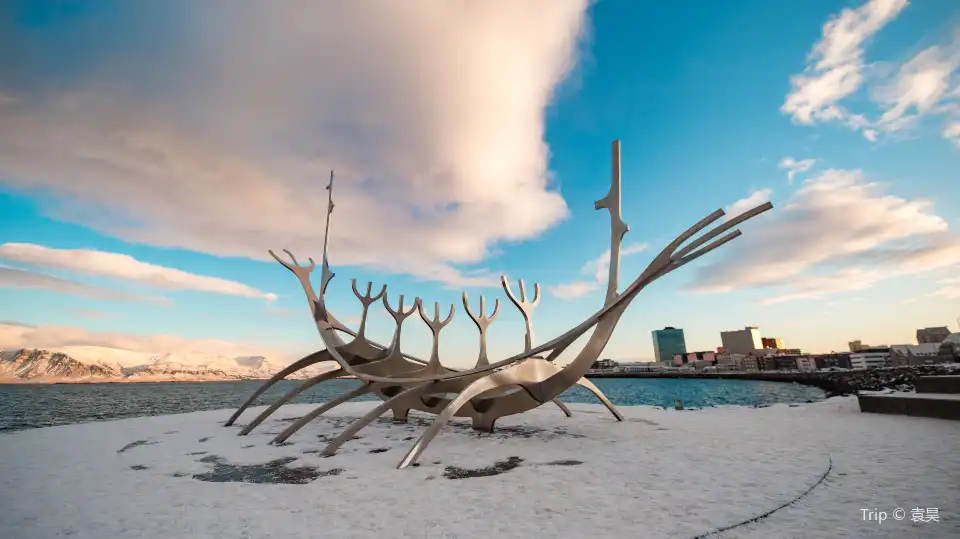
The Sun Voyager (Sólfar) is Reykjavík’s sculpture: Jón Gunnar Árnason’s steel dream-ship on the Sæbraut waterfront, its ribs drawn against the bay and Mount Esja, famous far beyond its size. It is not a viking ship — the artist called it a dream boat, an ode to the sun and to discovery — and the distinction matters to the story. Free, 24/7, ten minutes from downtown: it is the capital’s sunset appointment and the second half of the perfect blue-hour evening.
This is #21 of 39 in our Best Things to Do in Iceland guide (4.6/5 from 53 verified reviews). Below: the sculpture’s meaning (and the viking-ship myth), the light logic that makes the frames, the storm-and-winter versions, and the Hallgrímskirkja pairing (#9) that sequences the capital’s best evening.
Points clés à retenir
- A dream boat, not a viking ship: Jón Gunnar Árnason’s own description: an ode to the sun and the promise of undiscovered territory — the viking reading is the tourists’, not the artist’s.
- 1990, steel, waterfront: unveiled on Reykjavík’s 200th birthday by the bay at Sæbraut — Esja as permanent backdrop.
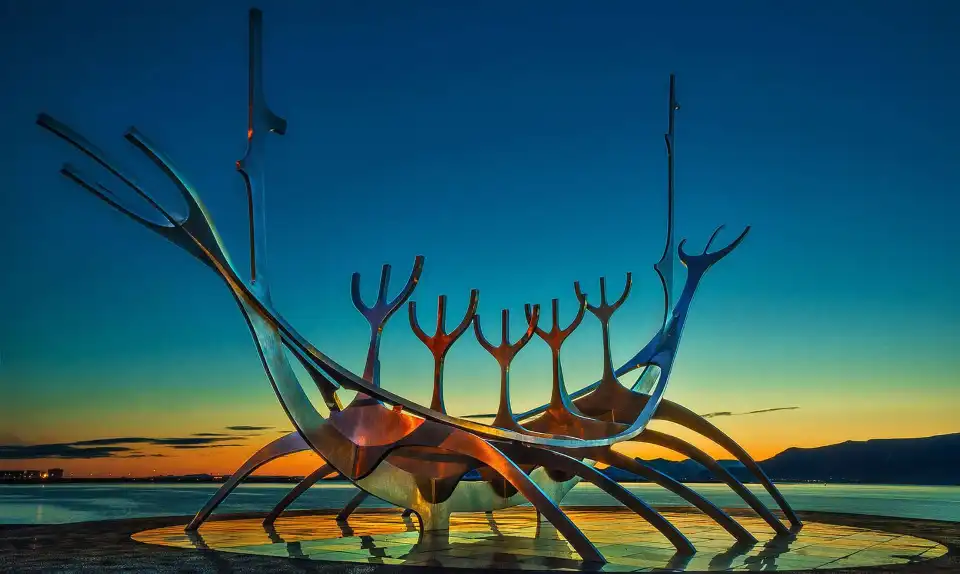
- Sunset and blue hour: the silhouette frames run on the bay’s light; wet-pavement reflections double the ship after rain.
- Storm steel is a genre: the ship in heavy weather — spray, dark sky, refusal to move — is the under-shot version locals shoot.
- Free, 24/7, walkable: on the waterfront path 10 minutes from downtown; pairs with Harpa (#26) and the church circuit.
Réponse rapide : Walk the waterfront path from Harpa or downtown, shoot the sunset silhouette from the sculpture’s west side (sun setting behind the ribs over the bay), stay through blue hour for the pastel steel-plus-city-lights frame, and photograph the wet-pavement reflection if rain cooperates. Pair with the Hallgrímskirkja tower (#9) earlier in the evening.
The sculpture and its real meaning
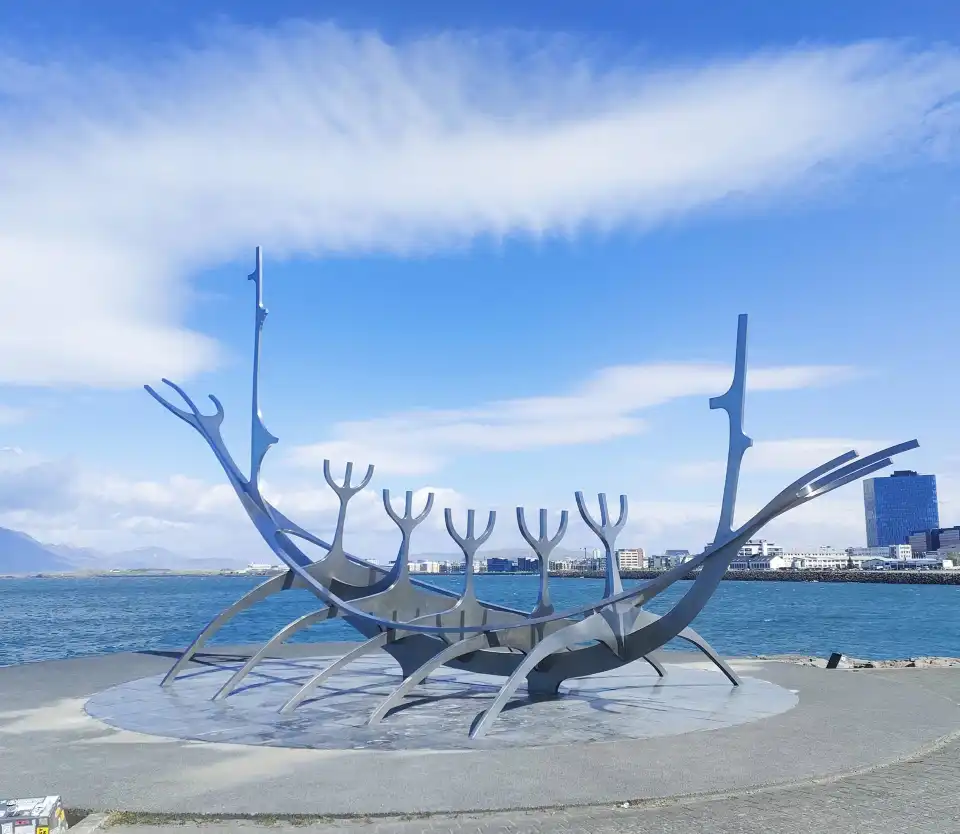
Jón Gunnar Árnason (1946–1989) conceived the Sun Voyager as a dream boat: a vessel of the imagination pointed at the sun, an ode to discovery rather than a historical replica — the artist died before the stainless-steel fabrication was finished, and the work was unveiled in 1990 on the city’s 200th anniversary. The form reads as a skeletal ship: keel, ribs, prow, all lines and voids, engineered so the frame changes completely with every ten degrees you circle it.
The location does half the work: the sculpture stands at the waterline of Sæbraut with Faxaflói bay west, Mount Esja’s massif north across the water, and the capital’s Harpa-and-tower skyline behind. Ships use the harbour approach — some evenings a real vessel crosses the sculpture’s sightline, the steel dream and the working ship in one frame. Crowds cluster at sunset; patience windows clear it, or the photographers become the composition.
The viking-ship myth: the sculpture is widely (and wrongly) read as a viking vessel heading west — the discovery framing fits Iceland’s story so well that even locals shrug at the correction. Árnason’s own title and description are the record: a sun-ode, a dream boat, “a promise of undiscovered territory”.
The light logic: sunset, blue hour and storm
Sunset: shoot from the west side with the sun dropping behind the ribs — the silhouette genre, 35–70 mm, the ship as graphic element in the gradient. Blue hour: stay; the pastel bay, the waking city lights and the steel silhouette make the second, better frame. After rain: the wet pavement doubles the ship — polarizer off, get low, shoot the reflection. Storm days: the steel in spray with dark sky is the local’s genre and under-shot — the sculpture does not move, the weather does.
Winter adds aurora odds on strong nights (the waterfront is a legitimate capital frame) and the ice-fog versions; summer adds the midnight-sun gradient that stretches the golden hour for hours. The full workflow — positions, settings, the Hallgrímskirkja sequencing — lives in our photography guide’s capital chapter.
The evening sequence that works: Hallgrímskirkja tower (#9) ninety minutes before sunset → walk down through the coloured streets → Sun Voyager through sunset and blue hour → Harpa’s glass facade after dark. One evening, three ranked frames, all within 2 km.
Practical: access and the waterfront
The sculpture sits on Sæbraut’s waterfront path, 10 minutes’ walk from downtown (Laugavegur’s east end) and 5 from Harpa. Bus stops along Sæbraut; parking on the street bays (paid, city rates); the waterfront path runs the whole bay for the walking loop. The visit itself is 15–45 minutes — the patience kind, at sunset.
No facilities at the sculpture; the harbour strip (Grandi’s cafés) and downtown carry everything. Accessibility is full: flat path, the sculpture reachable on paving. It works in every season — the light changes, the steel does not — and it is the rare capital stop that improves in bad weather.
How it fits an Iceland route
The Sun Voyager is the capital evening’s anchor (#9 pairing, #26 Harpa, the waterfront walk). It slots after any day trip’s return — Golden Circle (#11) back by 18:00 ends perfectly at the bay — and our photography guide sequences the blue-hour circuit in full. The sculpture is also the city’s most reliable landmark for orientation: whatever else the capital day holds, the ship points home.
Frequently asked questions
Is the Sun Voyager a viking ship?
No — the artist called it a dream boat, an ode to the sun and discovery. The viking reading is popular but not the work’s meaning; Árnason’s description is the record.
When is the best time to photograph it?
Sunset through blue hour — the silhouette, then the pastel-and-city-lights frame. After rain adds the wet-pavement reflection; storm days are their own genre.
How long does a visit take?
15–45 minutes — it is a waterfront sculpture, best treated as the light-dependent stop of an evening walk that includes Harpa and the church circuit.
Can you see aurora behind the Sun Voyager?
On strong nights, yes — the north-facing bay picks up active displays, and the steel silhouette under lights is a real capital frame. Faint aurora needs darker sites; our Reykjavík aurora guide ranks them.
Where this ranks — and what is next
Sun Voyager is #21 of 39 in our Best Things to Do in Iceland guide — the full ranked list, built from Trip.Best traveler data, lives in one place.
Go deeper: How to photograph Hallgrímskirkja and Sun Voyager (spot 19), Reykjavík — exploring the capital.
Sources & official references
- Trip.com listing for Sun Voyager: 4.6/5 rating, 53 reviews (checked November 2026).
- Trip.Best ranking data: #21 of 39 (November 2026).
- Published public-art records: Jón Gunnar Árnason, unveiled 1990, Sæbraut waterfront.
- Editorial blue-hour and storm sessions across seasons, 2023–2026.
