









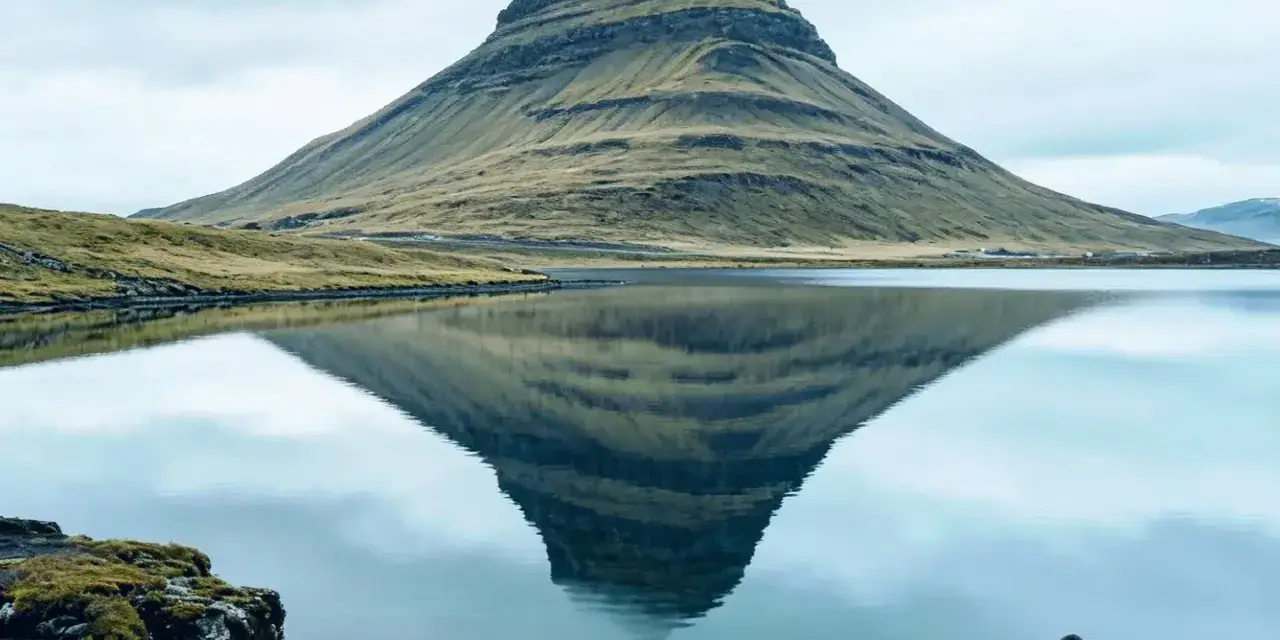
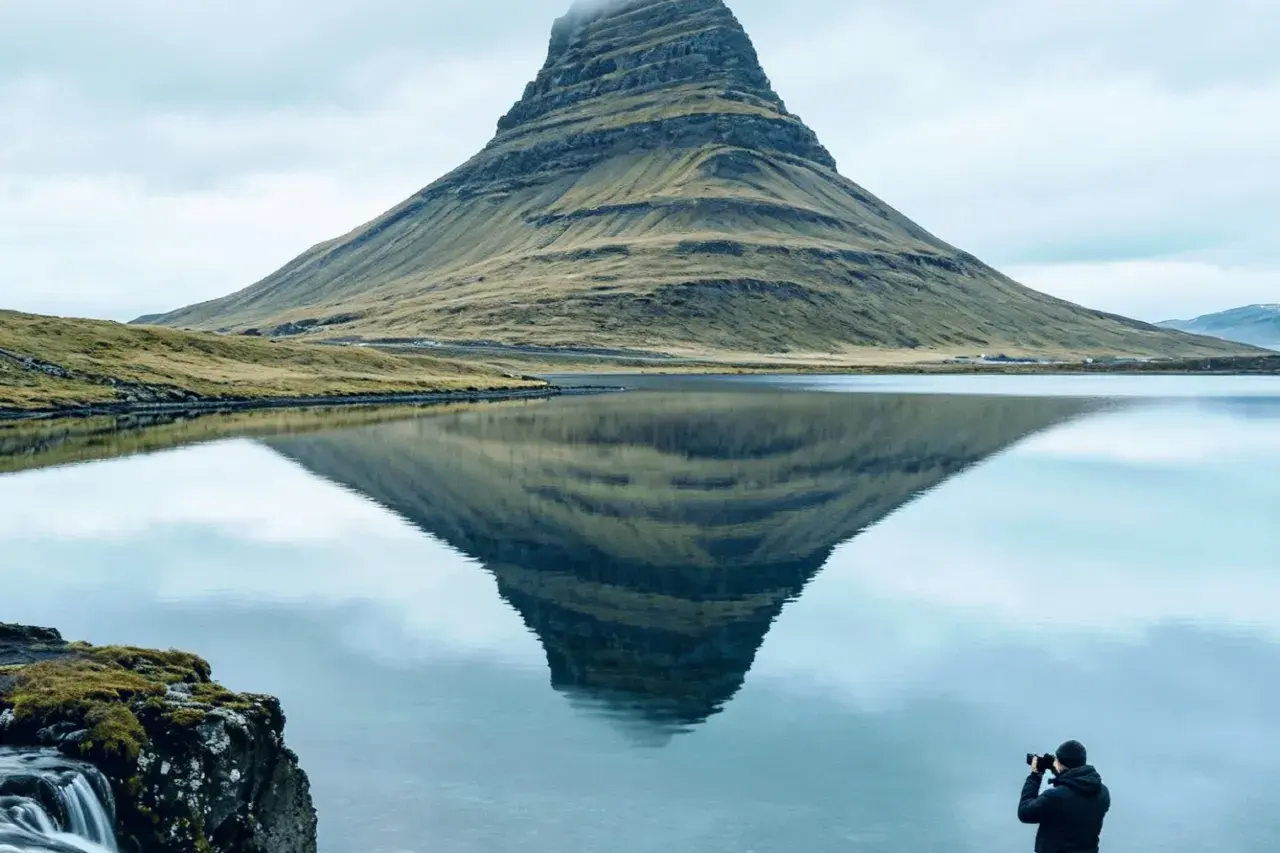
This is spot 1 of 20 in our Iceland Photography Guide — and the one image that, fairly or not, has become shorthand for the whole country. Kirkjufell, the 463-metre “church mountain” that rises straight out of the sea beside Grundarfjörður on the Snæfellsnes peninsula, is the most photographed mountain in Iceland: the cone, the triple stream of Kirkjufellsfoss and the reflection pond in front of it form a composition that works for almost every skill level, in almost every season. Our team has shot it in bluebird summer midnight sun, in howling October rain and at -15 °C in February with the aurora arcing over the summit, and we have never once driven away thinking we should have skipped it.
The honest truth about Kirkjufell is that the classic frame is easy and the hard part is everything around it — parking, wind, crowds and the light window. This guide walks through the access and the parking reality, the hours when the mountain actually earns your alarm clock, the compositions beyond the pond cliché, the settings that hold up in Snæfellsnes wind, and how to fold the stop into a Snæfellsnes day without fighting the tour-bus rhythm.
Conclusiones clave
- Shoot from the pond: the Kirkjufellsfoss viewing area gives waterfall-plus-reflection in one frame — sunrise and sunset, per the master list, are the windows that matter.
- Blue sky is genuinely required here: unlike most of Iceland, this reflection needs wind under ~3 m/s and light on the mountain; check en.vedur.is for both.
- Be there early or late: the small car park fills with tour buses from roughly 10:00–15:00 in summer; dawn is calm, empty and often glassy.
- Winter adds aurora: the mountain faces north over Grundarfjörður — a clear dark night turns the classic into an aurora composite in a single frame.
- Walk beyond the bridge: 200 metres downstream there are quieter stream braids with the same mountain and zero tripod elbows.
Respuesta rápida: park at the Kirkjufellsfoss lot on Route 54 just west of Grundarfjörður, walk five minutes to the falls, and set up at the pond below the footbridge for the reflection classic. Be there within an hour of sunrise or sunset, bring a polarizer for the stream and a tripod for the pond, and shoot the braid braids downstream for quieter versions of the same shot. If the wind is over 5 m/s, skip the reflection and work the coastal angles on the Grundarfjörður shoreline instead.
Getting there and parking
Kirkjufell sits on the north shore of the Snæfellsnes peninsula, and reaching it is the longest part of the job: roughly two and a half hours from Reykjavík by road 54, along the fjord-edge drive into Grundarfjörður. The mountain announces itself well before you arrive — the cone is visible across the bay from the Ring Road junction at Borgarnes on a clear day. The dedicated car park for Kirkjufellsfoss sits on Route 54 on the western edge of town, signed for the waterfall, with room for perhaps thirty cars and a handful of tour coaches; it fills and empties with the bus schedule rather than the light.
Access is genuinely easy by Icelandic standards: a flat, gravelled five-minute path leads to the falls and the viewing bridges, which makes this the most accessible sunrise on our whole list — no hike, no climb, no river crossing. Parking is free (unlike Stokksnes further east), and the area is maintained by the town. Two small warnings: the road into Grundarfjörður is narrow and sheep-bordered outside summer, and in winter the northern peninsulas clear ice later than the south coast, so check road.is before committing to a dawn run.
If the main lot is full at midday — it will be, in July — use the lay-bys along the coast road 100–200 metres west and walk in along the shore path; the mountain does not move, and the shoreline itself gives you the better wind angles anyway.
The light window
The master list calls Kirkjufell a sunrise-and-sunset spot, and the geometry explains why: the mountain faces roughly north across its fjord, so the sun rakes across the cone from the east at dawn and paints the western flank gold at dusk, while the water in front stays in shade long enough to hold a mirror. In summer the midnight sun keeps both flanks lit for hours and the “night” reflection shots never quite go blue; in winter the sun barely crests the peninsula ridge at all, and the best light becomes a two-hour warm sidelight around 11:00–13:00 — plus, of course, the nights.
The non-negotiable here is wind, not sun. The pond below Kirkjufellsfoss only mirrors below roughly 3 m/s, and Snæfellsnes is one of the windiest strips of coastline in the country. We check the hourly forecast on en.vedur.is before every drive: if Grundarfjörður shows gusts under 3–4 m/s at your target hour, go for the reflection; if it shows more, go for texture instead — waves, spray and streaked water are legitimate Kirkjufell compositions too, just not the postcard one.
One more local nuance: the summit clouds. The cone sits on the coast, where moist ocean air lifts over the ridge and caps the top on damp mornings. The cap burns off faster than any other cloud in Iceland once the sun finds it — wait twenty minutes after sunrise rather than packing up.
Compositions that work
The classic is a classic for a reason, but Kirkjufell rewards anyone who spends twenty minutes walking the same five hundred metres of stream. Start from the footbridge and work outward:
- The pond classic: from below the bridge, stack the triple cascade of Kirkjufellsfoss, the cone and the mirror in a vertical frame. A polarizer takes glare off the water and greens the moss; flip it fully off if you want the reflection to read at all.
- The stream braids: 150–200 metres downstream (seaward) the stream spreads into shallow braids over dark gravel. Low angle, tight aperture, foreground braid leading to the mountain — this is the quieter, portfolio-grade version of the same shot.
- The shore frame: from the rocky Grundarfjörður foreshore, the mountain sits clean against open sea; in winter, pack ice and snow on the headlands give the same cone an entirely different character.
- The road-out angle: the pull-offs east of the falls look across tidal flats toward the mountain with grass tufts and seaweed pools as foreground — strongest at mid-tide, dead at low.
Whatever you choose, keep the mountain small enough to breathe. The common failure at Kirkjufell is the telephoto frame that crops the falls out and turns an icon into a generic summit — the story here is the stack of three elements, not the cone alone.
Settings and technique
Treat Kirkjufell as two different technical problems. For the moving water of the falls, 0.5–2 seconds at f/8–f/11 with a 6-stop ND gives silky-but-structured cascades; shorter exposures freeze individual threads, which reads as “detail” in print and mush on screens. For the pond mirror, the rule inverts: you want the glassiest possible water, which means the shortest usable exposure with the polarizer rotated to kill wind-glare — typically 1/15–1/4 second. Long exposures over the pond rarely help; they average the ripples into nothing instead of removing them.
Focus stack when the braid braids are in frame: one frame on the foreground gravel at f/11, one on the mountain, blend in post. The vertical classic wants f/8 for depth and ISO 64–100 for dynamic range, because the classic frame puts a bright sky over dark basalt — shoot RAW, protect the summit highlights, and lift the shadow side of the cone in post rather than letting the meter flatten it.
In winter, the same pond becomes an aurora canvas: ISO 1600–3200, 8–15 seconds, manual focus set on the mountain edge before dark, exactly the recipe in our master guide’s aurora section. The mountain faces north, which means the aurora sits behind Kirkjufell in the classic frame — a genuinely rare alignment that this list does not have anywhere else.
Seasons and pairing the day
Kirkjufell photographs in all four seasons but each one changes the job. Summer (mid-June to August) gives endless soft light and the greenest foreground, and the crowds; go at 03:00 or 23:00 and you share the pond with nobody. Autumn (September–October) adds rust-red grass to the braids and returns real sunrises plus the first auroras. Winter (November–March) strips the scene to snow, ice and stars — the pond freezes at its edges, so work the open centre of the water. Spring is the weakest window: thawing snow, brown moss and the highest winds of the year, though the first clear evenings can be glorious.
For the day plan, Kirkjufell is the anchor of any Snæfellsnes peninsula loop: work the south-coast stops (Búðakirkja’s black church, Arnarstapi’s cliffs, Djúpalónssandur’s pebble beach) in morning light, and let the mountain be your late-day finish, when its west flank glows and the tour buses have gone. It is a long peninsula — allow a full day from Reykjavík, or stay overnight in Grundarfjörður or Stykkishólmur to own both light windows.
Frequently asked questions
Is Kirkjufell worth the detour from the Ring Road?
For photographers, unambiguously yes — it is spot 1 on our master list and the most recognisable frame in the country. Budget the 2.5-hour drive each way as part of a full Snæfellsnes day rather than a Kirkjufell-only dash; the peninsula is dense enough with subjects to make the day pay for itself even in mixed weather.
Can you climb Kirkjufell for the view?
There is a steep, unmarked climbing route to the summit that local guides run with ropes in dry conditions — it is not a trail and not something we recommend for photographers travelling light. The summit views are good, but every postcard Kirkjufell image you have ever seen was taken from the stream and pond below; spend your energy there instead.
When is the reflection actually visible?
When the wind in Grundarfjörður drops under roughly 3 m/s, in the low-light hours around sunrise and sunset when the thermals calm down. Summer evenings after 21:00 are the statistically best bet; winter gives the same glass on cold, clear, high-pressure nights — often with aurora included.
How long should I allow for the shoot?
Ninety minutes covers the classic, the braids and the shore if the light holds. If you are chasing the mirror specifically, give it two hours around your target hour — glass conditions come and go in ten-minute windows, and the shooters who leave at the first bad frame are the ones who miss the second window.
The full field list lives in one place
Spot 1 of 20 — the master guide ranks all twenty locations by region, best light and a field tip for each.
Go deeper on the peninsula: our Snæfellsnes guide covers the full loop with every stop mapped, the wind and weather planning guide explains how we read en.vedur.is before a shoot, and the Ring Road driving guide sequences this region into a working itinerary.
Sources & official references
- Weather and wind forecasts: en.vedur.is (Icelandic Meteorological Office), hourly values for Grundarfjörður.
- Road conditions and seasonal closures: road.is (checked 2026).
- Access and parking: Snæfellsnes municipal signage and Kirkjufellsfoss trail information, verified on editorial trips 2022–2026 by the Iceland Travel Guides team.
- Master list context: Iceland Photography Guide — 20 Best Photo Spots (this site).
