









This is spot 16 of 20 in our Iceland Photography Guide — the wildlife harbor. Húsavík, on Skjálfandi bay in the north, is Europe’s whale watching capital (the master guide’s own framing), and the photography genre changes here: the master list’s field tip — “long lens; boats and breaching whales in the same frame” — describes action work, not landscape. The harbor itself photographs beautifully (the traditional oak boats, the red-roofed town under its mountain), but the reason this spot earns a master-list place is the July peak, when humpbacks surface beside the boats in golden light and a 200–400 mm lens becomes the most important thing in your bag.
This guide covers the harbor compositions, the whale-boat reality (which boat, which hour, which lens), the wildlife technique that turns sightings into keepers, the bay’s other subjects (puffin island, Geosea’s cliff baths), and how Húsavík fits the north’s master-list cluster.
Conclusiones clave
- Long lens is the kit: 200–400 mm (or 100–400 mm zoom) is the whale tool; landscape lenses stay in the bag until the harbor walk before or after.
- July is the peak: the master list’s month — humpback density and the midnight-sun light make evening sailings the prime sessions.
- Book the early or late sail: midday tours carry the crowds; morning and evening boats give better light and calmer seas — and the whales feed all day.
- Shutter priority rules: 1/1600–1/2500 s for breaches and flukes, burst mode, autofocus tracking — the same action settings as Strokkur, with a boat platform’s wobble.
- The harbor itself earns an hour: oak boats, the town’s silhouette, Geosea’s cliff-edge baths — the landscape half of the stop.
Respuesta rápida: book an evening sailing in July with a reputable Húsavík operator, kit out with the long lens and rain cover, and shoot shutter-priority 1/2000 s in bursts whenever the guide calls a surfacing. Before and after the sail, walk the harbor for the oak-boat and town frames, and finish at Geosea above the bay if the hour allows. Treat every whale session as wildlife photography: the guide’s positioning is your composition, and patience is the setting.
Access, boats and the season
Húsavík sits forty minutes east of Akureyri on the north coast, and the whale watching industry here is the oldest in Iceland — operators run from the town’s harbor with two boat philosophies: fast RIBs that chase sightings aggressively, and traditional oak sailing ships that work the bay slowly and photograph beautifully from outside as well as inside. The season runs roughly April/May through October with the master list’s July peak; sightings of humpbacks are frequent in the bay (it is a feeding ground), with white-beaked dolphins, minke and — rarely — blue whales adding to the ledger. Book the sail ahead in July; evening slots sell out.
Photographers’ boat logic: the oak boats give the more atmospheric frames (canvas, rigging, wooden decks in frame are part of the genre) and steadier platforms; RIBs get closer faster. Both provide overalls; bring your own gloves. Seasickness settles or ruins the session — the usual remedies, taken in time, are camera equipment.
The town itself: the harbor front is walkable in fifteen minutes (Húsavík’s wooden church, the whale museum, the fleet moored in rows), and Geosea — the geothermal sea baths — sits on the hillside above the bay, its infinity pools facing the water the boats sail out of.
The harbor compositions
Before and after the sail, the harbor earns its own hour — the master list’s “boats” half of the frame:
- The oak fleet: the traditional boats moored in rows, rigging against the mountain backdrop — 24–70 mm at f/5.6–f/8, morning side-light or evening warm.
- The town silhouette: the red-roofed town and its church under Húsavíkurfjall, shot across the bay — 50–100 mm compression at golden hour, the town as the landscape’s warm note.
- The departure: boats heading out under the midnight sun (July’s 23:00 light) — 100–200 mm, silhouette-and-water, the session’s narrative frame.
- Geosea above: the cliff-edge pools with the bay beyond — the master list’s north-lagoon cousin (Mývatn’s baths get the master slot; Geosea is the harbor’s own version) at the same evening-steam logic.
The whale action system
Whale photography is a system, not a lottery — the guides call the sightings, and your job is the settings and the patience:
- Listen to the guide: the call (“left side, surfacing!”) is your composition cue — pre-aim, focus-tracked, burst armed. The guide sees the bay’s patterns; your job is reaction speed.
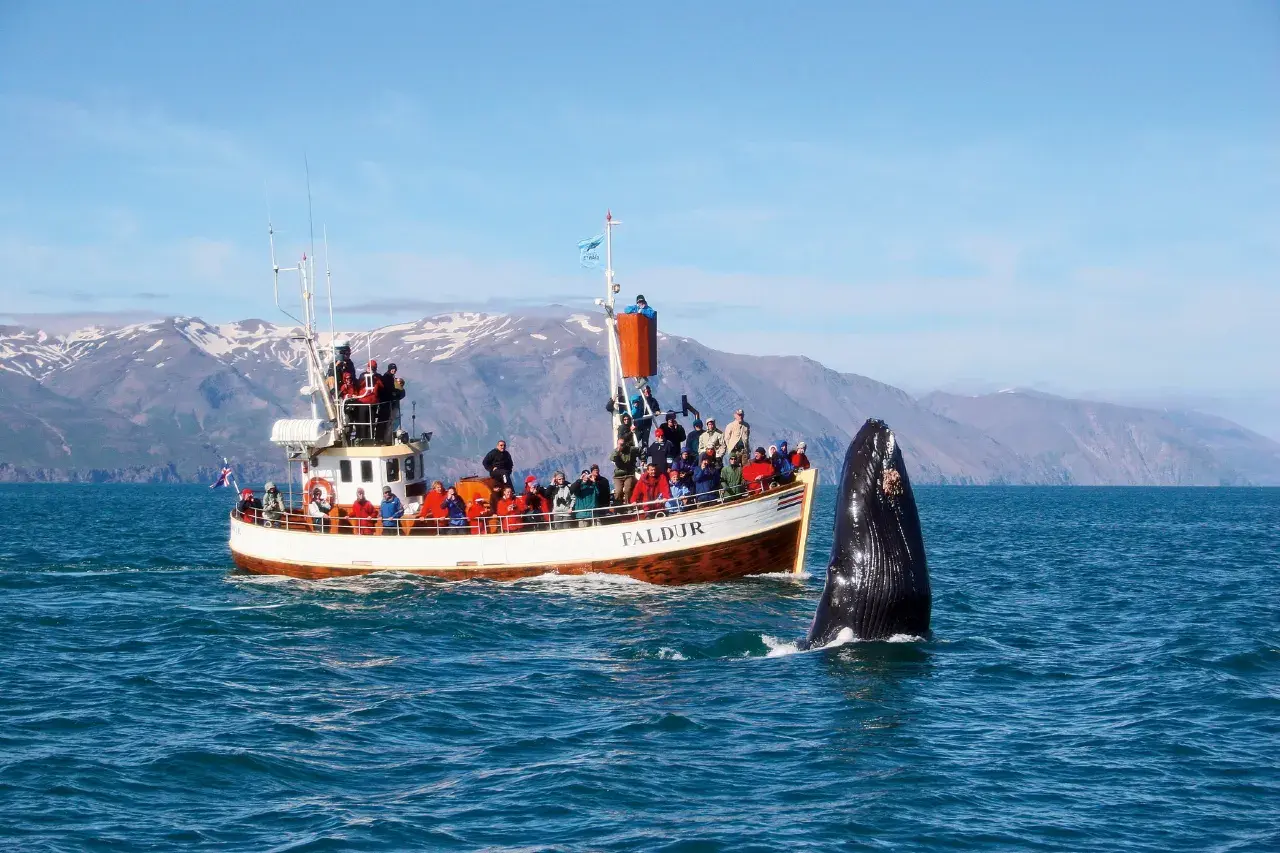
- Shoot the sequence: a humpback surfacing runs blow → back → fluke → dive. The fluke (tail) frame is the keeper — the classic ID photograph — and it comes last in the sequence; keep bursting until the water closes.
- The breach is the lottery prize: full-body jumps happen without warning; the only defense is the armed system (shutter priority, tracking AF, bursts of ten) held for the whole sail. The master tip’s “breaching whales” frames come from cameras that never stopped watching.
- Include the boat: the master tip says it — boats and whales in the same frame give scale and story. The oak boat’s bow, the passengers’ attention, the fluke beyond: the genre’s best single composition.
- Respect the distance: guides keep legal approach distances; a telephoto makes them work. The frame that requires the boat to push closer is the wrong frame.
Settings and boat technique
Shutter priority 1/1600–1/2500 s, auto-ISO capped generously (evening light pushes it), f/5.6 on the long zoom, back-button focus with continuous tracking, burst mode — the Strokkur action system on a moving platform. The boat’s wobble is the technical tax: brace against the rail, shoot between the swell’s peaks, and accept a higher keeper threshold (one sharp fluke per sail beats ten nearly-sharp).
Evening light is the ally: the master list’s July pick coincides with the golden-hour sailings, and the low sun turns every blow and fluke backlit. Exposure on the dark whale body (+0.3 to +0.7 EV keeps the wet skin from crushing). Rain cover stays on — bay spray plus overalls plus camera bags is the standard condition.
Seas and wind: check the en.vedur.is marine forecast the night before — wind over ~12 m/s cancels or shortens sails, and the calm-day-evening sessions are the ones the master tip’s frames come from.
Geosea and the bay’s other frames
Geosea, the geothermal sea baths on the hillside above the harbor, faces the bay the whale boats sail out of — the same evening-steam logic as Mývatn with a harbor horizon instead of a volcanic one. Photograph the exterior (steam and pools against the bay) at dusk, then get in: the recovery session after a wind-chilled sail is the north’s best reward combo. The hot springs guide ranks it in the national set.
The wider bay: puffin colonies on Lundey island (some boats route past it in summer — long lens, 1/1000 s+, the birds cross the bows in flurry bursts), and the north-coast drive out toward Ásbyrgi and Dettifoss extends the day eastward.
Seasons and the north cluster
July is the headline (master list’s pick, humpback density, midnight sun) but June and August sail nearly as well with thinner crowds; September’s clear nights start the aurora season over the bay. Winter quietens the harbor to its landscape self — the fleet, the snow-lit mountain, Geosea’s steam — until the boats return. The master list’s spot sits inside the north cluster: Hverir, Goðafoss, Dettifoss y Mývatn within an hour — Húsavík is the day’s wildlife bookend.
El complete Húsavík guide covers the town, the museum and the operator detail; the puffin guide carries the Lundey season dates; and the Reykjavík whale watching guide marks the capital-side alternative if the north is out of range.
Frequently asked questions
Which lens for whale watching?
200–400 mm or a 100–400 mm zoom — the flukes and breaches happen at 30–100 m and the compression is the genre. Bring the landscape kit in the bag for the harbor walk, not the deck. A rain cover and hand strap complete the boat kit.
Are whale sightings guaranteed?
No — it is wildlife, and the honest expectation is a high probability of humpback sightings in the July peak (the bay is a feeding ground), not a certainty. Most operators offer re-bookings on empty sails. The photographers who get the breach frames are the ones who treated the whole sail as the session.
Morning or evening sail?
Evening for the light (the master list’s July pick rides the midnight-sun window) and the calmer evening winds; morning for the emptier boats. Midday works for the whales but carries the coach crowds and the flattest light of the day.
Can I photograph from shore instead?
Surfacings occasionally happen inside the bay visible from the harbor — real, but rare and distant; the sail is the genre. The shore session belongs to the harbor’s own compositions (fleet, town, Geosea) and the departure frames.
The full field list lives in one place
Spot 16 of 20 — the master guide ranks all twenty locations by region, best light and a field tip for each.
Go deeper: the complete Húsavík guide, the puffin season guide, and the Reykjavík whale watching guide for the capital-side comparison.
Sources & official references
- Whale watching season and sighting patterns: Húsavík operator information and the town’s whale museum materials (checked 2026); verify sail schedules per season.
- Wildlife approach distances: Icelandic whale watching regulations; guides hold legal approach rules.
- Marine conditions: en.vedur.is marine forecasts for Skjálfandi bay.
- Action technique: editorial photography trips across seasons 2022–2026 by the Iceland Travel Guides team.
- Master list context: Iceland Photography Guide — 20 Best Photo Spots (this site).
