








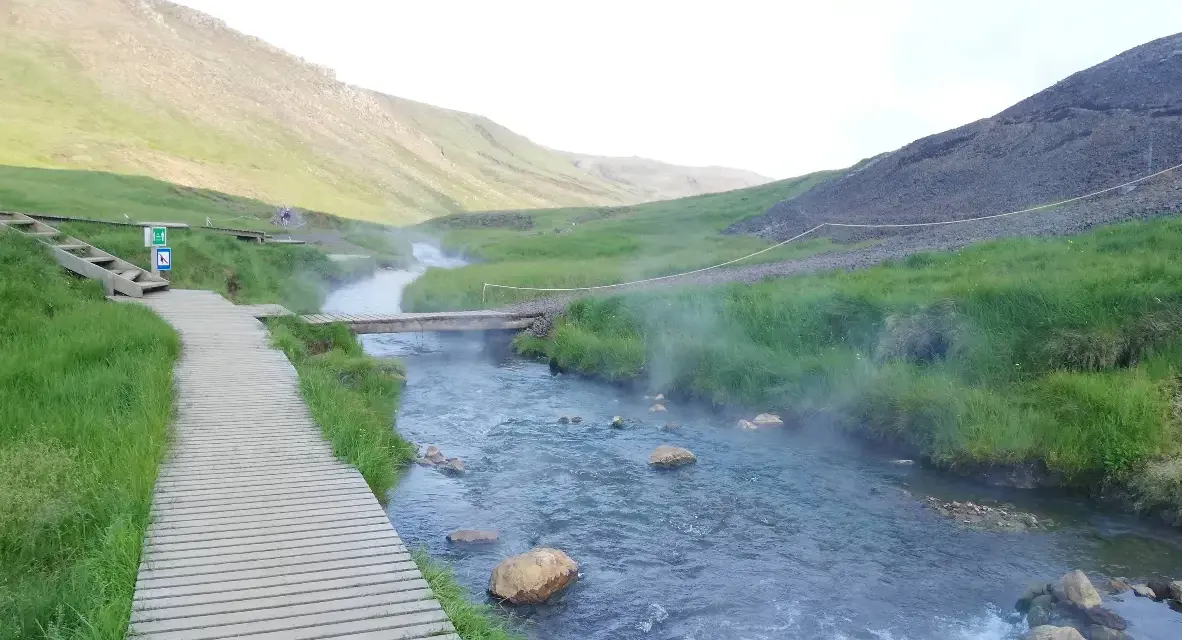
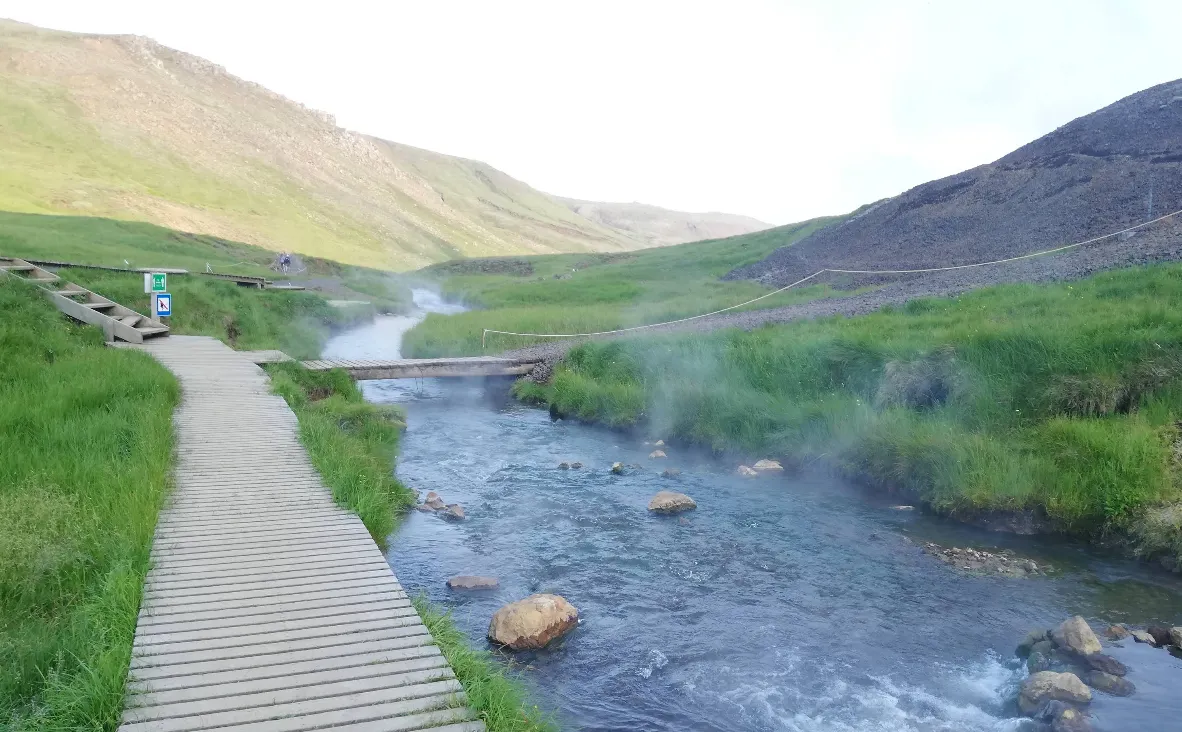
Forty-five minutes from Reykjavik — closer than most of the capital’s suburbs are to each other — there is a valley where the ground steams, the mud bubbles, and a river runs warm enough to bathe in. Reykjadalur, “smoke valley”, sits above the flower-town of Hveragerði, and the deal it offers is beautifully Icelandic: hike about 3 km uphill, earn your bath, and soak for free in a valley that no company owns. Our team has walked it in midsummer midnight light and in February with traction devices on the ice, and it remains our default answer to “what should I do on my first day in Iceland?”
The trail is moderate rather than easy, the wind is the real adversary, and the river’s temperature changes stretch by stretch in ways that reward a little local knowledge. This guide covers all of it: the walk’s honest profile, how the bathing actually works, timing for crowds and light, winter conditions, the family question, and the pairings — Hveragerði’s geothermal bakery and a Golden Circle or Þingvellir detour — that turn the hike into a full day.
Key takeaways
- Close and free: the trailhead sits about 45 minutes from Reykjavik above Hveragerði; the bath itself costs nothing — the parking lot is where your money goes.
- The numbers: roughly 3 km each way, with a moderate incline; count on 1–1.5 hours up and a faster walk down.
- The reward: a warm river whose temperature varies by stretch — hot springs feed in continuously, so you blend zones until you find your comfort.
- The real challenge: wind. The valley is exposed, and the wind chill after bathing is what actually tests visitors — pack warm layers and a towel.
- Family-friendly with discipline: safe for children on the marked paths, but the water runs scalding near the source vents and the boardwalks are there for a reason.
Quick answer: allow three to four hours door to door — hike up, soak an hour, hike down. Go early morning for emptiness or evening for the light; bring swimwear, a towel, warm layers and water; skip or shorten the soak if a gale is forecast. In winter, carry traction devices for icy patches and check conditions before you commit.
What Reykjadalur is & why it is free
Reykjadalur is a geothermal valley doing exactly what geothermal valleys do: venting steam, boiling mud, painting slopes yellow and rust with mineral outflow — and leaking just enough of that heat into a mountain stream to make it bathable. The name means “smoke valley”, and on damp mornings the plumes rising from the slopes explain it better than any etymology. What makes it special is the combination: a hot river calm enough to sit in, a trailhead within commuting distance of the capital, and no ticket booth between you and any of it.
That freedom comes with the standard Icelandic bargain. The land is open, undeveloped and unstaffed: no changing rooms, no lifeguards, no shop at the river. The infrastructure stops at the trailhead parking and the boardwalk sections; everything above is nature with rules — stay on paths, carry out what you carry in, and treat the hot margins with the respect owed to water that emerges at 80–100°C. Visitors who understand that bargain tend to rate the valley among their trip highlights; visitors expecting a lagoon product sometimes come away surprised. Now you know.
The trail: what the hike really feels like
From the Hveragerði trailhead parking, the path climbs steadily out of town through a first section that is honestly the least charming — gravel, wind, a few false summits — before the valley’s character arrives. Boardwalks then carry you across the fragile geothermal ground: bubbling vents, steaming fumaroles and mud pools close enough to warm your hands, with fences and planks defining exactly where walking is welcome. The final stretch drops gently into the valley proper, and the river appears exactly as advertised — steaming banks, green slopes, water running warm between stone banks.
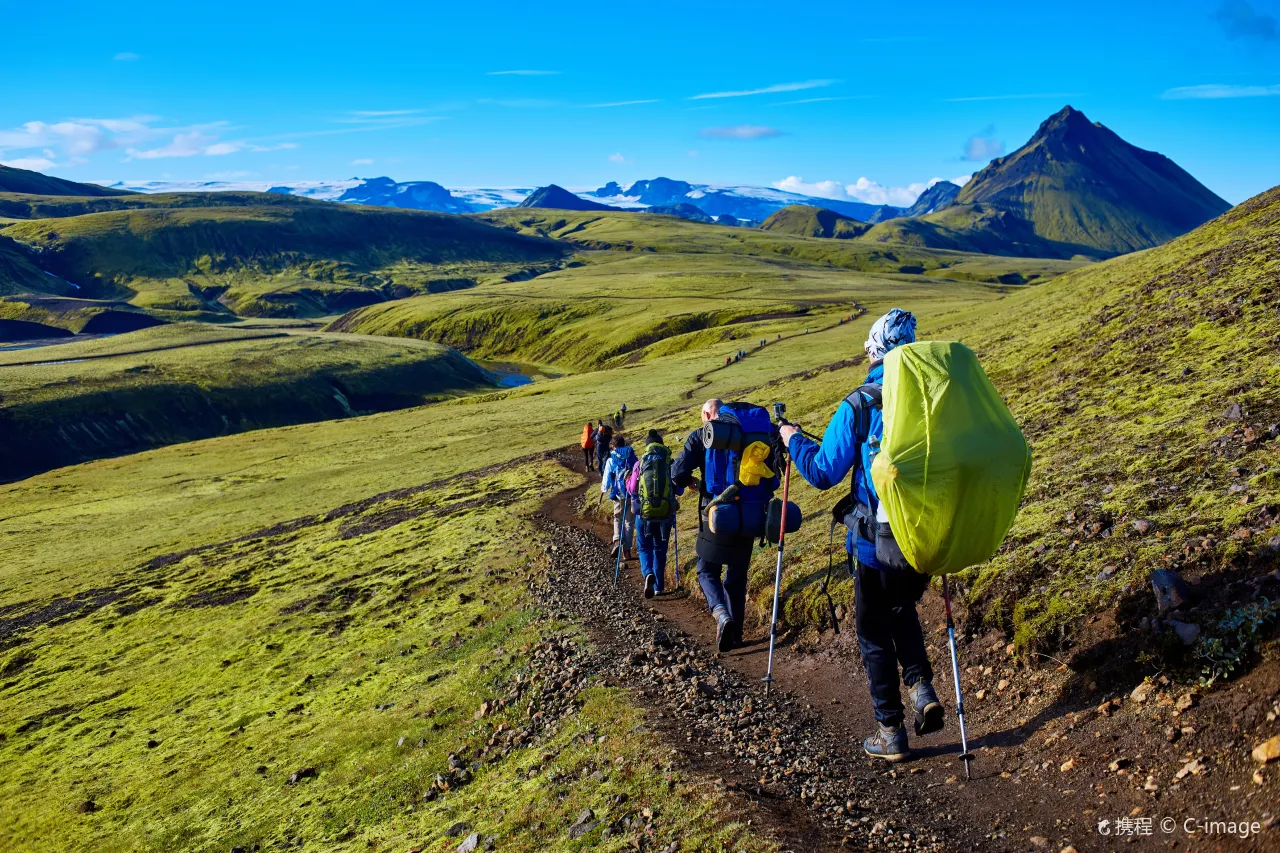
Profile-wise: about 3 km each way with a moderate incline, 1–1.5 hours up for most walkers and noticeably less coming down. Trail running shoes are fine in dry weather; boots earn their keep when the upper sections turn wet or icy. There is no shade and no water source worth trusting, so carry what you need — and note that the wind funnels through the valley mouth with an efficiency that locals mention first whenever the hike comes up.
Worth knowing: the geothermal ground is genuinely fragile crust over hot water. Keep to the boardwalks and marked paths — venturing onto the margins risks both the landscape and your ankles, and the water near the source vents is scalding. Photograph the mud pots from the path; it is close enough.
Bathing in the hot river: how it works
The bathing works on a simple principle: the river runs continuously, mixing cold water with the hot-spring inflow, so temperature changes every few metres. Walk the bank until you find a stretch that feels right — cooler downstream, hotter upstream, with the sweet spots shifting as flow and weather change. Bathers adjust a few stream stones here and there to tune the mix of warm and cold water coming through; it is a harmless, long-standing ritual, and part of the charm is that the river never quite stays tuned.
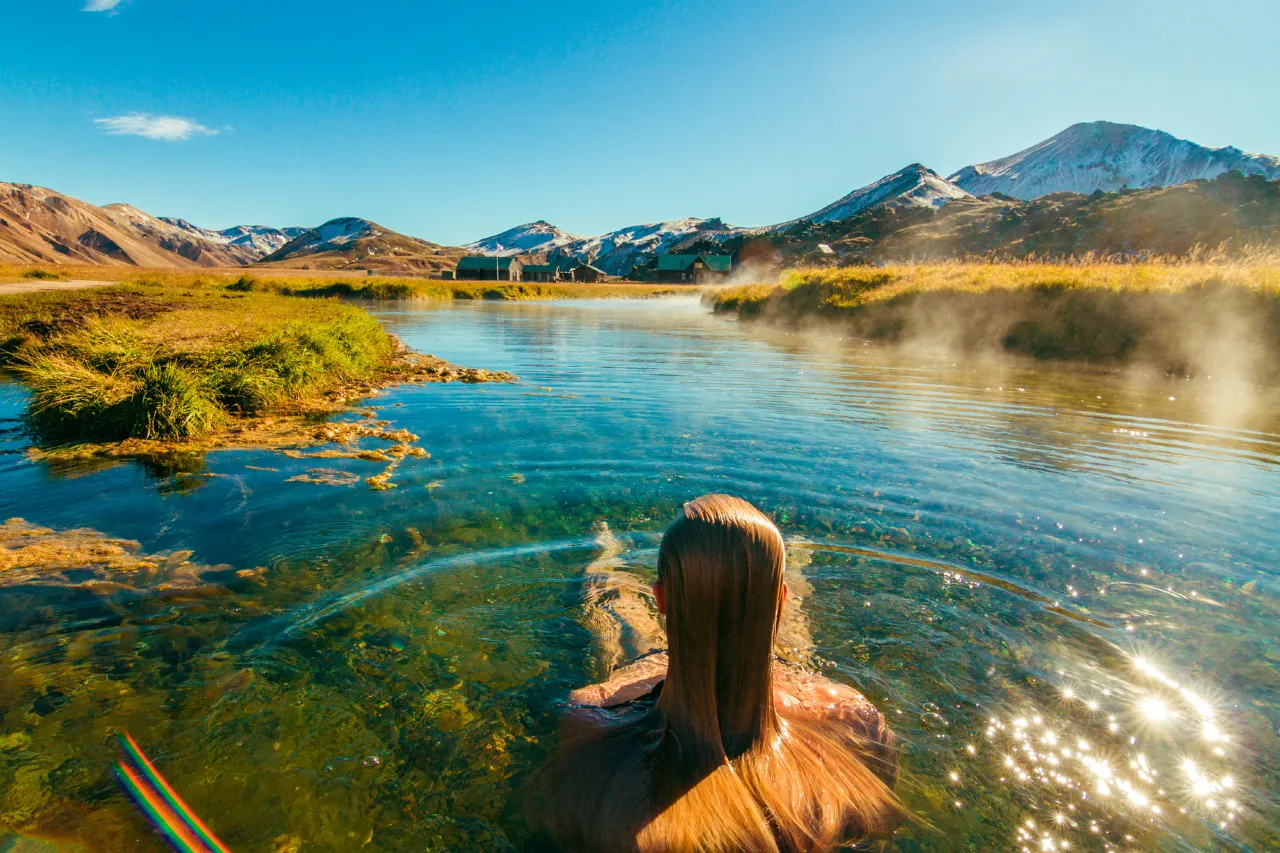
Practicalities: there are no changing rooms at the river, so travelers wriggle behind the banks with varying degrees of grace — a dry robe or big towel makes you look like you planned it. Water shoes help with the stony bottom; a dry bag keeps clothes wind-free. And the cardinal rule of Reykjadalur: the moment you leave the water, the wind owns you. Get dressed immediately, layer up, and only then enjoy the view — the after-bathe chill is the hike’s real rite of passage.
From real trips: our standard visit starts at the trailhead by eight in the morning, reaches the river around nine, and has the best pools nearly empty for an hour — then we walk down as the first tour groups climb up. The same valley at two in the afternoon in July is a popular place with a queue for the good pools. Timing is the only luxury that costs nothing here.
Best times, crowds & light
Early morning is the connoisseur’s slot: empty trail, steam caught in low light, the valley to yourself. Evening is the photographer’s slot — golden light rakes the slopes, and in summer the midnight-sun window stretches the day so far that “evening” can mean ten o’clock. Midday in high summer is when the tour buses arrive and the boardwalks hum; the experience stays good but communal. Weather outranks all of it: a calm overcast day beats a sunny gale, and the forecast apps (Veður, backed by en.vedur.is) should pick your slot, not the itinerary.
Crowd math for planning: weekends run busier than weekdays, July and August are the peak, and the pool density thins noticeably the further upstream you walk — most visitors settle into the first good stretch below the main hot-spring inflow. If solitude is the goal, keep walking upstream (safely, along the bank) and the valley rewards you.
Winter visits & icy trails
The trail stays walkable most winter days, and a hot river under snow is one of Iceland’s best-kept seasonal images — steam rising through -5°C air, banks trimmed with ice, nobody upstream of you. The catch is underfoot: icy patches form on the packed sections, especially on the shady side of the hill, and the boardwalks freeze. Traction devices (simple crampon-style straps) are the difference between a confident walk and a nervous one; bring them from November through March without debate.
Daylight is the other winter constraint — in December the useful window is a few hours around midday, which conveniently is also the warmest slot. Check both the road status on road.is and the forecast on en.vedur.is before setting out; wind events close the experience faster than cold does. And bathe conservatively in winter: the air-to-water differential that makes the river delightful in January also punishes any delay in getting dressed afterwards.
With kids & first-timers
The hike is a genuine family option — the trail is moderate, the boardwalk section is interesting enough to keep children moving, and the reward is swimming, not another viewpoint. Two rules make it work: keep children on the paths at all times (the geothermal ground is the hazard, not the trail), and hold small children’s hands near the water — the hot zones near the inflow run scalding, and the comfortable-looking stretches change temperature as the flow shifts. Pack more snacks and layers than seem necessary; children cool down faster after a swim than adults do.
For first-timers to Iceland generally, Reykjadalur is the ideal day-one excursion: short enough to fit a jetlagged schedule, free enough to forgive a weather cancellation, and authentic enough to reset your expectations of what the country offers beyond the famous ring sights. If the clouds close in, the fallback options below are minutes away.
Hveragerði, Þingvellir & the Golden Circle
Hveragerði itself deserves an hour: a flower town built on greenhouses heated by the same geothermal system that feeds the valley, with bakeries that bake rye bread using ground heat — grab a loaf and you have the perfect post-hike snack with a story attached. The town’s services (fuel, pools, cafés) make it the natural bookend for the hike; the local public pool is an excellent consolation soak if the wind wins.
Geographically, the trailhead sits conveniently between the capital and the country’s classic routes: Þingvellir National Park is a short drive west — the rift valley and its history are covered in our Þingvellir guide — and the full Golden Circle loop connects cleanly onto the same road, as laid out in our Golden Circle guide. Hike in the morning, Þingvellir in the afternoon: that combination is the best single day out of Reykjavik we know.
Frequently asked questions
How hot is the river in Reykjadalur?
It varies stretch by stretch: hot-spring inflow makes some sections properly hot, while the mixed flow downstream runs pleasantly warm. Test with a hand before committing, move a few metres rather than forcing a spot, and never enter near the source vents, where water runs scalding — geothermal water emerges at 80–100°C.
Is the hike really free?
Yes — the trail and the bath cost nothing, which is why we call it the best-value soak in the country. The trailhead parking is paid, and gear like towels or traction devices are your own costs; there are no tickets, no facilities and no services at the river itself.
Can you do it in winter?
Most winter days, yes — bring traction devices for icy sections, aim for the midday daylight window, and check road.is and the forecast first. The river stays warm all year; the challenge is the wind chill and the footing, not the water.
What should I bring?
Swimwear, a towel, water shoes, and — the part visitors underestimate — a warm layer to put on immediately after bathing, because the wind chill is real. Add water and snacks, a dry bag for clothes in wind, and traction devices between November and March.
How long does the whole trip take?
Three to four hours door to door from Reykjavik: about 45 minutes of driving each way, 1–1.5 hours hiking up, as long as you like in the river, and a quicker walk down. First-timers should add slack for weather and for the boardwalk’s photography gravity.
Build the perfect first-day plan
Pair the hot river with Þingvellir or a Golden Circle run — our route guides show how.
Keep the bathing theme going: the full lagoon-versus-pool comparison lives in our hot springs beyond the Blue Lagoon guide, the season-proof gear list in the packing guide, the safety basics in our 112 & safetravel guide, and the cost math in the budget travel guide.
Sources & official references
- Official Icelandic services: en.vedur.is (weather and wind forecasts), road.is (route status around Hveragerði), safetravel.is (geothermal-area safety guidance) — checked 2026.
- Trip.com Iceland destination guide (checked 2026): Reykjadalur listing — trail profile, free access, parking note and recommended visit length.
- Local trail information for the Hveragerði–Reykjadalur route: marked path, boardwalk sections over geothermal ground, paid trailhead parking; conditions as posted 2025–2026.
- Shared national facts: geothermal water at source runs 80–100°C; emergency number 112 with the 112 Iceland app.
- Editorial visits by the Iceland Travel Guides team across seasons, most recently 2025–2026.
