








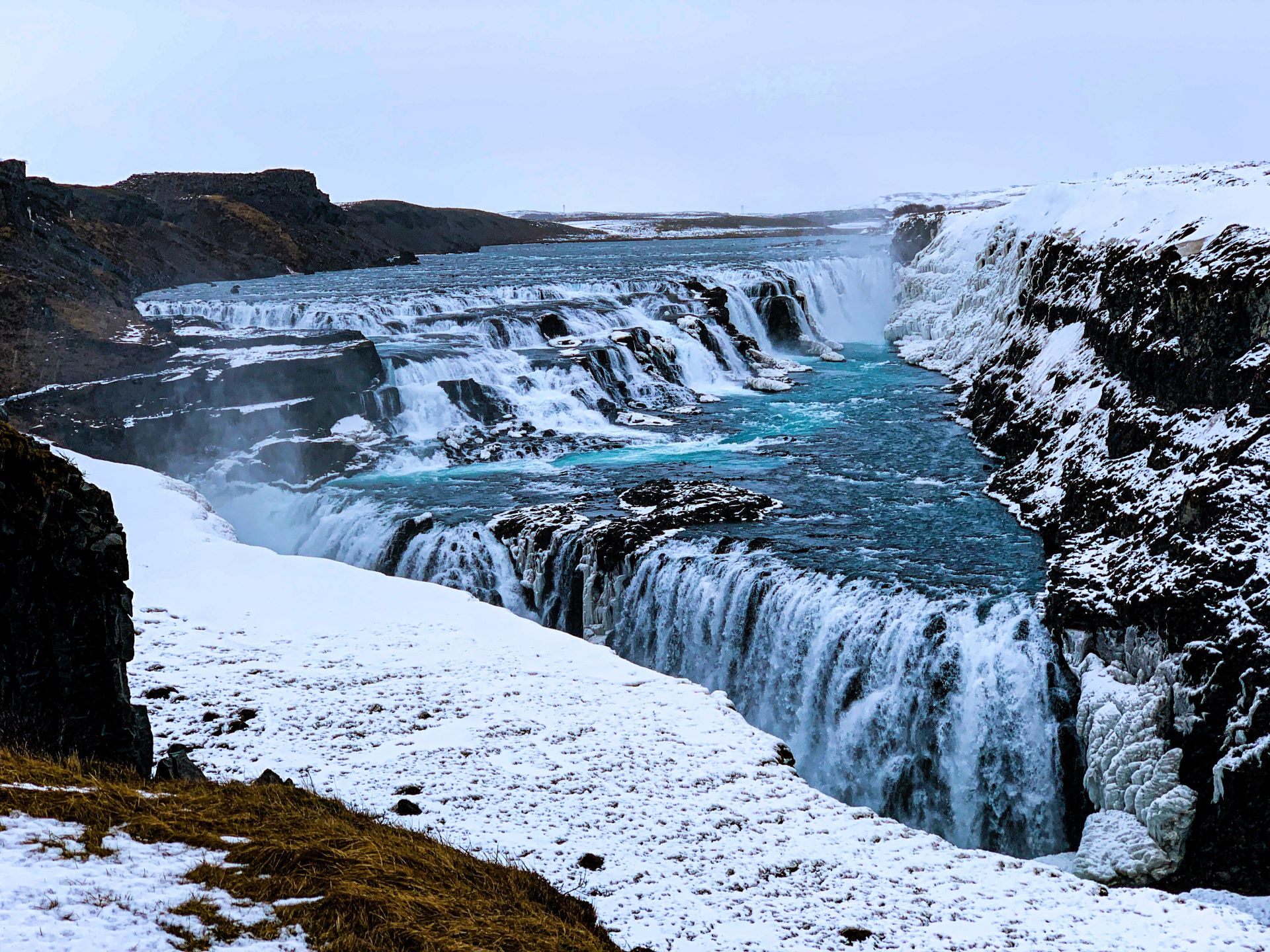
This is spot 8 of 20 in our Iceland Photography Guide — the golden waterfall. Gullfoss is the Golden Circle’s photographic anchor: the Hvítá river drops 32 metres in two tiers and disappears into a basalt crevice so close to the path that spray is part of the experience. The master guide’s field tip compresses the essentials — “wide lens; the lower path closes when icy” — and the “afternoon rainbows” entry in the best-light column tells you which hour earns the frame. Our team has shot Gullfoss in every season, and it remains the one major Icelandic waterfall where the geometry does half your composition for you: the 90-degree turn of the falls means the best angles are about position, not luck.
This guide covers the two viewing levels and the path rules that change with the weather, the rainbow window, the tiers-and-crevice compositions, the winter ice transformations, and how Gullfoss fits the Golden Circle day alongside Strokkur Und Þingvellir.
Key takeaways
- Afternoon is the light window: the sun’s southwest arc enters the gorge and builds rainbows over the lower tier — the master list’s “afternoon rainbows” is a schedule, not a hope.
- Wide lens mandatory: the viewing path runs metres from the crevice — 16–24 mm is the working range; long lenses only for the tier isolations from above.
- Two levels, two genres: the upper path gives the full two-tier panorama; the lower path (when open) puts you level with the canyon mouth — close, loud, soaked.
- The lower path closes when icy: exactly as the master guide warns — winter shooting is usually an upper-path genre unless conditions open the descent.
- Gray light for the classic: even sky cleans the white-water mass; sun is for the rainbow frames — the same visit switches genres with the clouds.
Quick answer: start on the upper path for the full two-tier panorama (16–35 mm, tripod, 1–4 s), then take the lower path if it is open and shoot the canyon-mouth frames (f/11, polarizer, lens cloth mandatory). Stay through the afternoon: the rainbow window over the lower tier is the frame worth waiting for. In winter, assume upper-path-only and shoot the ice-draped falls in gray light.
Access, paths and the icy-closure rule
Gullfoss sits ninety minutes from Reykjavík on Road 35, with a large free car park, café, and a short walk to two viewing levels. The upper path runs along the gorge rim to a viewpoint above the falls — open year-round, flat, the panorama angle. The lower path descends to the canyon mouth beside the water — the dramatic level, and the one the master guide warns about: it closes when icy, which in practice means most of winter and any freeze-thaw day in shoulder seasons. The closure signage is enforced and honest; shoot the upper frames on closed days rather than treating the barrier as optional.
Both paths are short (five to ten minutes from the car park), which makes Gullfoss the easiest major waterfall session on the list — and one of the busiest. Coaches dominate from 10:00 to 16:00 in summer; the dawn and evening windows give photographers the gorge nearly alone, and the evening light is precisely the rainbow-adjacent hour that works.
One access note for winter: Road 35 beyond the falls climbs to the highlands and closes — Gullfoss itself sits at the closure gate, always reachable in winter via the maintained section from the Ring Road side.
The afternoon rainbow window
The gorge runs roughly east-west with the falls’ face turned south-southwest; from early afternoon the sun’s position sends direct light into the gorge, and the spray cloud over the lower tier builds rainbows — first single, sometimes double, strongest from roughly two hours after midday through late afternoon on clear days. In summer the window stretches wide; in winter the low sun can throw its light into the ice-draped gorge for a brief, spectacular hour around midday.
Gray days flip the genre: even sky is the condition for the clean white-water classic — the two-tier mass reading as one graphic shape, the moss flanks saturated. Gullfoss’s power shot is a gray-light shot; the rainbow is the sun-bonus. Watch the sky and swap genres in the same visit — the gorge is small enough that switching positions takes minutes.
Wind matters more than at most falls: the crevice funnels gusts, spray travels, and the lower path in wind is a lens-cleaning exercise. The en.vedur.is hourly wind settles whether the lower frames are worth the gear cycle that day.
Compositions that work
The falls’ 90-degree turn does the composing; your job is choosing the layer stack:
- The two-tier panorama: from the upper path, 16–35 mm, both tiers stacked with the crevice disappearing bottom-right — the classic. Vertical frames hold the whole drop; horizontals give the river’s approach. Tripod, 1–4 s.
- The canyon mouth: from the lower path (when open), level with the water — the 21-metre lower tier fills the frame, spray everywhere, the crevice wall on your left. 24 mm, f/11, cloth cycle mandatory. This is the “standing inside the waterfall” feel and the reason the wide-lens rule exists.
- The rainbow over the tier: afternoon sun, 50–100 mm from either level, the arc crossing the lower fall. Fast shutter, polarizer off, re-shoot as the arc drifts.
- The river approach: the Hvítá’s glacial-gray water braiding toward the lip, shot from the upper path with the falls compressed in the distance — the quiet frame that most visitors skip.
People management: the lower path is narrow and single-file in places; the dusk and dawn windows solve it. The gorge photographs without a single tourist by 21:00 in summer — and that is when the rainbow-adjacent light returns.
Settings and technique
The water here is glacial-white and constant; exposure discipline is the whole game. Meter for the water, shoot RAW, keep the white mass unclipped (the histogram’s right edge is the truth), and let the moss and basalt go dark. Long exposure 1–4 s keeps the tiers’ structure while smoothing the surface; 10+ seconds needs the ND and reads softer. Polarizer: on for the moss and wet rock, off for the rainbow frames.
The lower-level frames eat gear: full rain cover, hood on, vertical cloth wipes before every burst, and a second cloth in a chest pocket because the first one is wet by frame three. Tripods on the lower path need sure footing — the gravel is polished and wet; one leg downstream, bag hanging from the column (the master guide’s wind rule applies even without wind, for spray-stability).
Wide-lens discipline: 16–24 mm is the range, and the temptation is to go wider still — resist; the gorge walls close in and the falls compress. The compositions that work put the water’s turn in frame, not just its drop.
Winter: the ice transformation
Gullfoss is the master-list waterfall that changes most in winter: the gorge rims build meters of ice and snow, the falls shrink to a blue-black ribbon between ice palaces, and the whole scene becomes a genre the summer crowd never sees. Shoot it from the upper path in gray light — the ice’s blue tones need even sky — with the usual cold kit (spare batteries warm, microfiber cloths stiffen, tripods ice at the joints).
The lower path’s icy closure is enforced for good reason, but the upper path’s ice is managed and gritted — photograph the falls from above, and treat any open lower path in thaw as a lottery you do not need to enter. The winter travel guide covers the season’s gear and driving rules that make a Gullfoss winter session possible.
Pairing the Golden Circle day
Gullfoss is the photographic anchor of the Golden Circle: Þingvellir fifty minutes west for the rift and (in season) aurora, Strokkur twenty minutes east for the eruption game, Kerið crater a detour south for the red-lake frame. The standard photographer’s day: Þingvellir first at morning light, Strokkur midday for the rhythm-of-eruptions frames, Gullfoss last for the afternoon rainbow window — the order the master guide’s light columns imply.
Der Golden Circle guide covers the route’s own logistics, and the complete Gullfoss guide carries the falls’ history — including Sigríður Tómasdóttir’s fight to save them from a hydro contract, the story that made Gullfoss Iceland’s most protected waterfall.
Frequently asked questions
When is the lower path actually open?
Roughly late spring through autumn in normal weather, and any winter day when the site team judges the descent safe — the master guide’s rule (“closes when icy”) is enforced and the closure is announced on site. Plan the upper-path compositions as your guaranteed frames; treat the lower level as the bonus.
What makes Gullfoss different from the south-coast falls?
The turn and the crevice: the river drops two tiers and vanishes into a basalt crack metres from the path — a composition geometry no other major fall in Iceland repeats, and the reason the wide-lens rule is non-negotiable. Skógafoss is a curtain in a canyon; Gullfoss is a staircase into a crack.
Which hour for rainbows?
Afternoon on clear days — direct sun entering the gorge builds the arc over the lower tier, strongest from mid-afternoon on. The rainbow moves with the sun; re-shoot every ten minutes from the same position rather than repositioning.
Can I photograph Gullfoss and the Golden Circle in one winter day?
Yes — the Circle is the one region that works as a winter day: Þingvellir and Strokkur stay accessible, Gullfoss’s maintained road section always reaches the falls, and the short daylight compresses everything into three clean stops. Run the winter rules on roads and light, and expect the ice-draped falls rather than the rainbow.
The full field list lives in one place
Spot 8 of 20 — the master guide ranks all twenty locations by region, best light and a field tip for each.
Go deeper: the complete Gullfoss guide, the Golden Circle route guide, and the weather planning guide for the sky-reading habits that choose between the rainbow and the classic.
Sources & official references
- Fall dimensions (32 m total, two tiers) per published survey figures and site signage.
- Path closures and access: Gullfoss visitor area information (checked 2026); Road 35 winter status per road.is.
- Conservation history (Sigríður Tómasdóttir): published accounts cited in the complete Gullfoss guide.
- Rainbow timing and technique: editorial photography trips across seasons 2022–2026 by the Iceland Travel Guides team.
- Master list context: Iceland Photography Guide — 20 Best Photo Spots (this site).
