









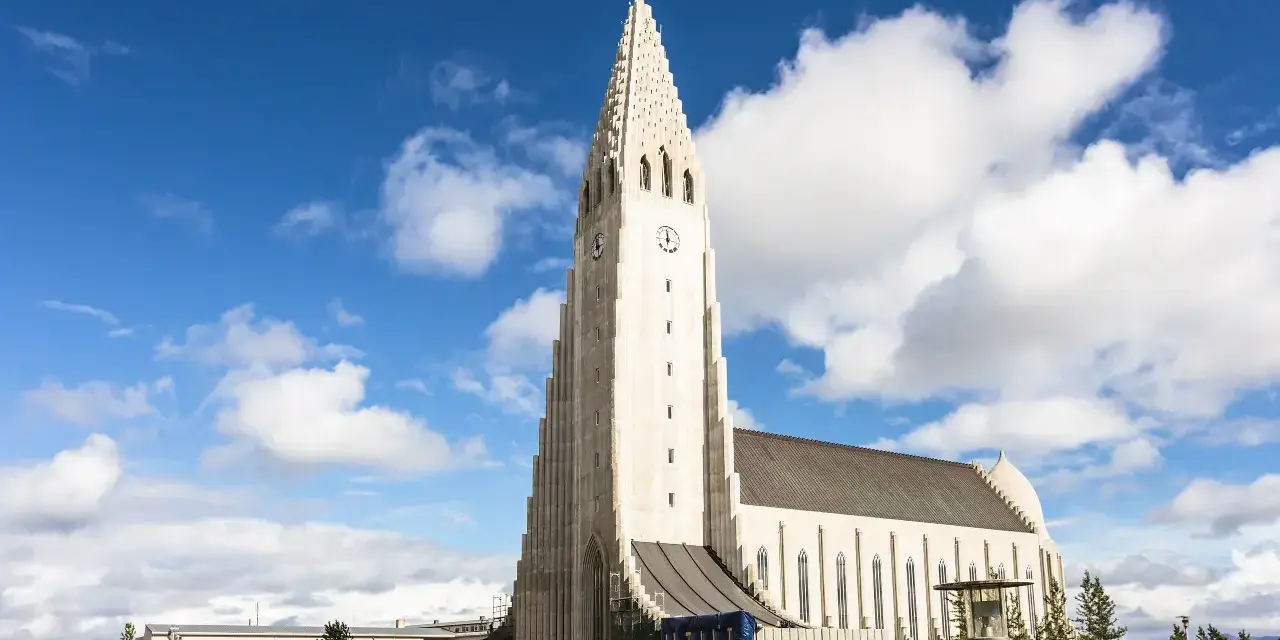
This is spot 19 of 20 in our Iceland Photography Guide — the capital’s two icons. Hallgrímskirkja and Sun Voyager sit four kilometres apart in Reykjavík and make one evening session: the 73-metre basalt-inspired church tower that anchors every city skyline frame, and Jón Gunnar Árnason’s steel sun-ship on the waterfront that anchors every sunset-over-the-bay frame. The master list’s field tip sequences them — “tower view first, waterfront steel sculpture second, café after” — and the blue hour is the light that joins both.
This is also the master list’s practical-entry genre: no hikes, no tides, no weather gamble — just the city’s geometry at its best hours. This guide covers the tower (and its observation deck), the church exteriors from every useful angle, the Sun Voyager compositions, the blue-hour logic, and the café-after that is genuinely part of the workflow.
Key takeaways
- Tower first: the observation deck (small ticket, lift most of the way) gives the city-from-above frames at the golden-hour-to-blue-hour turn.
- The basalt geometry is the exterior subject: the facade’s column inspiration reads best in side-light — shoot the west flank late and the east flank early.
- Sun Voyager at sunset and blue hour: the steel ship silhouettes against the bay — the master tip’s second stop, best in the last hour of light and after.
- Blue hour joins both: the master list’s pick — tower interiors and waterfront silhouettes share the same evening gradient.
- Cafe after is the workflow: the master tip’s third step — Café Loki opposite the church (the archive’s own shot) is the warm-up between genres.
Quick answer: arrive at Hallgrímskirkja ninety minutes before sunset: shoot the facade’s side-light, ride the tower for the city overview, and work the surrounding streets’ frame-with-the-tower angles as the light falls. Move to the waterfront for Sun Voyager through sunset and blue hour — silhouettes, reflections, the bay’s gradient. Finish with the café (Loki opposite the church, or the harbor strip). Rain? Both genres survive — the tower interior and the steel-in-storm are their own frames.
The tower and the deck
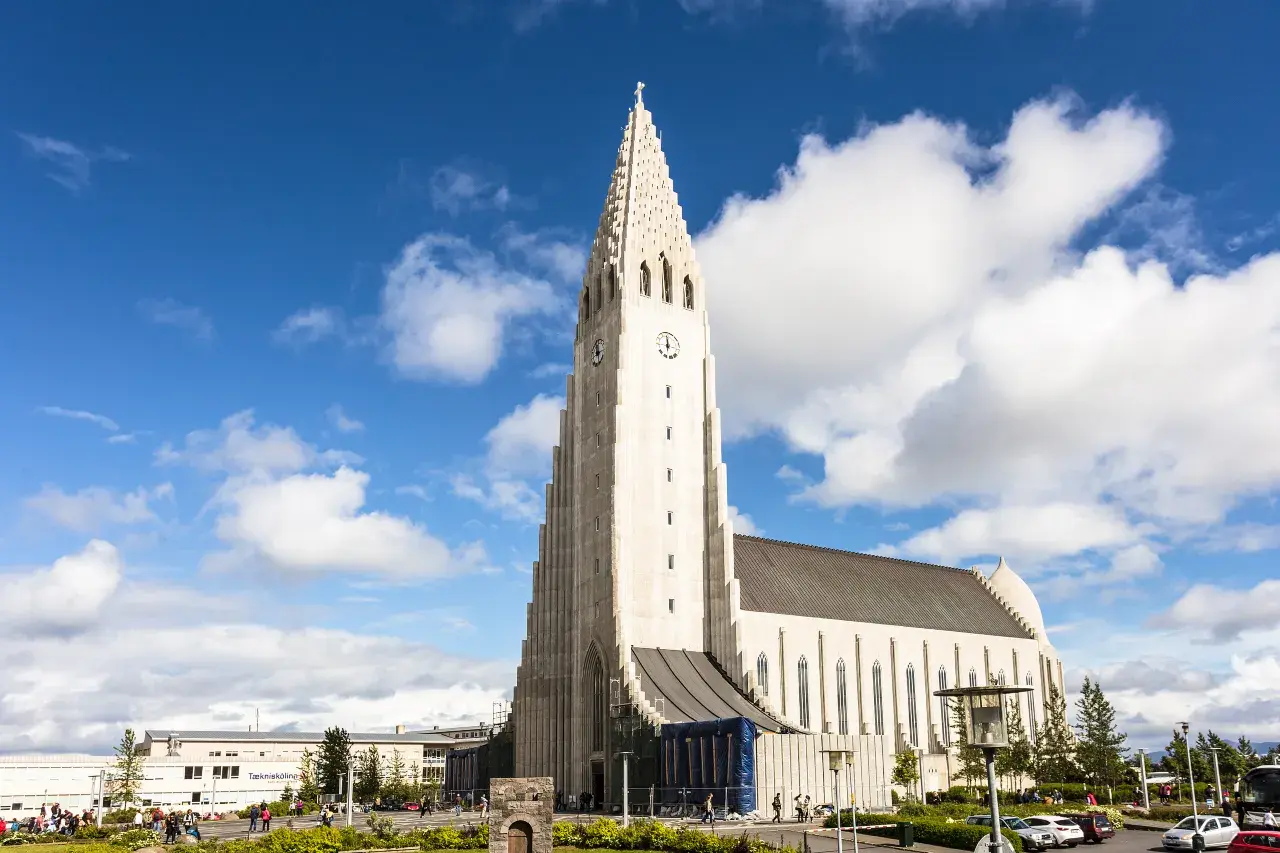
Hallgrímskirkja — designed by Guðjón Samúelsson, built 1945–1986, inspired by the basalt columns of Icelandic lava — is the capital’s vertical reference, and its observation deck is the city’s best free-ish view: a small ticket at the tower entrance, a lift most of the way, and a bison-of-a-balcony with 360° over the rooftops, the bay and (on clear winter evenings) the mountains. The master tip’s “tower view first” is a sequence instruction: shoot the city from above at the golden-hour turn, when the low light models the roofscape and the harbor reflects the sky’s warm side.
Deck technique: fast lens discipline (the balcony rail and the evening light both argue for the tripod-less approach — 1/60 s+ hand-held), the 24–70 mm as the working range, and the deliberate horizon discipline the deck’s tilt-and-glass windows punish. Watch the tower’s own lights come on at dusk — the silhouette-with-lit-windows frame from the street below is the session’s bridge between genres.
Der complete Hallgrímskirkja guide covers the church’s history, the Samúelsson design story and the deck’s practical detail; the deck’s hours vary seasonally — check on arrival, not afterward.
The church exterior compositions
The facade’s basalt-inspired geometry gives four dependable frames:
- The straight-on icon: 16–24 mm from the steps, the symmetric facade filling the frame — the postcard that works at blue hour when the floodlights come up.
- The side-light flank: from the west (late) or east (early), the column-texture raking — the composition that shows the basalt inspiration instead of asserting it.
- The street-context frame: the tower down a perspective of colored-roof streets — 35–50 mm from the lower streets northwest and south, the church as the skyline’s anchor with a human-scale foreground.
- The Leif Eriksson statue: the equestrian statue in front of the facade — the church’s own scale element and the classic foreground for the straight-on frame.
Der aurora-in-Reykjavík guide notes the church square’s own aurora genre: on strong nights the tower silhouette under the lights is a legitimate capital frame.
Sun Voyager compositions
The Sun Voyager (Sólfar) — Jón Gunnar Árnason’s steel dream-ship on the Sæbraut waterfront, unveiled in 1990 — is the master tip’s second stop, and its compositions run on the bay’s light:
- The sunset silhouette: the ship’s ribs against the setting sun over the bay — 35–70 mm, the sculpture as the graphic element in the gradient. Low angle, the sculpture’s own lines doing the drawing.
- The blue-hour steel: after the sun drops, the sculpture silhouette against the pastel bay with the city lights waking behind — the master list’s blue-hour pick.
- The reflection frame: wet pavement after rain or the bay’s edge water doubling the ship — polarizer off, get low, the ship twice in one frame.
- The storm genre: the same steel in heavy weather — spray, dark sky, the ship refusing to move. A legitimate and under-shot version.
People: the sculpture is a magnet — patience windows clear it at sunset, or include the photographers themselves (the “photographing the photographer” frame is the honest city genre).
Blue hour and the session sequence
The master list gives the pair blue hour, and the sequence is the session: tower view first (golden-hour city overview), waterfront second (sunset silhouette into blue-hour steel), café after (the warm-up and the card-backup). In Reykjavík’s summer the blue hour stretches long (the midnight sun keeps a residual glow for hours); in winter it compresses but compensates with the earliest aurora chances over the bay. The en.vedur.is clock and the seasonal sunset table run the schedule — the session’s two stops share one gradient, which is the design.
Rain and wind: the city genres survive both — the tower’s interior and the church’s floodlit facade work in weather that kills the mountain spots, which is exactly why the master list keeps a capital entry: the bad-weather evening that still produces frames.
Settings and technique
Blue hour is tripod-adjacent: the Voyager silhouettes want f/8, ISO 64–100, 2–8 s with the tripod (the waterfront’s rail and the sculpture’s plinth are legitimate braces when the crowd is thick), and RAW to hold the gradient. The tower deck runs hand-held discipline (1/60 s+, stabilization on, ISO auto-capped 1600). The church floodlights at dusk meter +0.3 EV for the facade’s white concrete; the street-context frames run normal city discipline with the 35–50 mm.
The reflections genre: watch the pavement — Reykjavík’s rain is frequent and the wet-street doubling is the city’s easiest gift. Polarizer off (the reflection is the subject); f/8; the low angle from the kerb.
The capital’s wider frames
The session extends naturally: Harpa’s glass facade photographs at the same blue hour (the harbor’s other graphic subject), the Perlan dome (its own guide) rides the skyline from the deck, and Grótta’s lighthouse at the bay’s end is the capital’s aurora wildcard when the lights are strong. The Reykjavík city guide and the neighborhood guide cover the city-side logistics; the food guide handles the café-after in depth — the master tip’s third step is a real recommendation.
Frequently asked questions
Is the tower deck worth the ticket?
Yes — the city-from-above frame at the golden-hour turn is the session’s unique view (nothing else in the capital reaches this height), the ticket is small, and the master tip’s sequence starts there for a reason. Check deck hours on arrival; they shift seasonally.
Sun Voyager at sunset or blue hour?
Both, in one session — the sunset silhouette and the blue-hour steel are different photographs of the same sculpture, and the master list’s blue-hour pick is the second half of the gradient. Arrive an hour before sunset; stay an hour past.
What if the weather is bad?
The capital genres survive weather that kills the mountains: the tower interior, the floodlit church, the steel-in-storm Voyager and the wet-pavement reflections are all bad-weather frames. This is why the master list keeps a capital entry — the evening that still produces work.
Can I catch aurora over these icons?
On strong nights, yes — the church tower and the bay’s waterfront photograph under the lights (our Reykjavík aurora guide covers the capital’s options and the Grótta alternative). The spot-20 recipe applies; the city glow means the lights need to be active, not faint.
The full field list lives in one place
Spot 19 of 20 — the master guide ranks all twenty locations by region, best light and a field tip for each.
Go deeper: the complete Hallgrímskirkja guide, the Reykjavík city guide, and the aurora-in-Reykjavík guide for the capital’s night genre.
Sources & official references
- Church facts (73 m tower, Guðjón Samúelsson design, 1945–1986 construction, basalt-column inspiration): published church and architectural records.
- Sun Voyager facts (Jón Gunnar Árnason, unveiled 1990, Sæbraut waterfront): published public-art records.
- Tower deck hours and tickets: Hallgrímskirkja visitor information (checked 2026); verify seasonally.
- Light and session planning: en.vedur.is sunset and cloud data.
- Editorial photography trips across seasons 2022–2026 by the Iceland Travel Guides team.
