


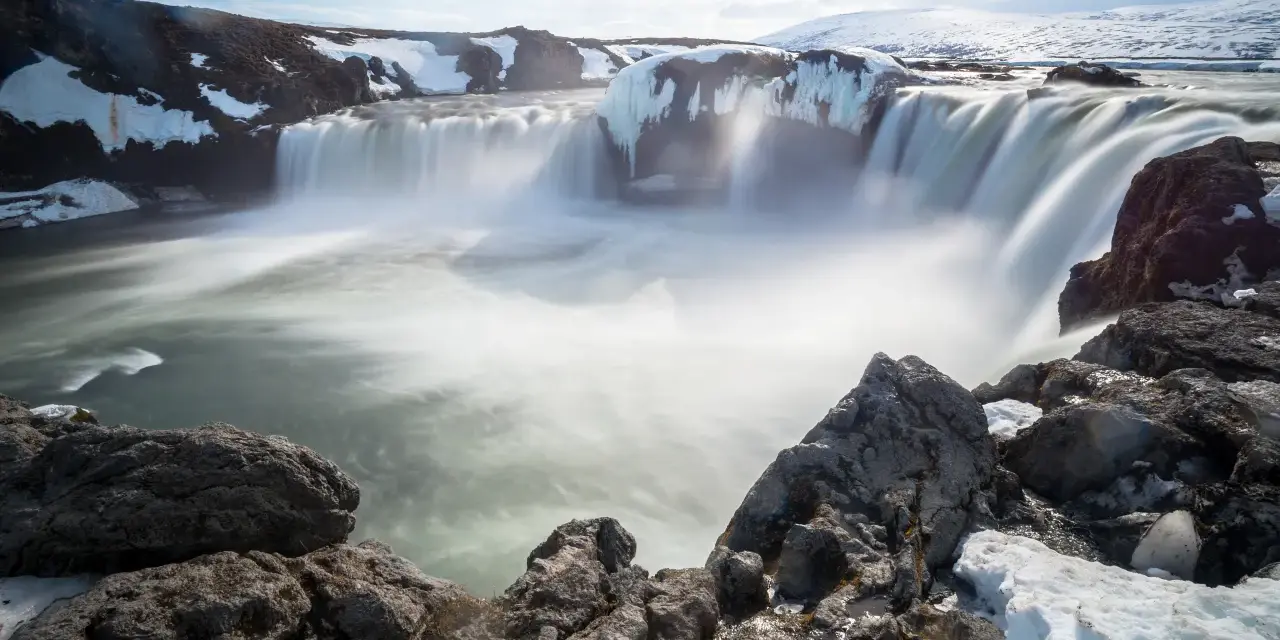
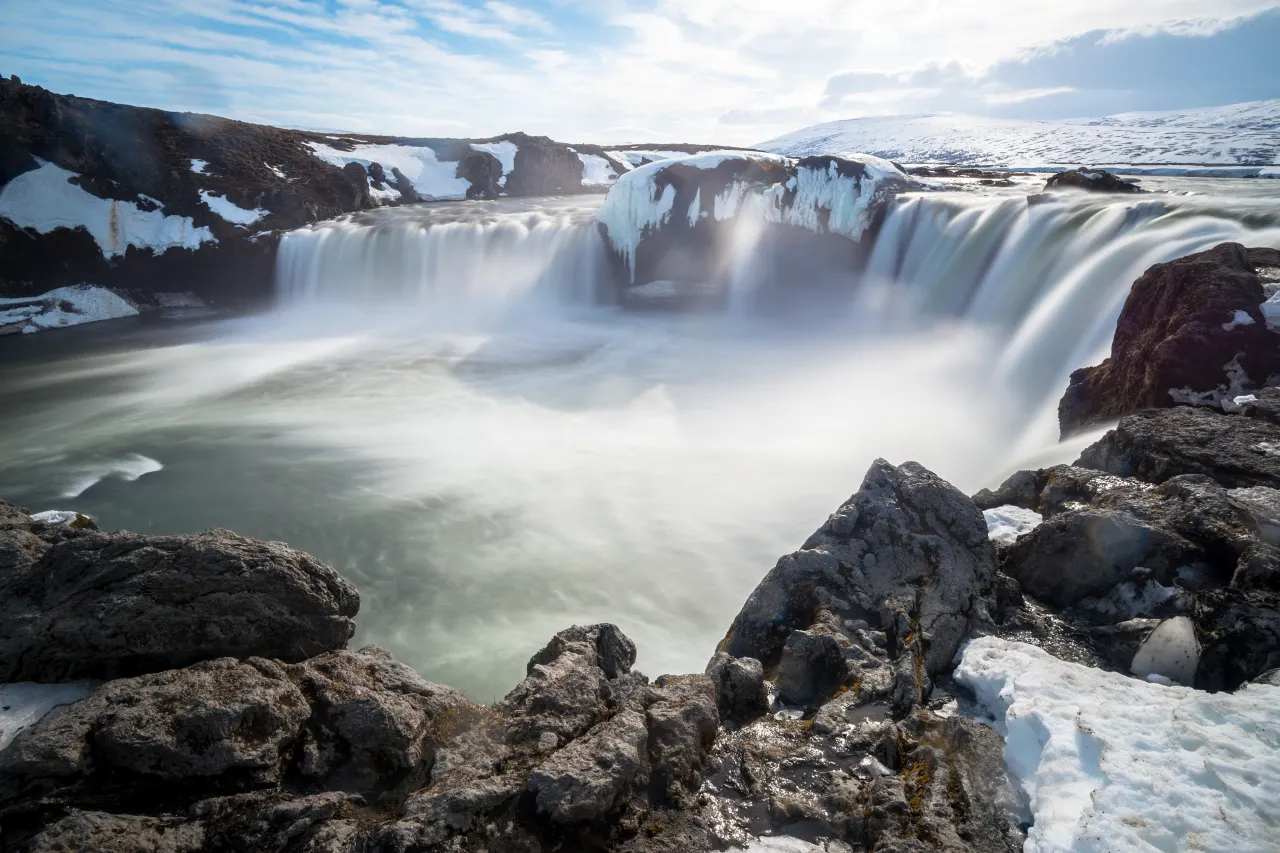
This is spot 15 of 20 in our Iceland Photography Guide — the waterfall of the gods. Goðafoss, where the Skjálfandafljót river spreads twelve metres of falling water across a thirty-metre horseshoe, is the master list’s winter pick: “winter ice and the horseshoe,” with the field tip naming the frame — “the horseshoe edge frames aurora on clear nights.” It is the most photogenic waterfall in the north and the most forgiving: two banks, easy walking, an icon that composes itself from almost any angle.
The name carries the story — in the year 1000, when Iceland’s assembly voted to convert to Christianity, the law-speaker Þorgeir reportedly cast the old pagan idols into this falls — and the horseshoe has been framing Icelandic light ever since. This guide covers both banks, the winter-ice genre, the aurora-on-the-horseshoe frame, the summer-versus-winter question, and how Goðafoss sits inside the north’s densest master-list cluster.
Key takeaways
- Winter is the signature season: the master list’s pick — the horseshoe under ice and snow is the fall’s defining image; summer is green and lovely but less distinctive.
- Shoot both banks: the west bank gives the head-on horseshoe; the east bank gives the edge-on and downstream angles — ten minutes apart on foot.
- The horseshoe edge frames aurora: the master tip’s line — clear dark nights, the falls as foreground, the lights over the north horizon; the spot-20 recipe applies.
- Wide and long both work: 16–35 mm for the full horseshoe; 70–200 mm for the individual curtains at the edge’s right side.
- It is the Ring Road’s gift stop: directly on Route 1, no detour, forty minutes from Mývatn and Akureyri alike.
Quick answer: stop at the west-bank lot on Route 1 (the falls are visible from the bridge), shoot the head-on horseshoe at 16–35 mm — tripod, 1–4 s in gray light, polarizer for the green flanks in summer. Walk the path downstream and cross to the east bank for the edge-on angle. In winter, treat the paths’ ice with respect and shoot the ice-framed horseshoe; after dark on clear nights, run the aurora recipe with the horseshoe edge as foreground.
Access and the two banks
Goðafoss sits directly on the Ring Road where Route 1 crosses the Skjálfandafljót — no detour, parking on both sides of the river bridge, and the falls audible from the car. The west bank (same side as the hotel and café) gives the head-on horseshoe from a low gravel bank minutes from the lot — the classic, and the aurora edge. The east bank paths run along the rim to the edge-on angle and the downstream view of the river bending away. Both are free, flat and short — Goðafoss is the easiest major waterfall access in the north.
Winter access stays reliable (the Ring Road is the country’s best-maintained line and the lots are plowed), but the paths ice: microspikes are the honest recommendation, and the rim edges deserve the same respect as any canyon — the master guide’s trail rules apply. The winter travel guide covers the traction and driving kit that makes cold-season falls work.
Crowd logic: Goðafoss is a coach stop between Akureyri and Mývatn, busy 10:00–16:00 in summer — dawn, dusk and any winter weekday give the horseshoe back to photographers.
Winter ice and the seasonal question
The master list names winter, and the case is simple: ice transforms Goðafoss from a pretty curtain into a sculpture — the horseshoe’s edges grow frozen aprons, the flanking rocks wear ice beards, and the gray-blue palette of the season matches the water. On cold clear days the low sun grazes the ice and the whole falls glows; on gray days the graphic shape carries itself. Summer gives full green flanks, the widest flow, and the midnight-sun side-light — lovely, but the ice version is the one that fills portfolios.
The shoulder seasons have their own gifts: September’s clear nights restart the aurora game (below), and the autumn browns frame the horseshoe with color; spring thaw is the loudest version of the fall. The river never stops — the seasonal question is which genre you want, and the master list answers for most photographers: winter.
Gray-versus-sun at Goðafoss: the horseshoe reads cleanest under even sky (the graphic-curtain frames), while the ice seasons want whatever light is available — the low winter sun is always low enough to model the ice. The en.vedur.is clock matters mostly for the aurora half.
Compositions that work
The horseshoe geometry produces four dependable frames:
- The head-on horseshoe: west bank, 16–35 mm, the full curtain with the river’s exit leading out — the classic. Vertical frames stack the falls and the sky; horizontals give the curve’s sweep.
- The edge-on: east bank rim, 24–70 mm looking along the horseshoe’s lip — the falls foreshortened, the canyon beyond. The composition that shows it is a curve, not a line.
- The curtain isolations: 70–200 mm on the right-side curtains — individual ribbons over the lip, ice rims in winter, water texture at 1/4–1 s. The detail set that fills a Goðafoss gallery.
- The downstream curve: from the east bank, the river bending away under the bridge — the quiet landscape frame that gives the falls their place.
Scale: the horseshoe is wide but shallow-feeling at distance — the standard trick is the low west-bank angle with the curtain filling the frame’s width; from there the twelve metres read properly.
Settings and technique
The curtain game: tripod, 1–4 s at f/8–f/11 — long enough to silk the falling water, short enough to keep the horseshoe’s shape. The curtain isolations run 1/4–1 s; the fast-freeze genre (1/500 s+) exists but the ice seasons dominate. Polarizer: on in summer for the flanking greens and the wet rock, off in winter when every stop of light matters and the ice needs no help.
Winter technique adds the cold kit: batteries warm, cloths stiffen (keep them inside the jacket), tripod joints ice — the weather guide’s cold-session rules apply. Spray is mild at Goðafoss compared to Dettifoss or Seljalandsfoss — the west-bank low angle in wind is the only position that needs the rain cover as default.
The aurora edge
The master tip’s line — “the horseshoe edge frames aurora on clear nights” — is the north’s signature night frame: the falls as a white curtain foreground under green light, from the west bank’s low angle. The recipe is the spot-20 standard (ISO 1600–3200, 8–15 s, manual focus on the falls’ edge before dark), with one Goðafoss-specific note: the river’s constant sound makes a lovely soundtrack and ruins nothing; the light pollution from Akureyri sits west, so keep the horseshoe against the northern horizon. September’s clear evenings are statistically the best bet; the winter ice version — aurora over the frozen horseshoe — is the frame of the whole north.
The north cluster
Goðafoss is the western anchor of the north’s master-list cluster: Hverir at dawn, Dettifoss mid-morning, the Mývatn circuit at midday, Mývatn Nature Baths at dusk — and Goðafoss either first (dawn light on the ice) or last (the aurora edge). Akureyri, forty minutes west, is the practical base with the region’s best services and its own city guide.
Season pairing: winter days handle two stops comfortably (short light); summer days handle the full cluster plus Húsavík in the whale season. The Ring Road guide sequences the north’s stretch in detail.
Frequently asked questions
Is Goðafoss really better in winter?
For photographers, yes — the ice transformation is the fall’s signature image and the master list says so explicitly. Summer gives the widest flow and the greenest flanks, but the frozen horseshoe is the frame that defines the north. Microspikes and the winter driving kit make the cold-season visit straightforward.
Which bank for the classic shot?
West bank for the head-on horseshoe (and the aurora edge at night); east bank for the edge-on and downstream angles. Both are minutes apart on foot — shoot both in one stop, they are genuinely different photographs.
How does the aurora frame actually work?
West bank, horseshoe as the lower foreground, lights over the north horizon; manual focus on the falls’ edge before dark; ISO 1600–3200, 8–15 s per the spot-20 recipe; keep Akureyri’s glow west of frame. September’s clear evenings and the winter ice season are the statistically best windows.
Do I need to worry about spray or ice?
Spray is mild (rain cover only at the windy low angles); ice is the real winter variable — microspikes on the paths, rim edges treated like canyon edges, and the plowed lots reached via the Ring Road’s maintained winter line.
The full field list lives in one place
Spot 15 of 20 — the master guide ranks all twenty locations by region, best light and a field tip for each.
Go deeper: the Mývatn geothermal guide for the cluster’s core, the aurora guide for the night recipe, and the Akureyri guide for the north’s base city.
Sources & official references
- Fall dimensions (12 m × ~30 m horseshoe) per published survey figures and site signage.
- Conversion story (c. 1000 AD, Þorgeir and the idols) per published Icelandic histories; recounted in regional interpretation materials.
- Winter road and path status: road.is and on-site signage (checked 2026).
- Aurora forecasting: en.vedur.is cloud and aurora outlooks.
- Editorial photography trips across seasons 2022–2026 by the Iceland Travel Guides team.
