









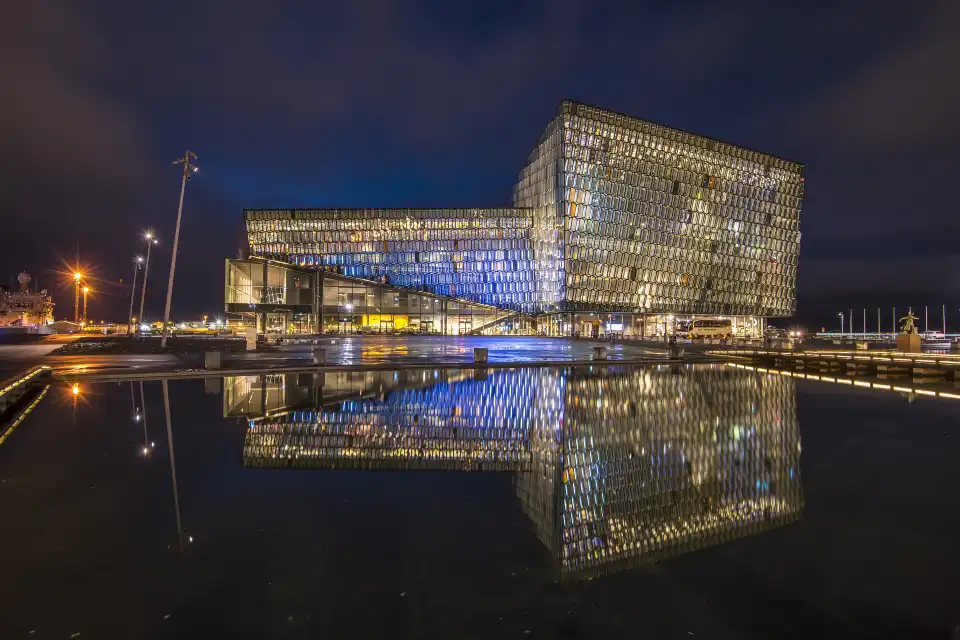
Harpa is the building that turned Reykjavík’s harbour into a destination: Olafur Eliasson’s honeycomb glass facade — thousands of glass bricks in basalt-inspired geometry — catches the bay’s light and throws it through the foyer in shifting spectra that change with every hour and every weather. Home to the Iceland Symphony Orchestra and the national opera, it is a working concert hall first and a free-entry light experience second; the foyer is open daily, and at blue hour the building performs its own show. Trip.Best ranks it #26 (4.3/5 from 52 verified reviews).
This is #26 of 39 in our Best Things to Do in Iceland guide. Below: the facade’s design story, what the free visit actually includes, the concert calendar logic (a concert ticket is the building’s real experience), and the capital evening sequence that ends at Harpa’s glass.
Principais conclusões
- Eliasson’s honeycomb: the facade’s glass-brick cells reference Icelandic basalt columns — the building is architecture and light installation at once.
- The foyer is free: open daily: walk the six foyer levels, watch the light change, no ticket needed.
- A real concert hall: Iceland Symphony Orchestra, opera and the big touring acts — the calendar is the building’s true programme.
- Blue hour is the show: the west-facing glass catches the bay’s sunset gradient; after dark the interior lighting takes over.
- Harbour-front position: between the Old Harbour and downtown — the whale sail (#4) departs next door; Sun Voyager (#21) 10 minutes along the waterfront.
Resposta rápida: Walk in (free foyer), climb the foyer levels for the facade’s interior angles, time your visit for late-day light through the west glass, check the concert calendar (a symphony night is the building’s best value), and pair the stop with the Sun Voyager (#21) sunset and the church tower circuit (#9) — the capital’s blue-hour trio.
The facade and the free visit
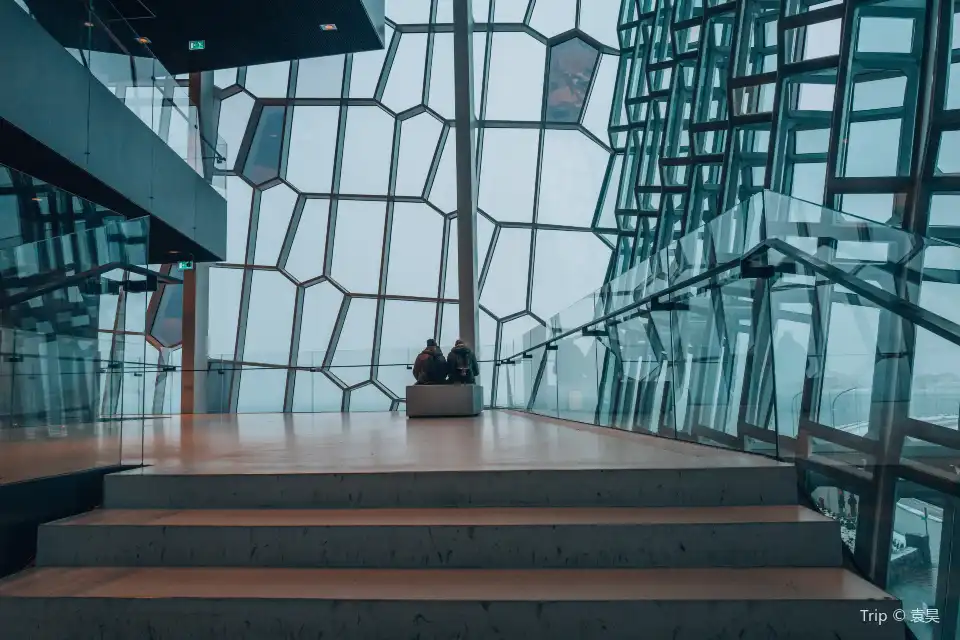
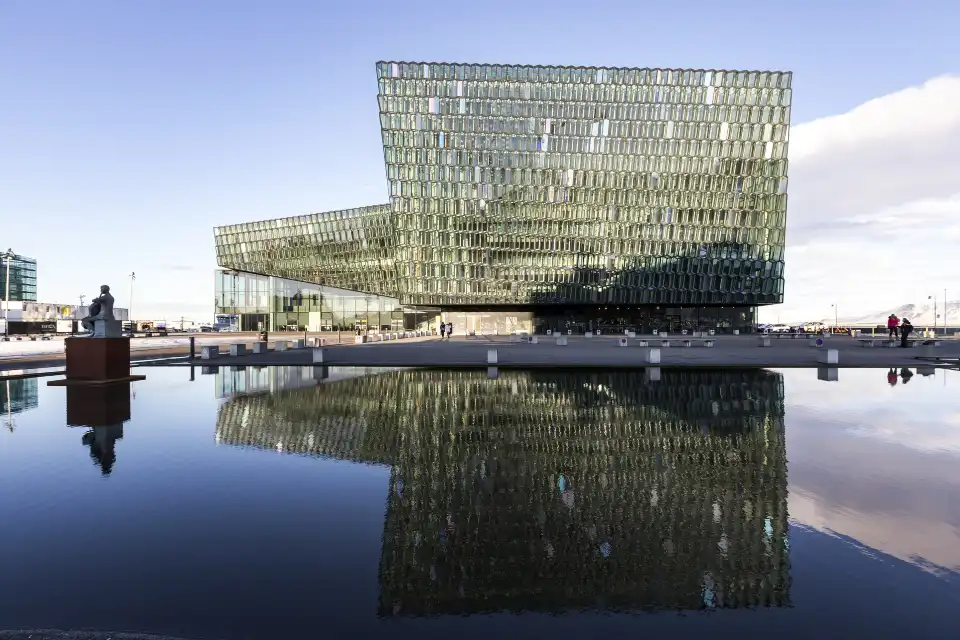
The design is a collaboration: Henning Larsen Architects’ building shape with Olafur Eliasson’s facade system — the honeycomb cells (quasi-brick glass units in basalt-inspired geometry) that give the building its name (Harpa: “harp”). The glass mixes steel-moiré and colour-filtered panels, so the facade performs differently all day: steel-grey in flat light, amber-and-green at sunset, deep blue at dusk, and internally lit after dark. Inside, the foyer’s six levels stack the same geometry — you walk through the light itself.
The free visit is legitimate: the foyer is open daily (hours vary by season), the levels are public, the cafe/bar sits mid-foyer, and the building’s scale — Iceland’s first true concert hall, opened 2011 in the financial-crash year as a statement of persistence — reads in every direction. The conference half of the building (Harpa is a conference centre too) stays behind doors; the performance spaces are the point.
The crash-story context: Harpa was under construction when Iceland’s economy collapsed in 2008; the half-built skeleton became the crisis’s symbol — and then the country finished it, and the opened building (2011) became the symbol of the recovery. Locals tell the story with pride; the architecture carries it.
The concert calendar — the real experience
A concert ticket converts Harpa from a light-show into what it was built for: the Iceland Symphony Orchestra’s season (autumn–spring calendar, guest soloists, the home of the national musical life), the Icelandic Opera’s productions, and the big touring acts in Eldborg hall’s acoustics. Prices run from modest symphony seats to premium touring nights; the calendar (harpa.is and the box office) is the booking layer, and summer visitors catch the festival and cruise-season programming.
The honest ranking logic: the foyer earns the 4.3 from free-visitors; the concert experience is the building’s real 4.9. If your capital evening has a symphony night on the calendar, take it — the hall’s acoustic (Eldborg, the main hall, shaped like a volcanic crater) is the country’s best room for it.
The blue-hour trio: Hallgrímskirkja tower (#9) for the city view → Sun Voyager (#21) for the sunset silhouette → Harpa’s foyer for the glass light and a drink. The sequence works in every season; in summer the midnight sun stretches it past midnight.
Practical: hours, access and the harbour
Access: Harpa sits on the harbour’s east edge at the downtown waterfront — 10 minutes’ walk from Laugavegur, at the Old Harbour where the whale sails (#4) dock. Parking in the harbour garages; buses along the waterfront; the coastal path runs past the door. Foyer hours: daily, roughly late morning to late evening (seasonal; concert nights run latest).
The visit: 30–60 minutes free (foyer levels, cafe, the harbour views through the glass); concert nights run two-to-three hours. Facilities: full accessibility, cafes, the box office. Winter: the foyer is a warm blue-hour stop on the evening circuit; summer: the midnight-sun light through the west facade is the building’s best hour.
How it fits an Iceland route
Harpa is the capital evening’s indoor anchor: after the whale sail (#4) dockside, after the Sun Voyager sunset (#21), before dinner on the harbour strip. It pairs with Perlan (#5) and the museum circuit (#22) as the capital’s weather-proof trio. Our Reykjavík city guide sequences the waterfront; the photography guide’s capital chapter shoots the facade at blue hour.
Frequently asked questions
Is Harpa free to visit?
Yes — the foyer and its levels are open to the public daily; concert tickets are separate. The building’s light show through the glass facade costs nothing and changes hourly.
Can you see a concert at Harpa?
Check the calendar — the Iceland Symphony Orchestra’s season runs autumn–spring, opera productions fill the calendar, and touring acts play Eldborg hall year-round. A symphony night is the building’s real experience at modest seat prices.
What is the facade made of?
Olafur Eliasson’s honeycomb glass-brick cells — steel-moiré and colour-filtered units in basalt-inspired geometry — over Henning Larsen Architects’ building. The mix is why the building changes colour with the light.
How long does a Harpa visit take?
30–60 minutes for the free foyer circuit; a concert night runs 2–3 hours. It slots into the capital evening circuit (church tower, Sun Voyager, Harpa) without any planning strain.
Where this ranks — and what is next
Harpa Concert Hall and Conference Centre is #26 of 39 in our Best Things to Do in Iceland guide — the full ranked list, built from Trip.Best traveler data, lives in one place.
Go deeper: Reykjavík — exploring the capital (the evening circuits), How to photograph Hallgrímskirkja and Sun Voyager — the same evening.
Sources & official references
- Trip.com listing for Harpa Concert Hall: hours, 4.3/5 rating, 52 reviews (checked November 2026).
- Trip.Best ranking data: #26 of 39 (November 2026).
- Harpa operator information: foyer hours, concert calendar, hall acoustics (checked 2026).
- Published design records: Henning Larsen Architects + Olafur Eliasson facade system, opened 2011.
- Editorial visits including symphony nights, 2023–2026.
