









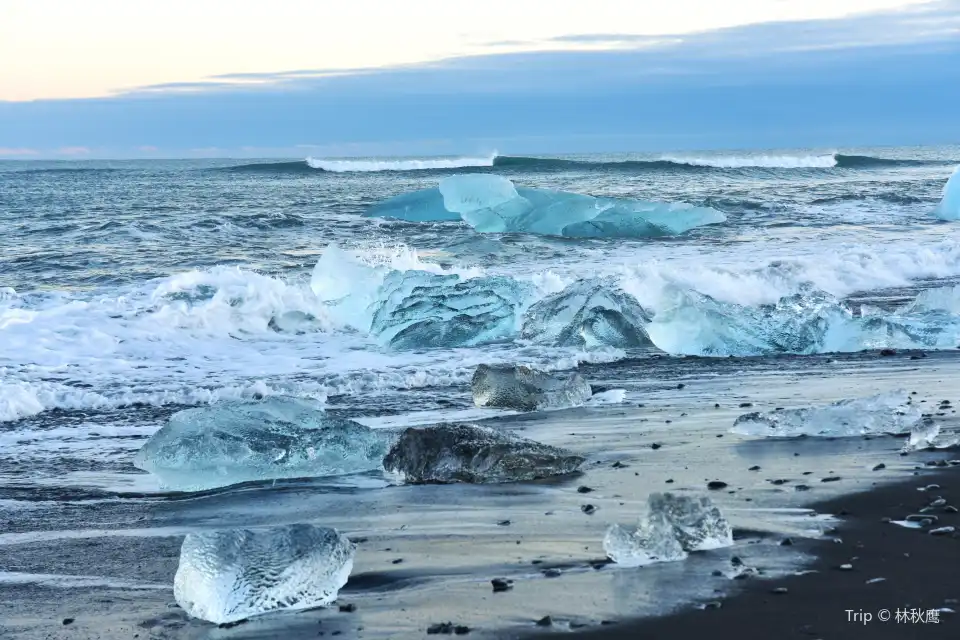
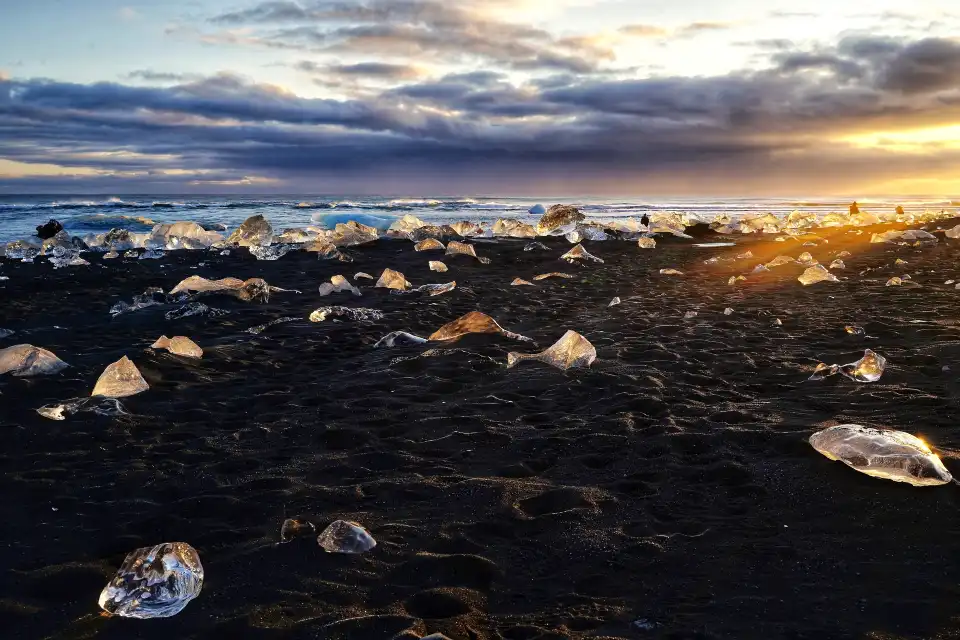
Diamond Beach is the outlet shore of the Jökulsárlón glacier lagoon: icebergs that calve into the lagoon drift under the Ring Road bridge, wash ashore on a jet-black volcanic beach, and sit there glittering — grounded ice blocks from fist-sized to van-sized, clear as glass, backlit by low arctic sun. The name is tourist marketing; the sight is not. It is one of the few places on Earth where the glacier meets the surf directly, and it photographs like nowhere else on the island.
This is #3 of 39 in our Best Things to Do in Iceland guide (Trip.Best heat 7.9, 4.9/5 verified rating, free entry). Below: how the beach works, the sunrise logic, the long-exposure recipe, and the sneaker-wave rules that are the difference between a portfolio shot and a rescue call — this is one of the two Icelandic beaches where the ocean actively hunts the shoreline.
Principais conclusões
- It is free and 24/7: an open beach on the Ring Road at the Jökulsárlón bridge — no gate, no fee, parking at the lagoon and roadside.
- Sunrise is the moment: low sun through clear ice is the signature shot; the beach faces southeast straight into the sunrise.
- The ice changes hourly: every tide deposits and removes ice — no two visits look alike, and calm high-tide mornings ground the most.
- Sneaker waves are lethal here: never turn your back on the surf, stay behind the berm, and never chase floating ice out with the waves.
- Bring the ND filter: 6-stop filters turn the surf to silk around grounded ice; long exposure is the beach’s signature technique.
Resposta rápida: Time the visit for sunrise (or the hour after), park at the lagoon’s east-side lot and walk to the beach under the bridge, shoot from behind the berm line with a long exposure (6-stop ND, f/8–f/11, 2–8 s), and leave when the tide starts reclaiming the ice. The ocean always has the right of way here.
What you’re looking at
The mechanics are the wonder. Jökulsárlón lagoon calves icebergs from Breiðamerkurjökull, a tongue of Vatnajökull; the ice drifts through a short channel under the Ring Road bridge and into the surf, and the waves throw the bergs back onto the black sand. Some blocks are clear freshwater ice (the “diamonds”), some are dense and white with trapped air, some are striped with volcanic ash. On a good morning the beach is littered with hundreds of them, steaming in the cold air.
The setting is pure southeast Iceland: the lagoon and its iceberg fleet on one side of the road, the open North Atlantic on the other, and the delta of grounded ice between. You can watch the same berg that calved at the lagoon wash onto the beach within the hour — the whole glacial cycle, calving to surf, in one walk. It is the most concentrated geography lesson in the country.
The name: the beach’s formal name is Breiðamerkursandur; “Diamond Beach” is the tourism name that stuck after the ice-on-black-sand photos went global. Locals will know both; signs say Jökulsárlón.
How the visit works
The beach has two sides, both usable: the east side (right when driving east) is the main parking and the classic ice-strewn shore; the west side offers wilder, emptier stretches. Park, cross with care (the Ring Road here is fast traffic), and drop onto the sand. There are no facilities on the beach itself — the lagoon area carries the toilets, café and parking.
Shoot and walk from behind the berm (the raised sand line the waves built). The best ice sits between the berm and the waterline, which is exactly the surf’s return path: every “calm minute” between sets is borrowed time, and the sneaker wave that reaches two meters up the beach arrives without warning after minutes of small surf. Watch the water the whole session; photographers have been swept from this exact shore.
The non-negotiables: never turn your back on the ocean, never stand on floating or wet ice at the waterline, never shoot from the wet zone when a set is running, and keep children off the ice entirely. safetravel.is maintains a standing warning for this beach; the ocean here does not negotiate.
The photography recipe
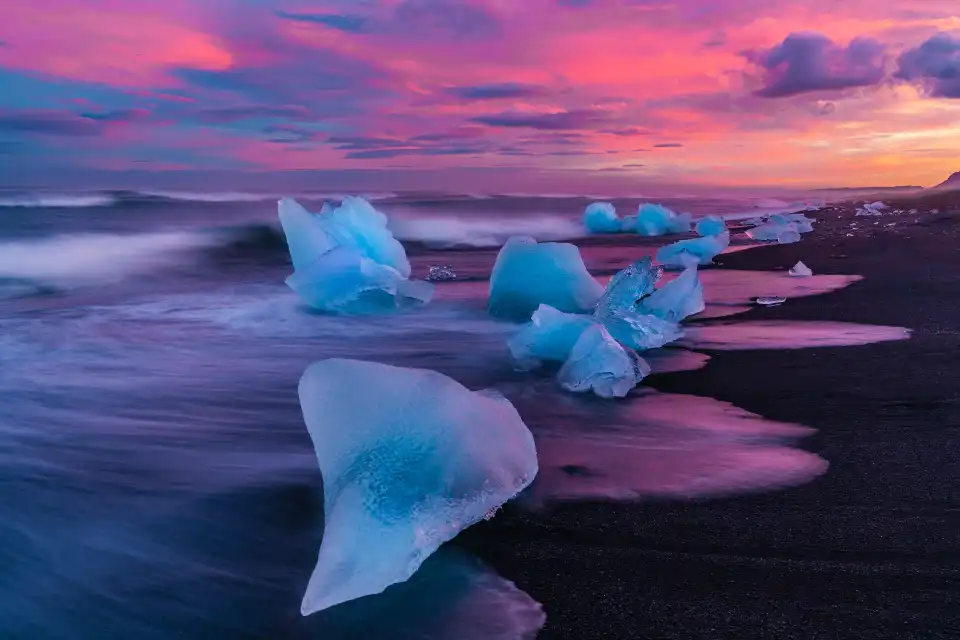
The signature frame is a grounded clear block at sunrise: low sun behind or beside the ice, the block backlit and glowing, long-exposure surf streaking around it. Settings that work: tripod behind the berm, 16–35 mm or 24–70 mm, f/8–f/11, ISO 64–100, 6-stop ND for 2–8 second exposures that render the wash as silk while the ice stays sharp. Bracket — the ice’s brightness against dark sand fools meters.
Second genre: individual “portrait” shots of single blocks with the mountain backdrop (Vestrahorn’s ridge sits west down the beach), and the abstract frame — ice texture close-up, sand, surf line. Blue-hour and aurora variants work on clear winter nights (the beach faces away from the aurora’s usual north, but strong displays photograph here too). Our photography guide’s Diamond Beach chapter carries the full field workflow.
Tide and weather windows: the most grounded ice follows calm high-tide mornings; after storms the beach is picked clean, then restocked. Check wind the night before — the beach is exposed east-coast shore and gale days are dangerous, not just disappointing.
When to go
Every season works; sunrise hours shift wildly. Summer (June) “sunrise” lands around 02:30–03:00 with the midnight sun — evening is the low-light window instead. September–October and February–March deliver real sunrises at humane hours with thin crowds: the sweet spot. Winter adds snow on the black sand and the strongest contrast, plus aurora odds.
Crowds are the one constant: tour buses hit the beach 10:00–15:00 in summer, so the pre-9am and post-17pm windows are yours. In winter the beach is emptier all day. Rain and overcast do not ruin it — gray light is moody and the ice still glows faintly — but gale warnings do: those days, stay behind the second berm or skip to the lagoon shore.
How it fits an Iceland route
Diamond Beach is the third leg of the southeast triangle: Jökulsárlón lagoon (shoot first, any hour), the beach (sunrise or golden hour), and the ice caves (#2) or Skaftafell (#29) depending on season. From Reykjavík it is a long day drive (4.5–5 hrs each way); from Vík, 2 hours east. Our Jökulsárlón guide sequences the full triangle, and the Ring Road guide slots it into the multi-day loop.
Frequently asked questions
Is Diamond Beach free to visit?
Yes — it is an open beach with no gate or fee. Park at the Jökulsárlón lots (paid parking at the lagoon side) or the roadside pull-offs near the bridge.
Can you take ice from the beach?
No — ice from the lagoon system is protected within the national park boundary, and in practice every guide will tell you the same thing: leave the diamonds where they lie. Photograph them; the next visitor deserves the same beach.
Why is it called Diamond Beach?
For the grounded icebergs: clear glacial ice on jet-black sand photographs like scattered gems, especially at low sun. The formal name is Breiðamerkursandur — the beach at the Jökulsárlón outlet.
How dangerous are sneaker waves really?
Lethal — multiple fatalities have occurred on this beach and neighbouring Reynisfjara. The waves arrive without warning after long calm sets and run far up the beach. Stay behind the berm, face the ocean, and never turn your back on the surf.
Where this ranks — and what is next
Diamond Beach is #3 of 39 in our Best Things to Do in Iceland guide — the full ranked list, built from Trip.Best traveler data, lives in one place.
Go deeper: The complete Diamond Beach guide (safety, tides, photography), Jökulsárlón glacier lagoon — where the ice comes from, How to photograph Diamond Beach (field workflow).
Sources & official references
- Trip.com listing for Diamond Beach: 4.9/5 rating, saved-by data (checked November 2026).
- Trip.Best ranking data: heat score 7.9, #3 of 39 (November 2026).
- safetravel.is sneaker-wave guidance for Breiðamerkursandur and Reynisfjara.
- Vatnajökull National Park visitor rules for the lagoon and outlet beach.
- Editorial sunrise sessions across seasons, 2023–2026.
