







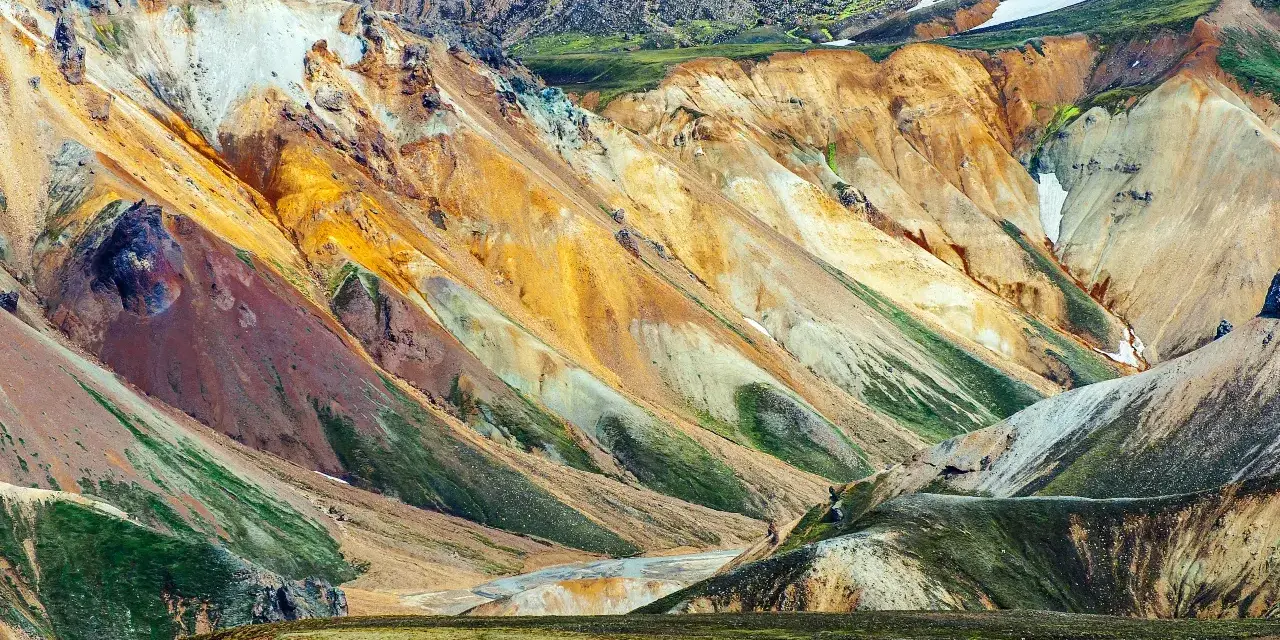
This is spot 17 of 20 in our Iceland Photography Guide — the rainbow highlands. Landmannalaugar, in the Fjallabak Nature Reserve at the edge of the interior, is the master list’s summer-only pick: rhyolite mountains striped in rust, cream, turquoise and black, steaming slopes, the Laugavegur trail’s famous start, and the natural hot pool where hikers soak at the campsite. The master guide’s field tip names the one viewpoint that changes everything — “climb Bláhnúkur for the aerial-style overview of the rainbow hills” — and this guide builds the session around that climb.
Landmannalaugar is also the master list’s access-strictest spot: F-roads only (F208/F224), open in the highland summer window, with river crossings on the F208 north route that rentals are not insured for — highland buses solve it for most photographers. This guide covers the access logistics, the color-and-steam compositions, the Bláhnúkur climb, the hot-pool evening, and the honest seasonal window.
Principais conclusões
- Climb Bláhnúkur: the master tip’s move — 940 m, one to two hours up, and the aerial-style overview of the rainbow hills that the valley cannot give.
- Summer only: the master list’s rule — F-roads open roughly mid-June to early September, weather permitting; road.is is the authority, not the calendar.
- No river crossings in rentals: the F208 north fords are for proper highland vehicles; the highland bus from Reykjavík (or the F225 southern approach) is the photographer’s route.
- Shoot the color in flat light: the rhyolite stripes photograph cleanest under even sky — side-light models, but gray saturates the palette.
- The hot pool is the evening: the natural soak at the campsite — the master list’s archive photographs bathers in it — and the reward for the climb.
Resposta rápida: take the highland bus (or F225 in a fit vehicle) in the highland window, photograph the valley floor’s stripes and steam in the morning, climb Bláhnúkur in the afternoon for the overview frames, and soak the hot pool at golden hour. One long day from Reykjavík works; an overnight in the hut or campsite owns both light windows and the emptier morning.
Access: F-roads, buses and the window
Landmannalaugar sits in the interior highlands, and the master list’s “summer only” is access-law, not preference: the approaches are F-roads (mountain roads) — F208 and F224 from the south, F208 north with its famous fords — open in a weather-dependent window that road.is declares, roughly mid-June to early September in normal years. The critical rental-car fact: river crossings are not insured on standard rentals, so the F208 north fords are out for most visitors; the southern F225 approach avoids the biggest fords but still demands a fit vehicle and patience.
The photographer’s standard solution is the highland bus: scheduled summer services run from Reykjavík (and connections) into Landmannalaugar, dropping at the hut — no crossing anxiety, and the ride itself surveys the highlands. Day trips work; overnight in the hut (book early) or campsite owns the light: the emptiest morning frames and the hot-pool evening that day-trippers miss. Facilities are minimal (hut, campsite, toilets, a small shop in season) — the highlands’ self-sufficiency rules apply, and our camping guide covers the campsite logic.
Weather discipline: the highlands make their own weather, and a Landmannalaugar day can run from t-shirt sun to sleet in an hour. Check the en.vedur.is mountain forecast, pack the full layers, and treat the F-road window as a promise road.is makes or breaks weekly.
Compositions that work
The valley is a color system — four frames build the portfolio:
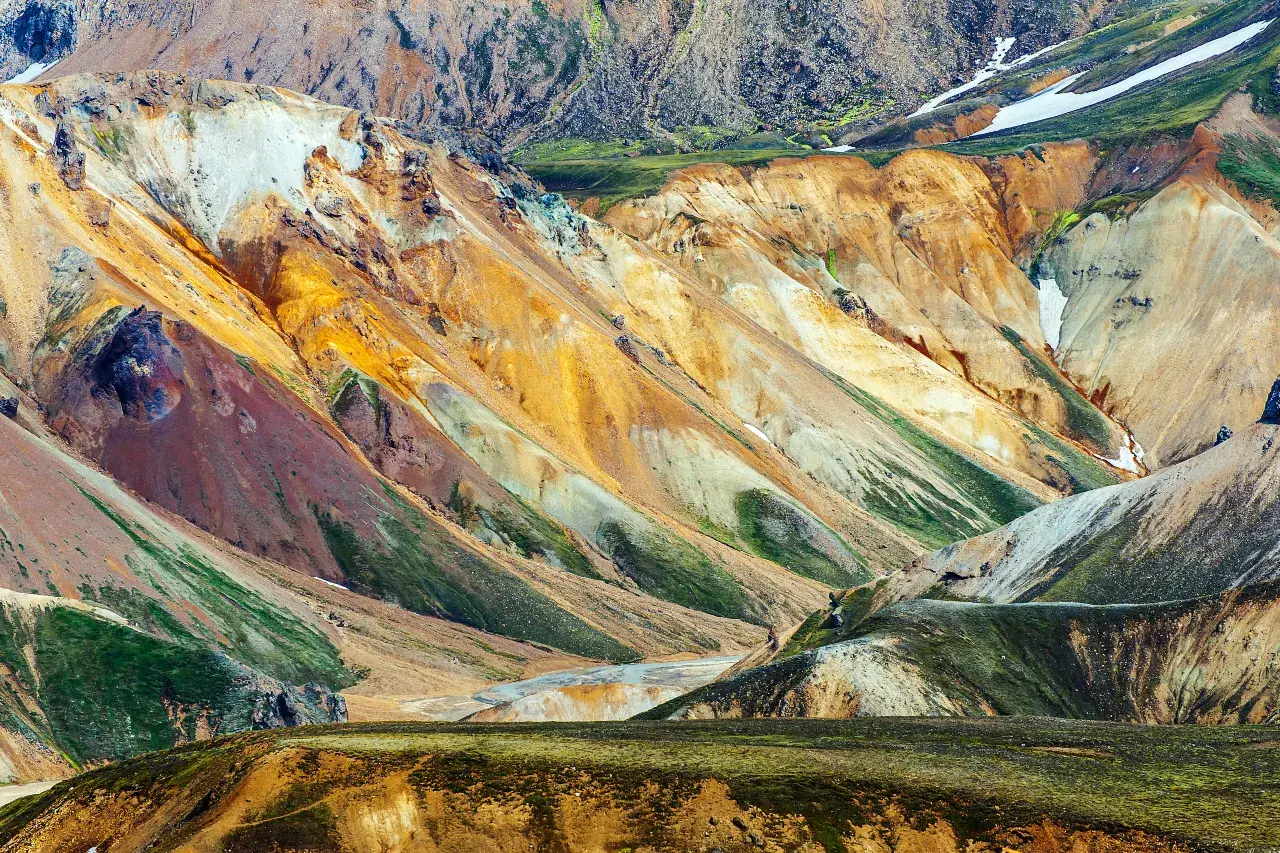
- The striped hillside: the rhyolite bands at 70–200 mm compression — rust, cream, turquoise layers filling the frame; the color IS the subject. Flat light saturates it best.
- The steam-and-color: the fumaroles’ white steam against the striped slopes — the master archive’s own pairing (steaming red-and-orange slopes). 100–200 mm, steam in backlight when the sun offers it.
- The valley floor: the black obsidian lava flow and the river’s approach under the rainbow walls — 16–35 mm, hikers for scale on the Laugavegur’s first kilometres.
- The overview (the master tip): from Bláhnúkur’s shoulder and summit, the rainbow hills laid out in layers — the aerial-style frame that justifies the climb and anchors the whole gallery.
Scale and people: Landmannalaugar’s trails carry hikers in summer — the small figures on the stripe-background trails are scale gifts, not annoyances; wait for them to walk into the composition rather than out of it.
The Bláhnúkur climb
Bláhnúkur (“blue peak,” 940 m) is the master tip’s move and the session’s physical centrepiece: a marked, steep, one-to-two-hour climb (each way) from the campsite up the blue-gray mountain, with the overview of the rainbow hills arriving in stages — the last third is the money. The trail is a ridge walk with real exposure at the top; wind decides the summit’s comfort, and the same en.vedur.is mountain forecast that gates the day gates the climb. Down-climbing in rain is the sketchy version — schedule the ascent for the day’s steadiest hours.
Photograph the climb itself: the trail’s switchbacks against the rhyolite, hikers ascending, the valley shrinking below. At the top: 24–70 mm for the layered overview (or verticals stacking the color bands), and the long lens (100–200 mm) for the compressed layers of hills — the “aerial style” the master tip describes is a compression effect, achievable without flying.
Settings and technique
Color discipline: the rhyolite palette is naturally saturated — shoot RAW, keep the saturation edits honest (the stripes are real; oversaturation makes them fake), and let flat light do the work. The steam frames expose like any backlit vapor (+0.7 EV); the overview frames want f/8–f/11 and focus-stacking when the nearest ridgeline enters focus range. UV protection is real at altitude on clear days — the polarizer doubles as the standard filter here.
The kit logic: one body, 16–35 mm and 70–200 mm, polarizer, and the hike kit (the climb is a hike with a camera, not a camera walk). Weather protection runs full — the highlands’ drizzle is horizontal and constant when it arrives. Batteries warm; the mountain wind is the coldest thing on this list’s summer season.
The hot pool evening
The natural hot pool at the campsite — where the hot river meets the cold — is the highlands’ reward session and a master-archive subject in its own right (the archive photographs a bather in it). At golden hour, steam rises off the water against the rhyolite walls and hikers soak with their boots on the gravel rim: the bathers-in-landscape genre, highlands edition, with the same etiquette as every Icelandic soak (photograph the scene and your own party, not strangers). Day-trippers miss this hour by schedule; overnight visitors own it — one more argument for the hut or tent.
The complete Landmannalaugar guide covers the pool’s rules and the hut booking detail; the Þórsmörk guide carries the Laugavegur’s other end for the hikers who catch the trail fever here.
Seasons and the highlands
The master list is unambiguous — summer only. The F-road window (mid-June to early September in normal years) is the whole access story; outside it, Landmannalaugar is a winter highland route requiring super-jeeps and guides, and the photography becomes a tour product rather than a self-drive session. Within the window, July and August own the green-and-brown palette and the full services; early September adds the emptier trails and the first aurora chances on clear highland nights.
Pair it with the interior’s other subjects: Þingvellir and the Golden Circle as the drive’s bookends, Þórsmörk across the way for the green-valley contrast, and the Ring Road guide‘s southern sections as the road home. The highlands are the master list’s only interior entry — the one spot that justifies the extra planning.
Frequently asked questions
Can I drive to Landmannalaugar in a normal rental car?
On the southern F225 approach in a fit vehicle, in good conditions, cautiously — but the F208 north’s river crossings are not insured on standard rentals, and the highland bus removes every variable. The master tip’s photography does not care how you arrived; the bus is the photographer’s default.
How hard is the Bláhnúkur climb with camera gear?
One to two hours up a steep marked ridge — a genuine hike. One body, one wide zoom and the long lens in a pack, water and layers as standard. Wind is the real factor; schedule the ascent for the day’s steadiest hours and skip it in gusts — the overview will wait for the next weather window.
Why flat light for the rainbow hills?
The rhyolite’s color bands are the subject, and even sky saturates them without the contrast chaos of direct sun — the same gray-day logic as Dynjandi, applied to color instead of water. Side-light models the terrain; flat light paints it. Watch the sky and pick the genre per hour.
Is an overnight worth it over a day trip?
Yes — the hot-pool evening, the emptiest morning frames and the hut-to-trail dawn light are the sessions day-trippers never see, and the hut’s booking is the highlands’ scarcest camera-adjacent asset. If the schedule allows one highland overnight on the whole trip, this is the master list’s candidate.
The full field list lives in one place
Spot 17 of 20 — the master guide ranks all twenty locations by region, best light and a field tip for each.
Go deeper: the complete Landmannalaugar guide, the Þórsmörk guide for the Laugavegur’s far end, and the camping guide for the overnight logistics.
Sources & official references
- F-road status and the highland window: road.is seasonal reports (checked 2026); treat road.is as the authority over any calendar.
- Bláhnúkur trail and Laugavegur details: Fjallabak Nature Reserve / Ferðafélag Íslands trail information.
- Hut booking and campsite rules: Landmannalaugar hut operator information; verify per season.
- Highland weather: en.vedur.is mountain forecasts.
- Editorial photography trips across seasons 2022–2026 by the Iceland Travel Guides team.
