








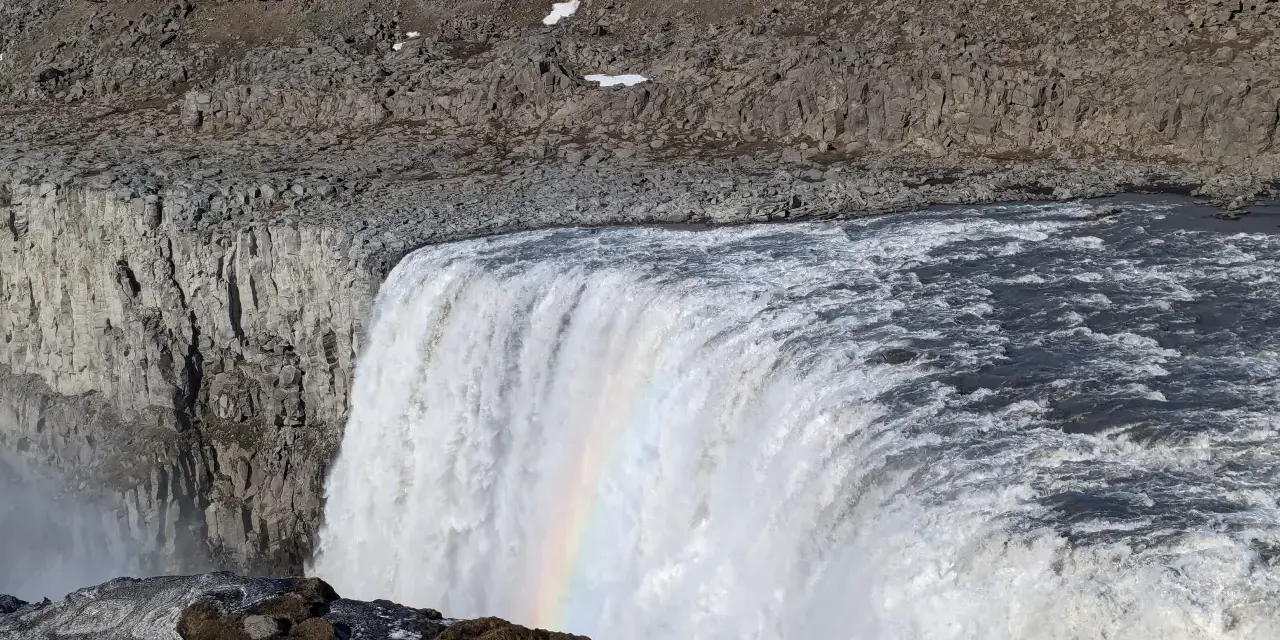
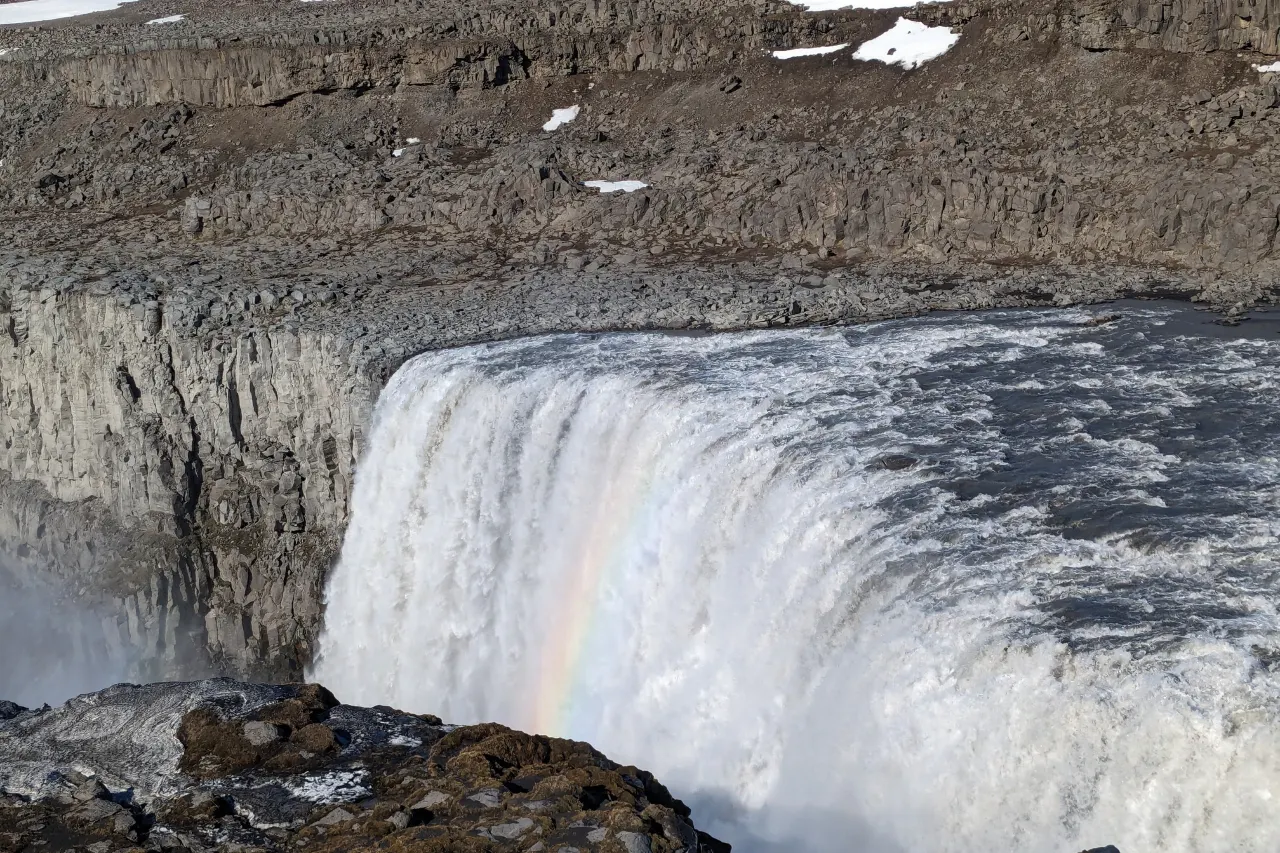
This is spot 14 of 20 in our Iceland Photography Guide — the most powerful waterfall in Europe. Dettifoss, where the glacial Jökulsá á Fjöllum river thunders over a 44-metre, roughly 100-metre-wide edge into the Jökulsárgljúfur canyon, is the master list’s drama pick: not the prettiest fall in Iceland (that argument belongs to Goðafoss and Dynjandi), but the most forceful — a wall of gray-brown water whose roar is the soundtrack you compose to. The master guide’s field tip names the two technical realities: “the wide canyon eats small lenses — bring width, mind the spray.”
Dettifoss also has an access split that changes everything: the west bank (paved road 862, the classic full-face view) and the east bank (gravel road 864, the downstream-and-into-the-spray angle) — two different waterfalls from the same river, one ticket each of a thirty-minute drive. This guide covers both sides, the gray-day logic, Selfoss downstream, the aurora-bonus frame the master list’s spot sits under, and the spray discipline that keeps gear alive at the most water-violent location on the list.
Principais conclusões
- Bring width, seriously: the canyon view eats anything longer than 35 mm from the main viewpoints — 16–24 mm is the working range; the master tip is a packing rule.
- Gray days are the drama days: the master list’s pick — even sky holds the fall’s tonal range and the canyon’s depth; bright sun adds nothing here.
- Two banks, two waterfalls: west bank (paved, full-face classic) and east bank (gravel, downstream spray-and-chaos angle) — shoot both if the day allows; the drive between is thirty minutes.
- Selfoss is the bonus: one kilometre downstream, a wider, gentler cascade — the quiet composition after Dettifoss’s violence.
- Mind the spray: the closest west-bank positions eat spray in wind — covers, cloths and the sealed-bag habit, like Seljalandsfoss but heavier.
Resposta rápida: drive the paved 862 to the west-bank lot, walk the fifteen minutes to the falls, and shoot the full-face classic at 16–24 mm, tripod, 1–8 s, gray light by preference. Walk one kilometre downstream to Selfoss for the quiet contrast. If you have the afternoon and a robust car, cross to the east bank via 864 for the downstream-and-spray angle — a genuinely different photograph of the same wall of water.
Two banks, two roads
Dettifoss sits inside the Jökulsárgljúfur canyon (part of Vatnajökull National Park), and its two banks are reached by separate roads from opposite sides. The west bank: road 862, paved from the Ring Road to the car park (season-dependent for the final section), a flat 15–20 minute walk on a gravel path to the fall’s edge — the full-face, river-toward-you classic, and the side most visitors mean. The east bank: road 864, gravel for long stretches, to a closer, lower viewpoint where you stand above the fall looking down its own throat — the spray-everything angle, spectacular in flow and genuinely hard on gear.
Check road.is for both roads’ seasonal status: 862’s upper section and 864 open late spring through autumn in normal years; winter access typically means the maintained lower 862 section only. The master list’s spot sits in the north’s dense cluster — Hverir, Mývatn, Goðafoss within an hour — so the standard plan is one bank per half-day, not both in one sprint.
Paths at the fall are natural gravel with low barriers — the canyon edges are real edges, and the master guide’s trail-etiquette rules apply with force here: the fence lines exist where the drops do, and the best frames are all shot from inside them.
The gray-day drama logic
The master list gives Dettifoss “gray-day drama,” and the reasoning is tonal: the fall’s subject is force — a gray-brown glacial wall over black basalt in a green-gray canyon — and even sky is the only light that holds that entire range without blowing the water or crushing the walls. Bright sun adds contrast the scene does not want and lifts nothing; the fall photographs its best when the sky does nothing at all. The Westfjords rule from Dynjandi applies here too: gray is the plan, not the fallback.
The drama has a sound component that shapes session length: the fall’s roar is constant and physically present — compositions come slower here than at prettier falls, and the standard session is shorter but more intense. Storm days after rain are the extreme version: the flow swells visibly, spray travels hundreds of metres, and the east bank in particular becomes a full rain-gear exercise.
Winter transforms rather than diminishes: partial ice-armor on the canyon walls, the flow still carrying force, and — the master list’s hidden bonus — the aurora over the falls on clear nights (the ITG archive’s own shot). The aurora game runs the spot-20 recipe; the fall’s constant mist complicates it (lens wiping between every frame) but the payoff is the rarest frame in this guide.
Compositions that work
The canyon’s scale sets the composition menu — three angles cover it:
- The west-bank classic: 16–24 mm from the main viewpoint, the full edge in frame, the river’s approach leading in, canyon walls flanking. Tripod, 1–8 s; the water’s gray-brown color needs no filter help.
- The canyon scale shot: step back and include the gorge — the fall compressed between walls, a human figure on the path for scale. This is the frame that communicates power; the close-up communicates motion. Both belong in the set.
- The east-bank throat: from the 864 viewpoint, looking down the drop’s own line — spray, chaos, the raw edge. Fast shutter (1/250 s+) for the exploding surface, full rain cover, and accept that half the frames die to mist.
- The river approach: the Jökulsá’s glacial braids arriving from the north — 70–200 mm compressions of the braided water against the canyon. The quiet counterpoint to the fall’s violence.
Settings and spray discipline
The wide-frame game: tripod, 1–8 s at f/8–f/11, ISO 64–100, no polarizer needed (the water’s tone is the subject, and the fall is too wide for polarization games). Expose for the water’s gray — the meter will drag the canyon dark; RAW and a +0.3 EV habit balance it. The canyon “eats small lenses” exactly as the master tip says: anything 35 mm or longer from the main viewpoints crops the edge; wide is the language here.
Spray discipline is the gear story: full rain cover as default, hood on, vertical cloth wipes before every burst, lens changes in the bag only, and a sealed dry bag as the base camp. The west bank in wind turns every frame into a wipe-then-shoot cycle — accept the rhythm rather than fighting it. The east bank adds mud: boots with grip, tripod legs wiped before packing.
The aurora variant (clear winter nights, west bank): ISO 1600–3200, 8–15 s, manual focus on the canyon edge before dark, headlamp red mode — and the wipe cycle doubles because mist freezes on glass. Rare, cold, worth it.
Selfoss and the canyon chain
One kilometre downstream on the west-bank path, Selfoss spreads the same river over a wider, lower lip — a braided curtain of hundreds of small streams. It is Dettifoss’s gentler sibling and the better composition for still water and reflections; shoot it at 24–50 mm with the same gray-light logic. The canyon chain continues — Hafragilsfoss further downstream and the Jökulsárgljúfur gorge itself, whose wide green sweep the ITG archive photographs from the rim.
The full canyon day (west bank): Dettifoss first, Selfoss second, the rim viewpoints last — three genres, one walk network, no driving between. The complete Dettifoss guide carries the fall’s own context — the river’s glacial source, the canyon’s geology, and the access detail per bank.
Seasons and the north day
Dettifoss photographs year-round but access rotates: summer opens both banks (the east bank’s gravel is a dry-weather road), autumn gives the empty paths and the strongest gray-day frequency, winter restricts to the maintained west section with the ice-and-aurora bonuses, spring is thaw-and-flow maximum. The fall’s force never pauses — the master list’s “gray-day drama” is available in every season that the roads allow.
The north day clusters: dawn at Hverir, Dettifoss mid-morning, Selfoss and the canyon after, the Mývatn circuit or Goðafoss for the afternoon — the densest master-list geography in the country, as our master guide notes in its regional sections.
Frequently asked questions
West bank or east bank?
West bank for the classic (paved access, the full-face composition, Selfoss on the same path); east bank for the raw angle (closer, lower, spray-heavy, gravel road). Photographers with one day and a standard rental car shoot the west bank; the east bank is the second visit’s reward.
Why gray light for the most dramatic waterfall?
Because the subject is force, not prettiness: even sky holds the fall’s full tonal range — the gray-brown water, the black basalt, the canyon’s depth — without blowing the whites or crushing the walls. The master list’s “gray-day drama” is a tonal instruction, and Dettifoss is the list’s purest example.
How do I keep spray off the lens?
Rain cover as default, hood on, vertical cloth wipes before every burst, lens changes only inside the bag, dry bag as base camp. The west bank in wind is a wipe-then-shoot rhythm; the east bank is heavier still. The master tip’s “mind the spray” is the packing list for this stop.
Is the aurora-over-Dettifoss shot realistic?
It is rare and real: clear winter nights, the maintained west-bank section, the spot-20 recipe with the fall’s mist managed by constant wiping. The canyon edge needs manual focus before dark and the cold kills batteries — treat it as the north’s bonus frame, not the plan.
The full field list lives in one place
Spot 14 of 20 — the master guide ranks all twenty locations by region, best light and a field tip for each.
Go deeper: the complete Dettifoss guide, the Mývatn geothermal guide for the region, and the top-10 waterfalls roundup where Dettifoss’s force is ranked against the coast’s curtains.
Sources & official references
- Fall dimensions (44 m drop, ~100 m width) and “Europe’s most powerful” per published survey figures and park interpretation materials.
- Road status per bank (862 paved, 864 gravel): road.is seasonal reports (checked 2026).
- Park rules: Vatnajökull National Park regulations; canyon-edge safety per site signage and safetravel.is.
- Weather windows: en.vedur.is forecasts for northeast Iceland.
- Editorial photography trips across seasons 2022–2026 by the Iceland Travel Guides team.
