









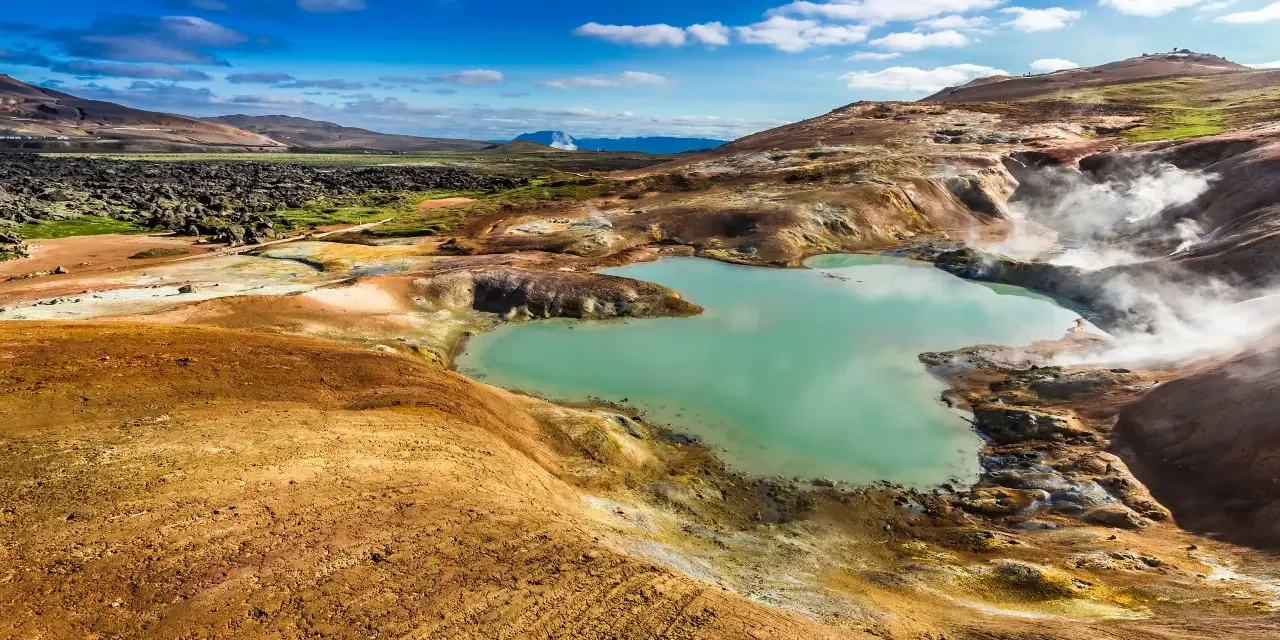
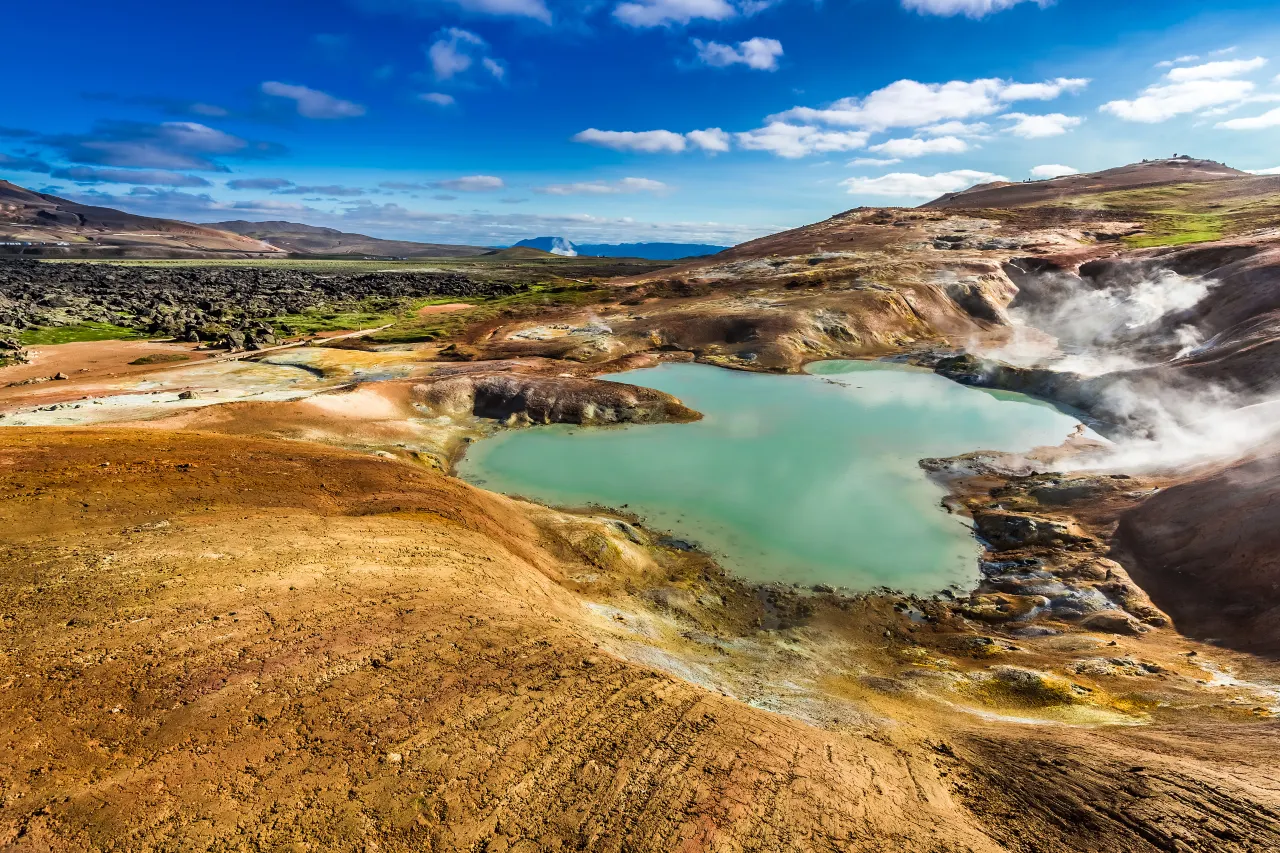
This is spot 12 of 20 in our Iceland Photography Guide — the steam fields. Hverir (the Námafjall geothermal area by Mývatn) is the master list’s dawn pick: rows of boiling mud pots, screaming fumaroles and sulfur-crusted orange-and-turquoise pools laid out along the Námafjall ridge, close enough to the path that steam rolls straight across your lens. The field tip — “low angled light makes the steam read; watch your footing off the paths” — contains both the art and the danger: dawn light is what turns white steam into a subject, and the ground between the features is genuinely treacherous crust.
Hverir is also the north’s gateway subject: it sits on the Ring Road east of Mývatn with Dettifoss, Goðafoss et Bains naturels de Mývatn within an hour — a geography that makes one dawn-and-day session cover four master-list spots. This guide covers access, the dawn window, the steam-and-texture compositions, the footing discipline, and the sulfur realities (including the smell — it is part of the experience).
Key takeaways
- Dawn is the window: low angled light makes the steam visible and the mineral colors glow — the master list’s pick, and the reason to book Mývatn-side accommodation.
- Stay on paths absolutely: the crust between features fails without warning and the water is at or near boiling — the master tip’s footing warning is the safety rule, not a style note.
- Shoot the texture: mud pot bubbles, sulfur crystals, mineral terraces — 50–100 mm frames are half the portfolio here, not just the wide steam field.
- Backlight is the technique: steam reads when the sun sits behind it; the dawn geometry puts the ridge east and the sun rising into your frame’s background.
- The smell is real: sulfur hangs over the whole area — clothes wash after, lenses wipe after, and the wind direction decides your comfort.
Quick answer: arrive thirty minutes before sunrise (the lot sits right on the Ring Road), shoot the steam field backlit as the sun crests the ridge, then work the pools’ colors and the mud pots’ texture at 50–100 mm as the light lifts. Fences and ropes are hard boundaries — the best frames are all shot from the paths. Spend the afternoon north at Dettifoss or west at Goðafoss; the same dawn session opens the north’s whole day.
Access and the field layout
Hverir sits directly on the Ring Road at the Námafjall pass, ten minutes east of Mývatn’s main settlement (Reykjahlíð) — a roadside lot, no fee as of our last visits, and a path network looping the active zone in fifteen minutes. The features: big mud pots bubbling in the foreground rows, fumaroles screaming steam along the ridge line, and the signature orange-and-turquoise pools at the field’s edges. The whole area is compact — every master-tip subject is within 150 metres of the car.
The paths are roped and the ropes are real: the crust between features is thin over near-boiling water, and the area has a documented history of off-path accidents. Unlike the wide gravel parks of the south, Hverir’s boundaries are close to the features — which is precisely what makes the photography so direct. Winter access is usually fine (the Ring Road is maintained and the lot plowed), though steam and ice make the paths slick — the footing rule doubles in cold.
The smell: sulfur hangs over the field constantly, stronger on still mornings. It is harmless at path levels but soaks into jackets and hair; plan laundry after, and keep lens cloths sealed — a sulfur-scented wipe frame is a real thing.
The dawn window
The master list gives Hverir dawn, and the physics earn it: steam is nearly invisible in flat frontal light — it reads only when backlit, and low sun makes the backlight long. At Hverir the geometry is perfect: the field sits below the Námafjall ridge, and the rising sun crests it directly behind the fumaroles’ steam columns. For roughly ninety minutes, every vent glows, every pool’s steam catches the warm side-light, and the mineral colors — the oranges, the turquoise — saturate under the low-angle light. After mid-morning, the same field is white vapor and flat color.
Evening has a weak echo of the same effect (sun behind the western horizon), but the master list is right: dawn is the real window, and it is cold — the steam is thickest when the air is coldest, which makes winter dawn the extreme version of the shot. Gray days flatten the steam but keep the mineral colors; the field never dies, it just changes from dramatic to graphic.
Wind is the compositional variable: still mornings build standing columns; windier ones tear the steam sideways — which is its own good frame. The en.vedur.is hourly wind at Mývatn settles which genre you get.
Compositions that work
Hverir is half steam drama, half texture study — the strongest sessions shoot both:
- The backlit steam field: 16–35 mm from the path loop, fumarole columns backlit by the cresting sun, mud pots dark in the foreground. Tripod, 1/15–1/4 s on still mornings (the steam has its own motion), +0.3 EV on the bright columns.
- The mineral pool close: the orange-and-turquoise pools at 50–100 mm — crust rims, steam wisps, the color gradient as the subject. Polarizer for the water surfaces; f/8–f/11; stay behind the rope.
- The mud pot texture: bubbling mud at 1/500–1/1000 s — each burst of mud is a micro-action shot; bursts of five catch the best blob. The detail work that separates a Hverir portfolio from a pass-through.
- The ridge context: the whole field with Námafjall’s red ridge behind — 24 mm, dawn side-light, the steam field as foreground texture. This is the “place” frame for the story.
People: dawn empties the paths — the master-tip window is also the crowd solution, and the two reasons stack into the same recommendation.
Settings and technique
Steam is a moving semi-transparent subject — it exposes like bright smoke: meter for the steam (+0.7 EV habit), RAW, and protect the backlight highlights. The wide field frames run 1/15–1/4 s on tripods (steam motion reads as texture at those speeds); the mud pots run fast (1/500 s+); the mineral pools run f/8–f/11 and the polarizer. One kit rule: wipe the front element between every setup — drifting steam condenses on glass quietly, and the “hazy frame” problem here is lens moisture, not weather.
Cold dawn sessions add the winter kit: spare batteries warm (the cold + steam kills them fast), cloths stiffen, tripods ice at the leg locks. The weather planning guide covers the cold-session habits that carry here.
Footing and geothermal discipline
The master tip’s second half is the safety rule and it is absolute: the crust between features fails without warning, the water and mud are at or near boiling, and the area has a real accident record. Stay on the paths and inside the ropes, every frame, no exceptions; the compositions that work are all shot from them. Tripods: keep legs on gravel path surfaces, never lean a leg over a rope “just for one frame.” Children hold hands on the paths here — this is the master-list spot where that rule matters most.
Seasons and the north day
Hverir photographs year-round with steam as the constant; seasons change the palette around it. Winter dawn is the extreme version — coldest air, thickest steam, snow rims on the crust; summer adds the green highland backdrop and the midnight-sun version of the backlight; autumn brings the emptiest lots; spring is the mud season (visually and underfoot). The field never closes — the dawn rule just shifts with the sun’s schedule.
The north day is the payoff geography: dawn at Hverir, morning at Dettifoss (sixty minutes east), the Mývatn geothermal circuit at midday, Bains naturels de Mývatn to recover in the evening, Goðafoss at golden hour — four master-list spots in one day, all within an hour of the steam fields. The Húsavík whale season extends the cluster in summer.
Frequently asked questions
Why is dawn so important at Hverir?
Steam reads only in backlight, and low sun makes the backlight long — at dawn the sun crests the ridge directly behind the fumaroles and every steam column becomes a visible subject. By mid-morning the same field is white vapor and flat color. The master list’s dawn pick is physics, not habit.
Can I step off the path for a better angle?
No — the crust between features fails without warning and the water beneath is near boiling. Every essential frame at Hverir is achievable from the paths; the master tip’s footing warning is the safety rule for this entire category of location, not a suggestion.
How do I keep steam off my lens?
Wipe the front element between every setup (drifting steam condenses quietly), keep the hood on, and store the camera inside the bag between positions. Cold dawn sessions add the battery-in-pocket rule — the steam and the cold both work against glass and power alike.
Is the smell harmful to gear?
The sulfur smell is harmless at path levels, but it clings — wash jackets after, and keep cloths sealed. The real gear risk is moisture and mud, not chemistry; the standard rain-cover-and-cloth discipline covers it.
The full field list lives in one place
Spot 12 of 20 — the master guide ranks all twenty locations by region, best light and a field tip for each.
Go deeper: the Mývatn geothermal guide for the north’s full circuit, the Dettifoss complete guide for the day’s second act, and the safety guide for the geothermal-ground rules.
Sources & official references
- Geothermal features and temperatures: Námafjall/Hverir site interpretation materials (checked 2026).
- Path and crust safety: on-site signage and safetravel.is geothermal-area guidance.
- Weather and wind: en.vedur.is hourly forecasts for the Mývatn region.
- Dawn technique: editorial photography trips across seasons 2022–2026 by the Iceland Travel Guides team.
- Master list context: Iceland Photography Guide — 20 Best Photo Spots (this site).
