









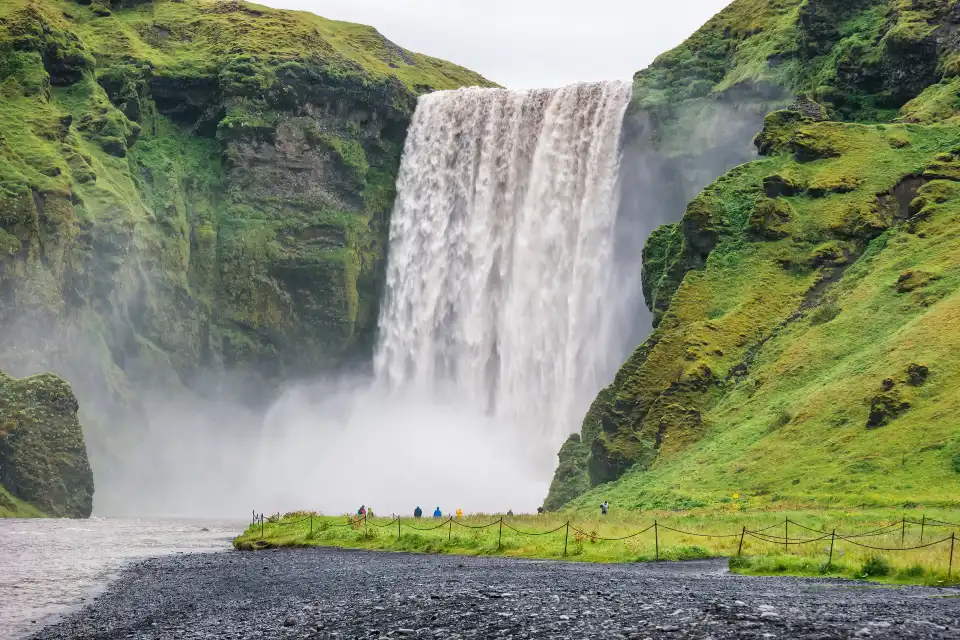
Skógafoss is the waterfall that ends arguments: a 60-metre, 25-metre-wide curtain dropping off a former sea cliff with such consistent force that it makes its own weather — permanent mist, reliable midday rainbows, and a roar you feel through your boots. It sits directly on the Ring Road, drops you from car park to waterfall face in four minutes, and hides the country’s best day-hike (the Fimmvörðuháls trail) behind its top edge. Trip.Best ranks it #8 with 4.8/5 and a night-attractions badge for the illuminated evenings.
This is #8 of 39 in our Best Things to Do in Iceland guide. Below: what makes Skógafoss unlike its neighbours, the staircase and the top-gate views, the rainbow timing, the trail that starts at its shoulder, and the Þrasi treasure legend that explains why nobody has found the chest.
Conclusiones clave
- 60 m × 25 m: one of Iceland’s biggest waterfalls by curtain width — and the most consistent in flow year-round (glacier-fed).
- 527 stairs to the top: the viewing platform hangs over the fall’s edge; the Fimmvörðuháls trail continues beyond it into the highlands.
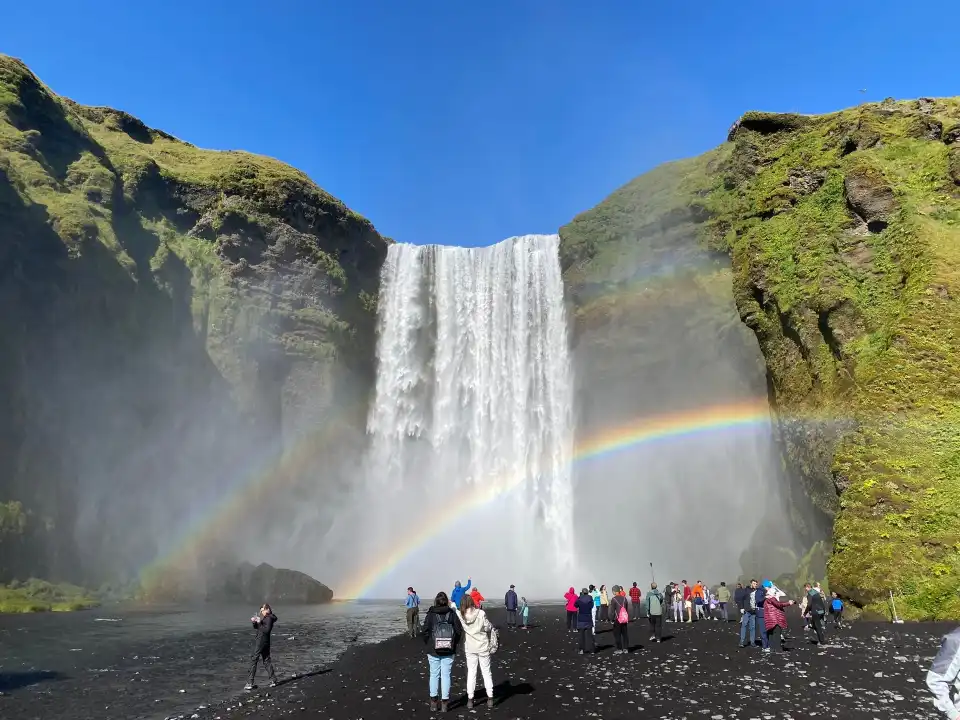
- Midday rainbows: the mist column catches the sun in a reliable double-rainbow window roughly 11:00–15:00 on clear days.
- Free, 24/7: no gate; illuminated evenings in summer earn the night-attraction badge.
- Fimmvörðuháls starts here: the 25-km day hike between the two glaciers — the trailhead is at the fall’s top.
Respuesta rápida: Walk the base first (get soaked — it is the point), climb the 527 stairs for the top platform and the river-braids view upstream, time a clear-sky midday visit for the double rainbow, and continue west to Seljalandsfoss (#6) or east to Reynisfjara (#17) — Skógafoss is the South Coast’s centre point. Summer evenings: come back for the illuminated fall and empty paths.
The base, the stairs and the top
The base visit is the postcard: a flat gravel path from the car park runs straight to the curtain’s edge, and the fall’s force pushes a permanent mist wall you walk through to reach the closest views. In high season the rainbow arcs cross the mist column repeatedly; on storm days the curtain leans sideways. There is no barrier between path and pool — the wet zone is the experience, and the phone-in-a-face tragedy is a daily occurrence.
The staircase on the fall’s east flank climbs 527 steps to the top platform — a steel grate hanging at the curtain’s lip, where the full 60-metre drop is visible beneath you and the Skógá River’s braided channels stretch upstream toward the highlands. From the platform, the Fimmvörðuháls trail continues: 25 km between Eyjafjallajökull and Mýrdalsjökull to Þórsmörk, passing the 2010 eruption craters Magni and Móði. The first kilometre makes a excellent sampler hike if the full crossing is not on the itinerary.
The treasure legend: Þrasi Þorfinnsson, the first settler at Skógar, supposedly buried a chest of gold behind the fall. A boy found the chest’s ring in the 17th century — it hangs on the local church door now — and the chest itself remains in the pool. Locals will tell you the fall’s roar is Þrasi still guarding it.
The rainbow window and the drone rules
Skógafoss is the South Coast’s most reliable rainbow machine: when sun clears the cliffs midday, the mist column throws double rainbows that appear and move with your angle. The window is roughly 11:00–15:00 on clear days, strongest in spring–summer. Photographers: the base gives the classic frontal (wide lens, fast shutter to freeze the curtain), the top platform gives the upstream braids, and the drone question is answered by regulation — this is a busy site with tight air-traffic etiquette, so follow the national drone baseline and site signage; in practice, leave the drone packed on crowded days.
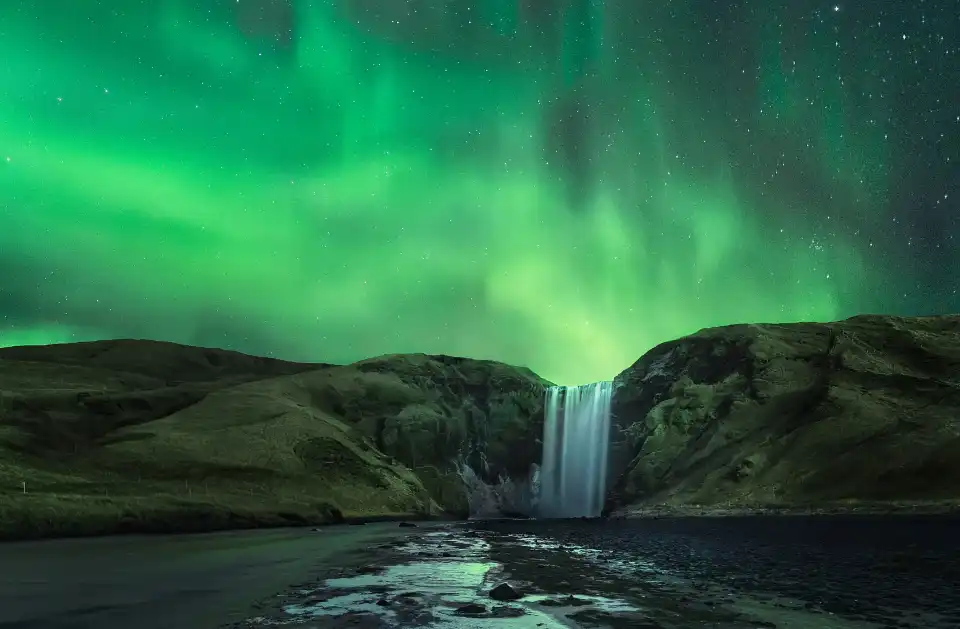
Winter transforms the fall: the cliffs ice over, the mist freezes into formations on the rocks, and the aurora occasionally sits above the curtain on clear nights — part of why the night-attractions badge exists. Studded overshoes help on the icy base path; the top stairs close when iced.
Beat the buses: the car park fills 10:00–15:00 with South Coast tours. The 08:00–09:30 window and the post-18:00 window are the quiet ones — and the latter often has the best light angle on the curtain.
Practical: access, kit and facilities
Access is Ring Road-direct: the turnoff is signed, the car park is paid, the path is 200 metres of flat gravel. Facilities: toilets, the Skógar Museum and folk village (a legitimate 1-hour stop — turf houses and the fishing history) five minutes away, and the restaurant/café at the hotel. The visit itself is 30–60 minutes; with the top stairs and museum, half a day.
Kit: waterproof jacket (the mist is constant), studded overshoes in winter, and the standard South Coast wind discipline. The fall flows identically year-round — glacial source, big catchment — which is why it is the country’s most dependable big waterfall in every season and weather short of a gale.
How it fits an Iceland route
Skógafoss is the hinge of the South Coast day: Seljalandsfoss (#6) 30 minutes west, Reynisfjara (#17) and Dyrhólaey (#25) 40 minutes east, Vík beyond. Multi-day Ring Road routes sleep in Vík after a Skógafoss stop. Hikers: the Fimmvörðuháls crossing (summer, guided or experienced-party) starts at the fall’s top — our Skógafoss deep-dive carries the trail logistics, and the South Coast photography chapter sequences the light.
Frequently asked questions
How many stairs to the top of Skógafoss?
527 — the staircase climbs the east flank to a platform at the curtain’s lip. It closes when iced in winter; the base path stays open year-round.
When can you see rainbows at Skógafoss?
On clear days roughly 11:00–15:00, when midday sun catches the mist column — double rainbows are common. Storm and overcast days trade rainbows for drama; the fall itself never thins.
Is Skógafoss free?
Yes — open access 24/7 with paid parking. The Skógar Museum next door charges its own modest admission and is worth the hour.
What is the hike behind Skógafoss?
The Fimmvörðuháls trail: 25 km between the Eyjafjallajökull and Mýrdalsjökull glaciers, over the pass between them (past the 2010 eruption craters) down into Þórsmörk. A serious full-day summer hike; the first kilometres make a good sampler.
Where this ranks — and what is next
Skógafoss is #8 of 39 in our Best Things to Do in Iceland guide — the full ranked list, built from Trip.Best traveler data, lives in one place.
Go deeper: Skógafoss: the mighty cascade (full guide), How to photograph Skógafoss (field workflow).
Sources & official references
- Trip.com listing for Skógafoss: 4.8/5 rating (checked November 2026).
- Trip.Best ranking data: heat 7.3, #8 of 39; night-attractions badge (November 2026).
- Site operator information: parking, illumination evenings, stair status (checked 2026).
- The Skógar Museum and Þrasi legend, local historical records.
- Editorial visits across seasons including the Fimmvörðuháls approach, 2023–2026.
