







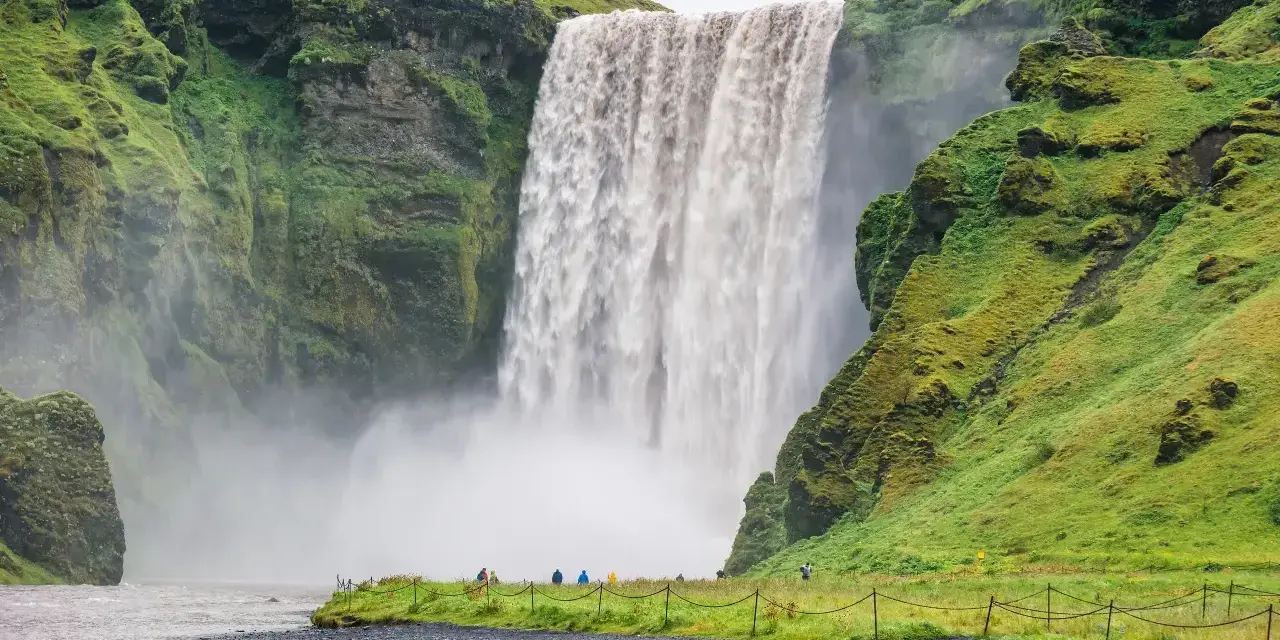
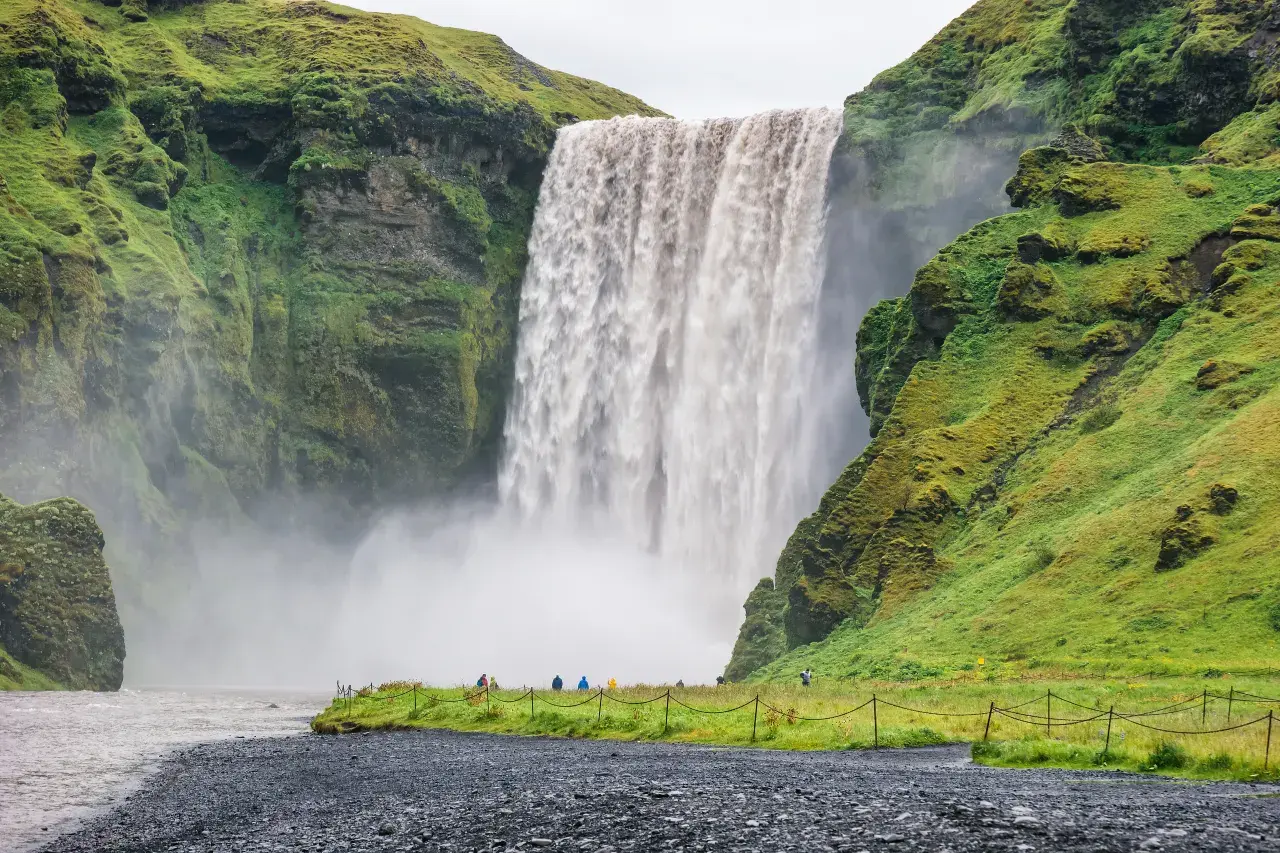
This is spot 7 of 20 in our Iceland Photography Guide — the mightiest curtain on the south coast. Skógafoss throws a 60-metre, 25-metre-wide wall of water off the old sea cliff, and it is the rare waterfall that photographs three ways in one visit: the frontal classic from the river bed, the rainbow midday game the master list calls out (“midday sun for rainbows”), and the aerial-and-canyon work from the staircase and the Fimmvörðuháls trail above. Our team has shot Skógafoss more often than any other fall on the list, and it remains the one we send every visiting photographer to first.
The fall is also the most logistics-friendly stop on the master list: ten minutes from Seljalandsfoss, parking beside the river, flat paths, a staircase to the top platform, and a trail system that turns a one-hour stop into a half-day canyon session. This guide covers the frontal compositions, the rainbow timing, the drone rules that apply here in full, the top-of-fall frames, and how the stop fits the south-coast chain.
Key takeaways
- Midday is legitimate here: direct sun enters the canyon and builds rainbows in the spray — the only master-list spot where the noon hour is a recommendation.
- Gray light for the classic: the frontal curtain reads cleanest under even sky — overcast is the portfolio condition, sun is the rainbow condition.
- Climb the staircase: the 527-step platform gives the fall-over-the-edge frames and starts the Fimmvörðuháls canyon trail for the aerial-style shots.
- Drone rules in full: the master guide’s baseline (120 m altitude, line of sight, 150 m from buildings) applies here; check signage — the busiest falls have real restrictions.
- Weather the spray: the closest positions eat spray — rain cover, hood, cloth cycle like Seljalandsfoss, only heavier.
Quick answer: shoot the frontal classic from the river bed at gray light (tripod, 0.5–2 s, f/8–f/11, polarizer), wait for a sun break and shoot the rainbow frames at 1/500 s+, then climb the staircase for the top-platform and canyon angles. Give the fall ninety minutes; add two hours if you start up the Fimmvörðuháls trail for the canyon-and-river frames.
Access and the lot
Skógafoss sits directly off the Ring Road with a large free(ish) parking area, café, and facilities — the most logistically simple major waterfall in Iceland. From the lot, two paths: the flat river-bed path to the frontal classic (two minutes, spray-soaked on windy days), and the staircase on the east side climbing 527 steps to the top platform. Both are open year-round; the top platform and the first kilometres of the canyon trail can ice over in winter — traction and the site status matter then.
The river bed is broad and gravelly, which makes Skógafoss the easiest big fall to compose freely: unlike Seljalandsfoss’s narrow ledge, you can walk the bank line and pick your foreground. Coaches cycle through from late morning; dawn and late evening give the bed back to photographers. In winter the frontal approach is sometimes closed for ice at the fall’s base — the signage system is honest, and the staircase usually remains the access.
The Fimmvörðuháls trail (the 22-km pass to Þórsmörk) starts at the top platform; the first two kilometres along the Skógá river deliver a chain of two dozen smaller falls — a legitimate half-day of photography without committing to the full hike, and covered in our Þórsmörk guide.
Light: gray for the curtain, sun for the rainbow
Skógafoss is the master list’s midday exception, and the physics are worth understanding so you can play both games. The fall faces south down a shallow canyon; when direct sun enters, the constant spray cloud builds rainbows that arc across the curtain — the classic double-rainbow shot happens under high sun, most reliably from late morning through mid-afternoon on clear days. The rainbow game wants the fast shutter and the telephoto: 1/500 s+ freezes crest and spray; the rainbow lives for minutes at a time.
The frontal portfolio frame, though, wants gray: even sky flattens the canyon’s contrast, the mossy flanks saturate, and the curtain reads as one clean graphic mass instead of a blown white blob over black rock. Overcast is when we schedule the long-exposure work; bright hours are when we schedule the staircase, the trail and the rainbows. The same visit plays both — watch the sky and switch genres when it does.
Storm days are Skógafoss’s secret season: after heavy rain the curtain widens beyond its edges, spray fills the canyon, and the river bed at 1/4–1 s in gray light looks biblical. The en.vedur.is precipitation clock tells you when to go; the fall answers to rain, not to season.
Compositions that work
Three zones, three genres — a full Skógafoss session touches all:
- The frontal classic: from the river bed, 24–35 mm, the full curtain over the cliff with the mossy flanks framing it. Tripod, long exposure, polarizer. Move along the bank: closer = more spray and more intimacy; farther = the flanks and the context. The single human figure on the gravel bar remains the best scale element on the list.
- The top-of-fall edge: from the platform, the river pours past your boots and off the edge — 16–35 mm, low, the lip as the horizon line. At sunset in summer this is a legitimate aerial-style composition without a drone.
- The canyon chain: the first kilometres of Fimmvörðuháls above the platform stack fall after fall down the Skógá river — 50–100 mm isolations, side-light in the canyon, the upstream chain receding. This is the frame most visitors never take and the one that fills our southeast portfolio pages.
- The rainbow frames: midday sun, 70–200 mm, fast shutter, the arc crossing the curtain. The rainbow’s position shifts with the sun; re-shoot every ten minutes rather than chasing it once.
Settings and technique
Frontal work: tripod, 0.5–2 seconds (the curtain keeps structure at this range; longer silks it into fog), f/8–f/11, ISO 64–100, polarizer on. Expose for the spray highlights — the meter will drag the moss up; RAW and a -0.3 EV habit hold the flank texture. Spray on the front element is constant at close range: hood on, cloth between bursts, cover between frames — the Seljalandsfoss wet-gear cycle, heavier.
Rainbow work: 1/500–1/1000 s, f/5.6–f/8, telephoto, polarizer OFF (it suppresses exactly the polarization you are shooting), exposure on the arc’s brightest band. Wind is the technical variable at Skógafoss — the master guide’s gear note (“anchor the tripod, hang your bag”) is not decorative here: gusts off the cliff top rock every tripod on the river bed, and the windbreak of a standing figure in front of the rig is a real technique, not superstition.
Top-platform and canyon work run daylight discipline — 1/125 s+ handheld or the tripod braced against the rail — with the rail shadow and the midday glare as the only real exposure challenges.
Drones, platforms and rules
The master list flags it and it is worth repeating in full: drone flights here follow the national rules — 120 m maximum altitude, line of sight required, 150 m from public buildings — and site-level restrictions at the busiest waterfalls are real. Skógafoss’s canyon is narrow and crowded; fly it only when the signage and the site rules clearly permit, never over people or the curtain itself, and pack it down the moment a coach crowd arrives. The staircase-and-trail angles deliver most of the aerial look legally and free.
Seasons and pairing the day
Summer owns the rainbow game (high sun) and the endless golden hours; winter owns the ice-fringed curtain, the quiet bed and the aurora bonus above the fall on clear nights; autumn and spring own the storm-swell sessions after rain. The flow never stops — Skógafoss is a four-season subject with three genres per season, which is why it anchors every south-coast itinerary.
Pair it with Seljalandsfoss twenty minutes west (the natural single-afternoon chain), the plane wreck between them for the full portfolio day, and Reynisfjara forty minutes east for the dusk finish. The complete Skógafoss guide covers the fall’s own legend (Þrasi’s chest), the staircase detail and the canyon trail in depth.
Frequently asked questions
When do the rainbows actually appear?
On clear days under high sun — late morning through mid-afternoon is the reliable window — when the spray cloud catches direct light. The arc shifts with the sun’s position; shoot it every ten minutes. Gray days kill the rainbow but make the frontal classic better, so the same visit trades genres rather than failing.
Is the staircase worth climbing with camera gear?
Yes — 527 steps give the fall-over-the-edge frame and open the first kilometres of the Fimmvörðuháls canyon chain, which is a genuine half-day of photography. Go light: one body, one wide zoom, cloth. The platform rail is a legitimate brace if you skip the tripod.
What exposure freezes the curtain with structure?
0.5–2 seconds at f/8–f/11 keeps the curtain’s vertical structure while smoothing the spray — the sweet spot for the frontal classic. Under 1/100 s freezes everything (energy mode); over 10 seconds turns the curtain to fog (and usually needs the ND plus real wind discipline). RAW, -0.3 EV, histogram check.
Can I fly my drone at Skógafoss?
Only within the national baseline (120 m altitude, line of sight, 150 m from buildings) and whatever the site signage says on the day — busy waterfalls carry real local restrictions. The staircase and trail angles give you the aerial-style frames without the risk, and the master guide’s gear section covers the full ruleset.
The full field list lives in one place
Spot 7 of 20 — the master guide ranks all twenty locations by region, best light and a field tip for each.
Go deeper: the complete Skógafoss guide for the legend and the canyon trail, the Þórsmörk hiking guide for the Fimmvörðuháls end of the chain, and the Ring Road guide for the south-coast sequencing.
Sources & official references
- Fall dimensions per published survey figures (60 m drop, ~25 m width).
- Drone rules: national baseline of 120 m maximum altitude, line-of-sight requirement, 150 m from public buildings — per the Icelandic aviation authority and site signage (checked 2026).
- Trail and platform status (ice closures): Fimmvörðuháls/Skógá trail information and road.is/safetravel.is advisories.
- Rainbow timing and spray technique: editorial photography trips across seasons 2022–2026 by the Iceland Travel Guides team.
- Master list context: Iceland Photography Guide — 20 Best Photo Spots (this site).
