









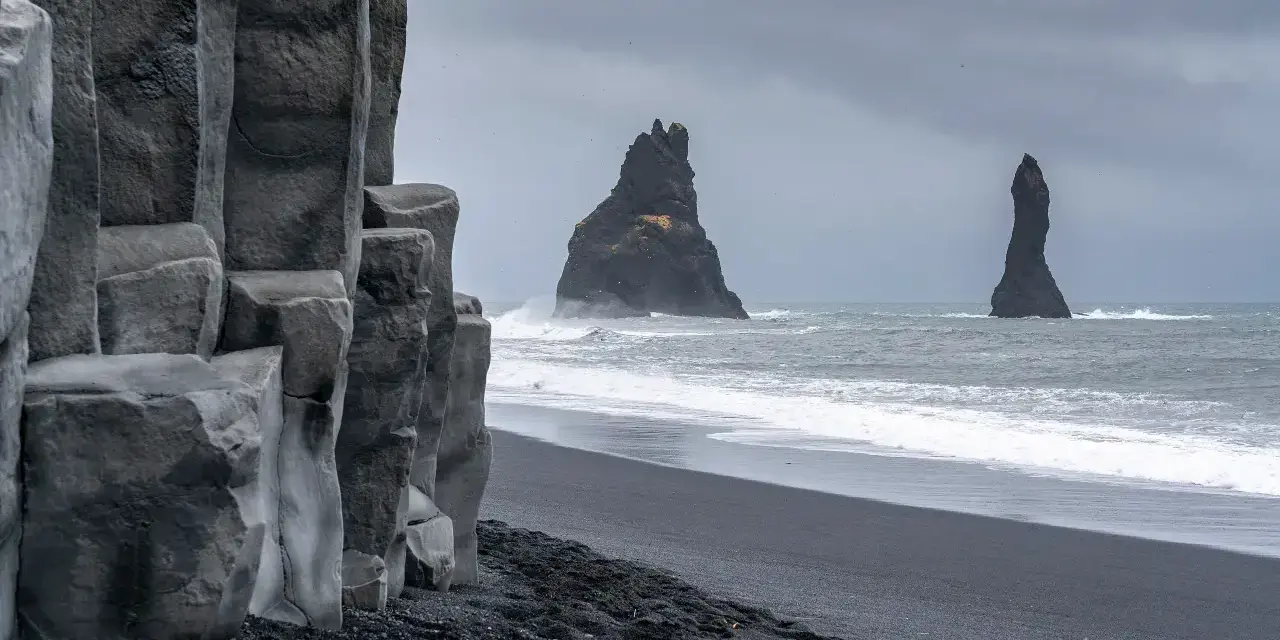
This is spot 5 of 20 in our Iceland Photography Guide — the black-sand coast that made Vík famous. Reynisfjara stacks four subjects into one beach: geometric basalt columns (Reynisfjall’s kitchen-wall cliffs), the Reynisdrangar sea stacks standing offshore, the Hálsanefshellir cave mouth, and two kilometres of black sand that surf carves into graphic curves. The master guide’s field tip is the bluntest on the list — “sneaker waves: never turn your back on the sea” — because Reynisfjara is the beach where the Atlantic has killed photographers. Everything else in this guide is subordinate to that rule.
Shot well, Reynisfjara is one of the most graphic locations in the country: dusk light, per the master list, turns the columns amber and the stacks into silhouettes; fog days turn the whole beach into a monochrome study. This guide covers access, the column compositions, the sea-stack frames from Dyrhólaey’s opposite angle, the dusk window, and the wave discipline that every session here must run.
Key takeaways
- Dusk is the window: low warm side-light or blue-hour silhouette is what makes the columns and stacks earn the frame; midday reads harsh and empty.
- Never turn your back on the sea: sneaker waves on this beach are documented killers — the berm line and the column wall are the only safe zones.
- Shoot the columns close: the basalt geometry at 24–50 mm is a texture study in itself; the wide beach shot is the cliché, the abstract is the portfolio.
- Dyrhólaey is the other half: the headland west of Vík photographs the same stacks from above — different stop, same subject, best at the same hour.
- Fog is a gift: the headland fogs roll in fast; monochrome Reynisfjara in mist is one of Iceland’s best bad-weather portfolio sessions.
Quick answer: park at the Reynisfjara lot west of Vík, read the posted wave warnings before walking, and stay above the berm for the entire session. Work the basalt columns and the cave mouth at 24–50 mm, the Reynisdrangar stacks long-lens from the dry sand, and return at dusk when the side-light gives the wall its amber. If the ocean starts throwing surprise sets, move to the column wall and finish the session there — the beach will still be there tomorrow; you only get one warning you might not recognize.
Access and the layout
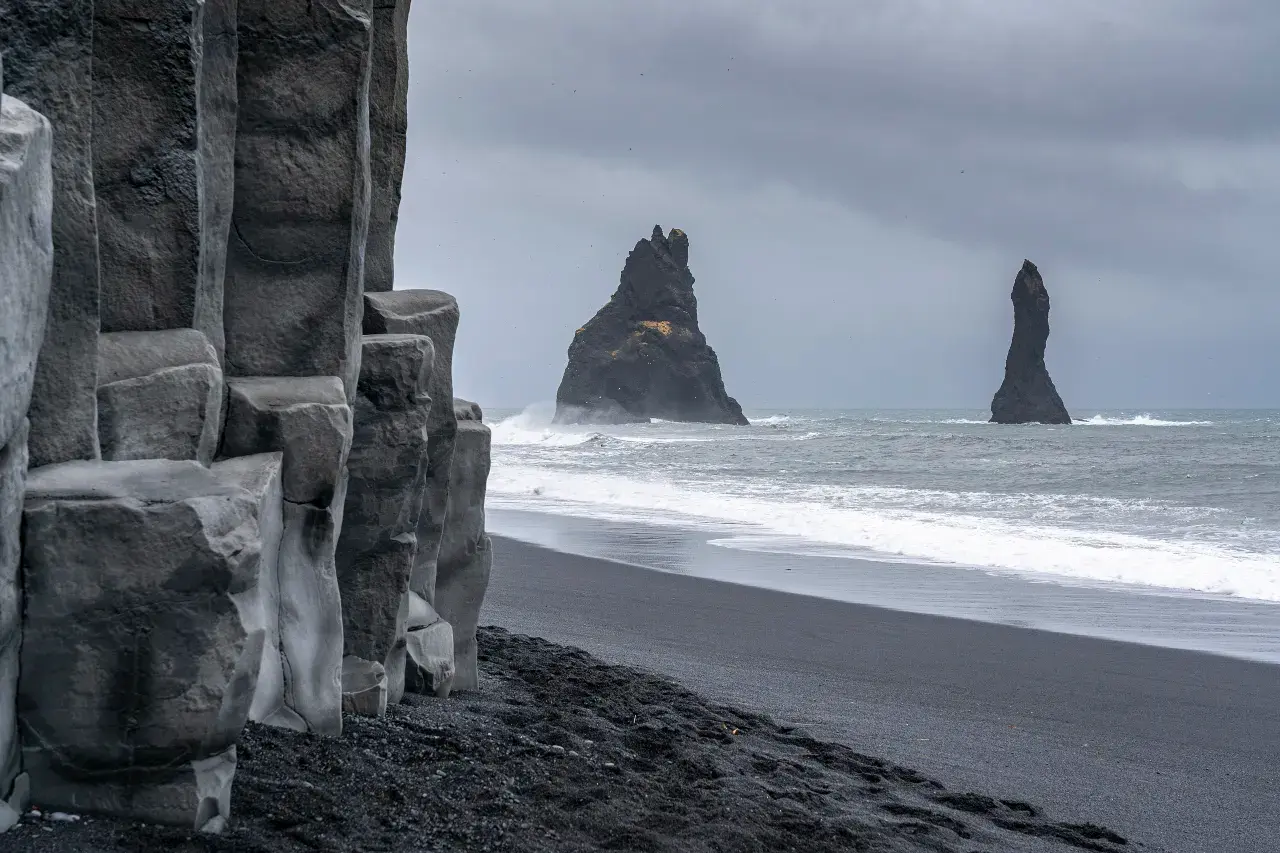
Reynisfjara is twenty minutes west of Vík on the Ring Road, signed clearly, with a large car park, café and — uniquely — permanent wave-danger signage and a traffic-light-style warning system. The beach is free to access and open year-round; the walk from the lot to the columns is five minutes over soft black sand. The layout matters for both composition and safety: the basalt wall (Reynisfjall) forms the northern edge with Hálsanefshellir cave at its base; the columns run up the wall like a giant pipe organ; the Reynisdrangar stacks stand offshore to the west; and the beach opens southwest toward the open Atlantic.
The cave and the column base are walkable at normal tide and calm surf — but both are exactly the zones the waves reach when a sneaker set comes in. The rule set from our safety guide applies here with maximum force: read the signage, note the traffic light (it reflects measured surf state, not a guarantee), and never assume yesterday’s calm is today’s.
Parking fills with tour coaches from late morning to mid-afternoon in season; dawn and dusk sessions are comparatively quiet, which is convenient because those are precisely the master list’s recommended hours.
The dusk window (and the fog plan)
The master list says dusk, and the geometry delivers: the beach faces southwest, so the setting sun rakes straight down the coastline, lighting the column wall amber and putting the Reynisdrangar stacks into silhouette. In summer the midnight sun holds that rake for hours; in winter the window compresses to a forty-minute golden hour in mid-afternoon. Either way, the columns photograph best with side-light — frontal sun flattens the geometry that makes them special.
Fog is the beach’s second great light. The headland pulls marine fog in on damp southerlies, and the wall, stacks and sand simplify into a monochrome study — one of the few Icelandic scenes where featureless gray is the goal, not the failure. Watch the en.vedur.is hourly fog/visibility fields; when Vík shows mist, Reynisfjara is the first place we point the car.
Storm days have a genre too: heavy surf, spray off the stacks, the cave booming. Photograph them from the column wall side, never the open beach — big-surf days are exactly the days the sneaker rule stops being theoretical.
Compositions that work
Reynisfjara is a multi-subject beach, and the strongest images pick one subject and go deep rather than trying to fit everything in one frame:
- The column abstract: 24–50 mm tight on the basalt geometry from inside the cave mouth or along the wall base — hexagon stacks, side-light, shadows doing the drawing. This is the portfolio frame most visitors walk past.
- The stacks long-lens: 100–200 mm from the dry sand at dusk, stacks in silhouette against surf or sky, a single wave mid-crest if the surf cooperates. Long exposure (1–4 s) renders the stacks against silk; fast shutter keeps spray crisp.
- The cave frame-out: from inside Hálsanefshellir, the columns frame the beach and stacks beyond — shot at f/11, tripod, the cave’s darkness against the wet sand’s sheen.
- The surf curves: from the dune edge above the beach, the receding tide draws sweeping black curves; 1–8 seconds with the ND keeps them smooth and graphic.
- The opposite angle: drive ten minutes west to Dyrhólaey headland — the same stacks from above, plus the arch itself. Sunset there is its own master-class composition; our Reynisfjara guide treats the pair as one session.
Scale and safety conspire here: the best frames want the wet zone the master guide forbids. Resist it — the dry-sand vantage with a long lens delivers the same stacks without the waterline risk, and the column abstracts give the portfolio its depth without a single wet footprint.
Settings and technique
Black sand is a metering trap: it dominates the frame and pulls exposures up, blowing the surf and sky. Meter for the highlights (the foam, the sky, the wet sheen), expose RAW, and let the sand go near-black — the beach’s graphic power comes from that reduction. -0.7 EV habit, check the histogram, no bracketing excuses: the histogram is the truth here.
The surf game runs two modes. Silk mode: tripod, 6-stop ND, f/11, 1–8 seconds — water becomes streaks and curves, stacks stay sharp. Energy mode: 1/500–1/1000 s handheld (or tripod-ready), f/8, freezing the crest and spray against the stacks; wind over 10 m/s makes the second mode tripod-only work. The column abstracts want f/8 and the tripod off — they are texture studies, not depth studies.
Polarizer: on for the wet-sand sheen and sky contrast, off when shooting into dusk light through the stacks (the CPL eats 1–2 stops exactly when the light is already low). Winter blue-hour sessions add the aurora option — the stacks under green light are a legitimate, if rarely calm, bonus genre.
Sneaker waves — read this twice
The south coast’s black-sand beaches drop steeply underwater, which is why waves arrive as sudden surges — a “sneaker” that sweeps the dry sand where people stood a minute earlier. Reynisfjara’s incidents are documented and fatal. The discipline, identical at Diamond Beach: identify the berm line before unpacking; stay above it; face the ocean at all times; never shoot from the wet sand; keep children on the dry zone; and treat the posted traffic-light system as a floor, not a ceiling. The master guide’s rule is three words because three words are what survives adrenaline: never turn your back.
Seasons and pairing the day
Reynisfjara photographs in every season but the accents rotate: summer owns the midnight-sun dusk rake and the crowds; autumn and spring own the storm surf and the fog; winter owns snow dusting the stacks (a rare, brief, spectacular occurrence), blue-hour silhouettes and aurora sessions. The beach is the closest master-list spot to Reykjavík in its region — a 2.5-hour drive each way — so it anchors every south-coast day.
Pair it westward or eastward: west, Seljalandsfoss and Skógafoss complete the classic south-coast chain; east, the Kerið crater closes a Golden-Circle-plus-day. Vík itself supplies food, fuel and shelter between sessions — the church on the hill photographs the same stacks from the village side.
Frequently asked questions
Is Reynisfjara safe for photography?
With discipline, yes — and the discipline is specific: stay above the berm, face the sea, respect the signage system, and relocate when the surf grows. Every documented incident here involved people below the safe line. The columns, cave and dry-sand vantages deliver every essential frame without touching the wet zone.
Can I photograph inside the cave?
Yes, at calm surf and normal tide — the cave mouth frames the beach beautifully. Watch the ceiling-logic: waves reach the cave base on bigger sets, so keep camera bags off the floor and be ready to step back in seconds. Do not enter when the traffic light is red or the surf is booming.
Reynisfjara or Dyrhólaey?
Both — they are the same subject from complementary angles and sit ten minutes apart. Beach first for the columns and close work, headland second for the elevated stack-and-arch frames. Sunset light works for both on the same evening in most months.
What settings handle the black sand exposure trap?
Meter for highlights and shoot RAW: roughly -0.7 EV in mixed light, histogram-checked. The sand should sit near-black in the file; lifting it in post costs noise, and letting the meter lift it costs the surf and sky. Our weather guide covers the light-reading habits that pair with it.
The full field list lives in one place
Spot 5 of 20 — the master guide ranks all twenty locations by region, best light and a field tip for each.
Go deeper: the Reynisfjara complete guide for the beach’s own detail, the safety and 112 guide every beach shooter should read, and the south-coast sequencing in the Ring Road guide.
Sources & official references
- Sneaker-wave warnings, incident history and the beach warning-light system: safetravel.is and on-site signage (checked 2026).
- Access and parking: Reynisfjara visitor area information; verify café and lot hours seasonally.
- Weather, fog and wind: en.vedur.is hourly forecasts for the south coast.
- Field discipline: editorial photography trips across seasons 2022–2026 by the Iceland Travel Guides team.
- Master list context: Iceland Photography Guide — 20 Best Photo Spots (this site).
